
Yale Used an AI Detector to Suspend a Student for a Year. Its Own Dean’s Writing Flagged Too. That’s Not Even the Point.
Here is what happened at Yale’s School of Management.
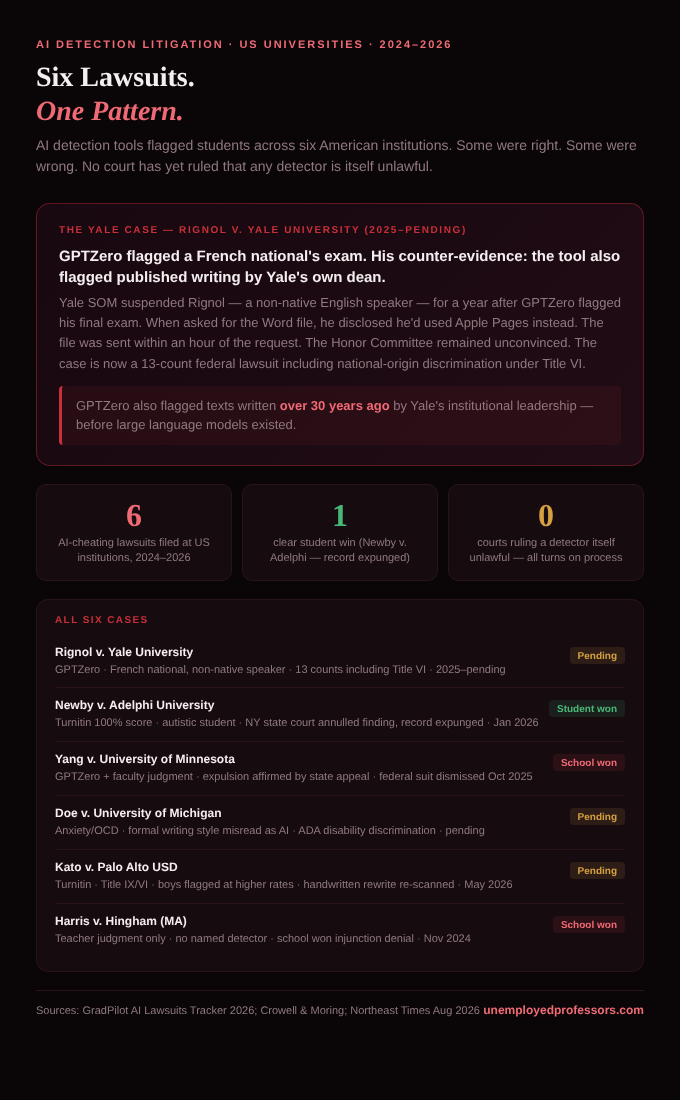
Rignol denied cheating. When the committee asked him to produce the Microsoft Word file used to write his exam, he didn’t provide it for weeks. When pressed, he said, for the first time, that he had never used Word. He wrote the exam in Apple Pages. He sent the Pages file within about an hour of being asked for it.
The committee remained unconvinced. Rignol filed a 13-count federal lawsuit against Yale, its Board of Trustees, and individual administrators. The claims include breach of contract, national-origin discrimination under Title VI of the Civil Rights Act, and intentional infliction of emotional distress.
He also submitted, as evidence, GPTZero scans of published writing by a Yale dean and a former Yale University president. The tool flagged those texts too — including some written more than thirty years ago.
Rignol is right that the detector flagged work that was not AI-generated. Yale is right that the committee needed some mechanism to investigate the exam. Both are arguing about the right question for the wrong reason.
Neither outcome — Rignol winning, Yale winning — resolves what his MBA now certifies to anyone reading his CV.
The Tool That Flagged Its Own Dean
GPTZero classifies text as probably human-written, probably AI-written, or somewhere in between. It does this by analyzing patterns that correlate with AI output: the kind of regularity, the absence of certain kinds of stylistic variation, the statistical predictability of word choices across a passage.
The problem with these correlations is that they also describe a certain kind of careful, formal, non-native English writing. Someone who learned English academically, writes deliberately, and structures arguments with the precision a second language sometimes enforces will produce text that shares some statistical properties with AI output.
Rignol’s litigation documents allege that he presented GPTZero results on writing by Yale’s own institutional leadership. Some of those texts were written decades before large language models existed. The tool flagged them anyway.
This is not an isolated problem. A 2026 study found that GPTZero produced significantly higher false-positive rates for non-native English speakers than for native speakers writing in a similar register. The detector’s designers have acknowledged that the tool is not a standalone evidentiary standard. Its website says it should be used in conjunction with other evidence.
Yale used it as the initial trigger for a year-long suspension and a federal lawsuit.
Six Lawsuits and Counting
The Rignol case is not the only one. AI-cheating lawsuits tracker data as of November 2026 shows six active or recently resolved cases across American educational institutions:
Rignol v. Yale — GPTZero flagged a French national’s exam; 13-count federal lawsuit pending.
Doe v. University of Michigan — a student with documented anxiety and OCD says her formal writing style was misread as AI output; case turns on disability discrimination under the ADA.
Newby v. Adelphi University — an autistic student received a 100 percent AI score from Turnitin; a New York state court annulled the misconduct finding and ordered her record expunged.
Yang v. University of Minnesota — the student lost; expulsion affirmed by state appeal and the federal suit dismissed. This is the clearest example of a court upholding AI-related discipline when the school followed its own process.
Kato v. Palo Alto Unified — a K-12 case alleging that boys are flagged by Turnitin at higher rates than girls; also alleges administrators ran a handwritten rewrite through the detector without family consent.
Harris v. Hingham — teacher judgment only; no named detector; the school won.
One student has clearly won. Two institutions have clearly won. Three cases are still pending. No court has ruled that an AI detector is itself unlawful. The cases that have resolved did so on process — whether the accused received a fair hearing, whether contrary evidence was considered, whether the institution followed its own procedures.
That is a significant legal finding. It is not the same as knowing whether the detector was right.
What the Employer Sees
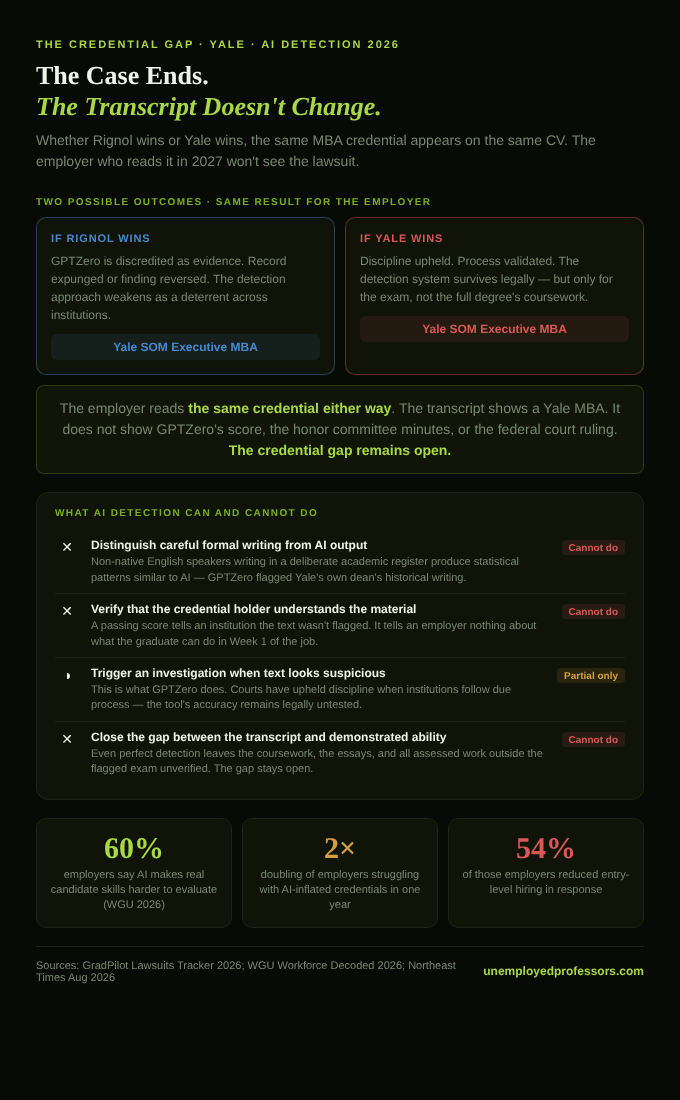
Here is what appears on Rignol’s CV when this litigation concludes, however it concludes: Yale School of Management, Executive MBA.
The employer who reads that credential in 2027 or 2028 will not see GPTZero’s score. They will not see the Pages file. They will not see the thirteen counts, the honor committee minutes, the judge’s ruling on the preliminary injunction, or Rignol’s counter-evidence about the dean. They will see Yale SOM. They will read it as a signal about what Rignol can do.
If the detection approach works — if Yale wins, the system holds, and the deterrent effect is real — the credential still doesn’t tell the employer who actually did the thinking in which assignments, across a three-year degree, through the full range of coursework that the final grade represents. The exam gets litigated. The coursework doesn’t.
If the detection approach fails — if Rignol wins, the tool is discredited, and institutions retreat from AI detection — the credential becomes even less meaningful, because the structural disincentive to substitute AI for genuine work has weakened.
Both outcomes make the credential less informative. The legal system is working exactly as it should. That doesn’t fix the transcript.
The Detection Approach Is Wrong Either Way
The Harvard situation, the Oxford situation, and now the Yale situation share the same underlying structure: an institution applies an imperfect technical method to an unsolved structural problem, produces a contested outcome, and the degree ends up less legible to the people who eventually have to use it.
Harvard’s Dean called detection a losing race and suggested institutions accept it. Oxford expelled students at a 46 percent higher rate than the year before while one of its own students published an op-ed arguing the whole framework is philosophically wrong. Yale is now defending a 13-count federal lawsuit in which its own detection tool flagged the writing of its own institutional leaders.
The institutions are not incompetent. They are applying the available methods to a problem those methods were not designed to solve. AI detection can tell you something about the statistical properties of a text. It cannot tell you whether the student who submitted it understands the material. It cannot tell you whether the credential will predict performance.
The credential gap — the distance between what the transcript says and what the holder can demonstrate — is not a detection problem. No detector solves it. No lawsuit resolves it. No honor committee closes it.
What Getting Help Actually Means
The legal cases all share a structural asymmetry: the institution has access to a statistical tool, the student has access to their own claim of innocence, and neither side can produce the one piece of evidence that would resolve the question definitively — a record of what actually happened when the student was thinking through the problem.
That record exists in exactly one context: when a scholar with verified expertise engages with a student’s argument as it develops, watches the reasoning form, challenges it in real time, and can attest to the process not because they trust the student but because they witnessed it. That is a qualitatively different kind of credential than a GPTZero score and qualitatively different from the absence of one.
This is not a new idea. It is what the tutorial system at Oxford is supposed to produce. It is what the viva voce is supposed to verify. It is what face-to-face academic engagement certifies that a submitted document cannot. These mechanisms exist because institutions have always understood, at some level, that submitted text is an imperfect proxy for understanding.
The AI crisis has made that imperfection load-bearing. The statistical detector was an attempt to shore up a proxy that was already under strain. That attempt is now in federal court six times and counting.
The Bottom Line
Rignol may win. Yale may win. The court may eventually rule on the reliability of GPTZero as evidence. None of that changes what appears on the transcript when the case ends.
Six federal and state lawsuits in a little over a year. A detection tool that flags its own institutional leadership’s historical writing. A student who might have used AI and might not have — and whose year-long suspension is an equal outcome whether he cheated or was falsely accused.
What employers in 2026 are confronting is not the question of which students cheated. It is the question of whether the credential predicts what it has always been supposed to predict. When 60 percent of employers in a 2026 WGU survey of three thousand hiring professionals said AI-assisted credentials are making real skills harder to evaluate, they were not responding to any individual case. They were responding to a systemic erosion of a signal they had been relying on for decades.
The lawsuits are a symptom. The credential gap is the condition.
That condition has a treatment. It requires a human scholar who can produce work in your name that you can stand behind — because a human expert with disciplinary knowledge and a verifiable record can do what a statistical detector cannot: engage with the actual argument, produce something that reflects genuine understanding, and leave a credential you can answer for in an interview.