
A quiet but significant shift is underway in how universities are responding to AI. For the past three years, the dominant institutional response to generative AI has been defensive: detection software, integrity policies, AI-use disclosure requirements. That era is not over, but a new framing is emerging alongside it.
According to 2026 predictions for AI in higher education circulated through UPCEA, the professional and online education association, institutions are moving toward what’s being called “AI-First Curriculum Redesign” — described as moving beyond academic integrity enforcement toward “AI fluency” as a graduation standard, where AI agents help faculty redesign assessments to focus on process rather than product.
Boston Public Schools made this concrete on a K-12 scale: starting September 2026, AI fluency becomes a graduation requirement across all BPS high schools — the first major-city school district in the country to do so. Florida’s K-12 AI Education Task Force, coordinated through the University of Florida with 250 members across 39 districts, is developing what organizers describe as the nation’s first coordinated state guidance for teaching and learning with AI.
At the higher education level, the Inside Higher Ed US AI Summit convened at the University at Buffalo this month with university leaders explicitly grappling with what UB’s dean of Arts and Sciences called the absence of “a clear agenda for public AI — for what we as a society want AI to do for the public good.”
The shift from product-focused to process-focused assessment is, on its face, exactly the right instinct. It is also a shift that raises the stakes for students in ways that are not immediately obvious — and that make the choices students make about how they engage with their coursework more consequential, not less.
What “Process Over Product” Actually Means
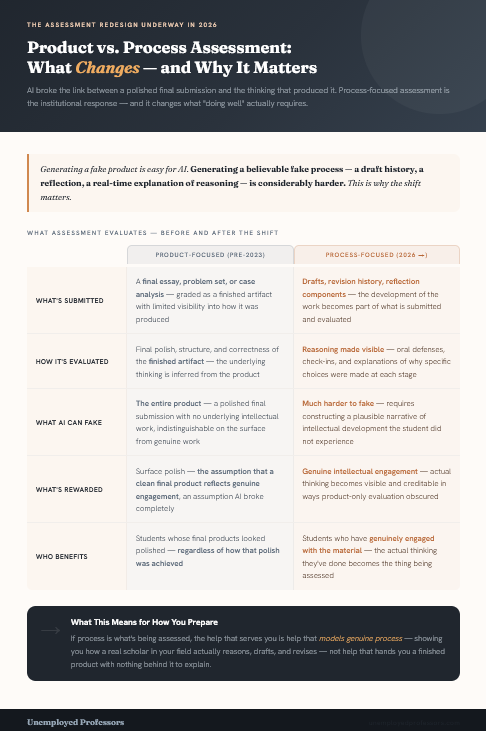
For most of the history of academic assessment, what mattered was the final submission. The essay, the problem set, the lab report, the case analysis — professors graded what arrived in the dropbox, with limited visibility into how it was produced.
This product-focused model was always somewhat artificial — it assumed that a polished final submission was a reliable proxy for the thinking that produced it. For most of academic history, that assumption was reasonable enough, because producing a polished final submission required doing the underlying intellectual work. There was no way to separate the product from the process that generated it.
Generative AI broke that assumption completely. A polished final submission can now be produced with minimal underlying intellectual work. The product no longer reliably indicates the process. This is the precise mechanism behind the grade inflation data from UC Berkeley’s half-million-enrollment study — A grades up 30 percent, concentrated in exactly the assessment formats (unsupervised take-home essays, take-home coding) where the product-process link has been most completely severed.
The institutional response described in the UPCEA predictions — using AI agents to help faculty redesign assessments around process rather than product — is the correct response to this breakdown. If the final product can no longer reliably indicate the process, assessment has to find ways to make the process itself visible and evaluable.
In practice, this looks like: requiring drafts and revision histories rather than just final submissions; incorporating reflection components where students explain their reasoning and decision-making; oral defenses or check-in conversations about written work; portfolio-based assessment that shows development over time; and assignments structured around documented engagement with sources and ideas rather than just final synthesis.
Why This Raises the Stakes, Not Lowers Them
Here is the part that is not immediately obvious: process-focused assessment is harder to fake than product-focused assessment, but it is not impossible to fake badly — and faking it badly is now more visible than ever.
A student who has been using AI to generate final products faces a new problem under process-focused assessment: they now also need to produce a draft history, a reflection on their reasoning, an oral explanation of decisions they did not actually make. Generating a fake process is a different and in some ways more demanding task than generating a fake product — it requires constructing a plausible narrative of intellectual development that the student did not actually experience.
This is where process-focused assessment becomes genuinely revealing. A student asked to explain why they made a particular argumentative choice, or to walk through how their thinking evolved from an early draft to a final version, either has a genuine answer — because they actually did the thinking — or they do not. AI can generate a final essay. It is considerably harder for AI to generate a believable account of the intellectual journey that produced that essay, delivered in real time, in conversation with a professor who knows the material.
For students who have been relying on AI to produce final products, the shift to process-focused assessment is not good news. It closes the gap that made AI-generated submissions viable — the gap between what the product showed and what the process actually was.
For students who have been doing genuine intellectual work, the shift to process-focused assessment is unambiguously good news. It means that the actual thinking they have done — which may have been somewhat obscured in a product-only evaluation focused narrowly on final polish — becomes visible and creditable. Process-focused assessment rewards genuine intellectual engagement more directly than product-focused assessment ever did.
What This Means for How You Get Help With Your Work
If assessment is moving toward process — toward drafts, reflections, oral explanations, documented development — then the kind of academic help that is actually useful is changing too.
Help that produces a finished product without any underlying process leaves a student with nothing to draw on when process-focused assessment asks them to explain their reasoning, walk through their draft history, or defend their choices in conversation. A finished essay generated by AI, submitted as-is, provides no foundation for the process-based components that AI-First Curriculum Redesign is bringing into assessment.
Help that models genuine intellectual process — that shows a student what authentic disciplinary reasoning actually looks like, how a real scholar in their field approaches a problem, develops an argument, weighs evidence, and arrives at conclusions — provides exactly the foundation that process-focused assessment is asking students to demonstrate. When a student studies genuine expert work, engages with how the argument was constructed, and develops their own understanding of the reasoning process, they have something to draw on when asked to explain their own thinking — because they have genuinely engaged with what good thinking in their discipline looks like.
This is the distinction Unemployed Professors has been built on since 2010, and it is increasingly the distinction that the assessment landscape itself is converging on. Our scholars do not just produce a final product. The work they produce reflects an authentic disciplinary process — genuine engagement with sources, genuine theoretical reasoning, genuine analytical development — that students can study, learn from, and draw on. When a student engages seriously with expert work as a model rather than as a submission to copy, they develop the kind of understanding that process-focused assessment is specifically designed to surface and reward.
The Convergence That Matters
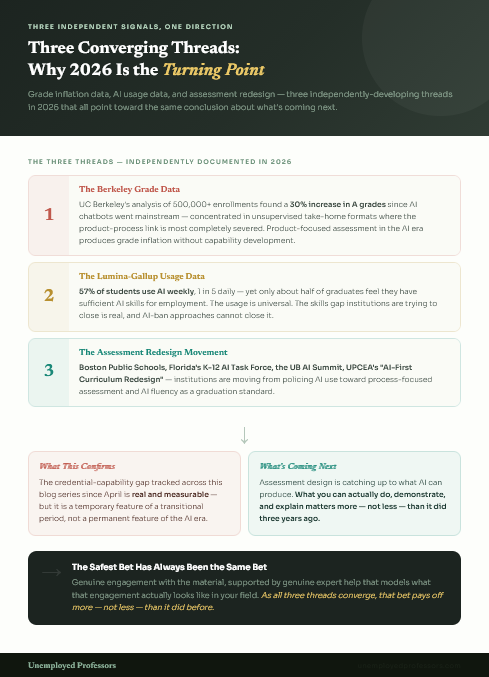
Three threads are converging in 2026. The Berkeley data shows that product-focused assessment in the AI era produces grade inflation without capability development. The Lumina-Gallup data shows that the majority of students are already using AI weekly, with only about half of graduates feeling they have sufficient AI skills for employment — a gap institutions are now trying to close through AI fluency requirements rather than AI bans. And the assessment design conversation, visible at venues from the UB AI Summit to UPCEA’s predictions to Boston’s graduation requirements, is moving toward process-focused models that make genuine intellectual engagement visible again.
All three threads point in the same direction: toward an academic environment where what you can actually do, demonstrate, and explain matters more — not less — than it did three years ago. The credential-capability gap that this blog series has tracked since April is not a permanent feature of the AI era. It is a temporary feature of a transitional period during which assessment design has not yet caught up to what AI can produce. That catch-up is now visibly underway.
For students currently navigating this transition — managing coursework, deadlines, and the genuine difficulty of academic work while institutions redesign how that work is assessed — the safest bet is the one that has always been the safest bet: genuine engagement with the material, supported by genuine expert help that models what that engagement looks like in your field.
The Bottom Line
Universities are redesigning assessment around process rather than product, with AI fluency becoming a graduation standard rather than something to be policed away. Boston Public Schools requires it starting this fall. Florida is building statewide K-12 guidance. University leaders are convening at AI summits to figure out what comes next.
This shift closes the gap that made AI-generated final products viable as academic submissions — and it rewards genuine intellectual engagement more directly than the product-focused model it is replacing.
For students, the implication is straightforward: the help that serves you well in this environment is help that models genuine process, not help that produces a product with no process behind it. Unemployed Professors has provided genuine human scholarly expertise — work that reflects authentic disciplinary process from real scholars — since 2010. As assessment design catches up to what that distinction has always meant, that is the kind of help that holds up.