
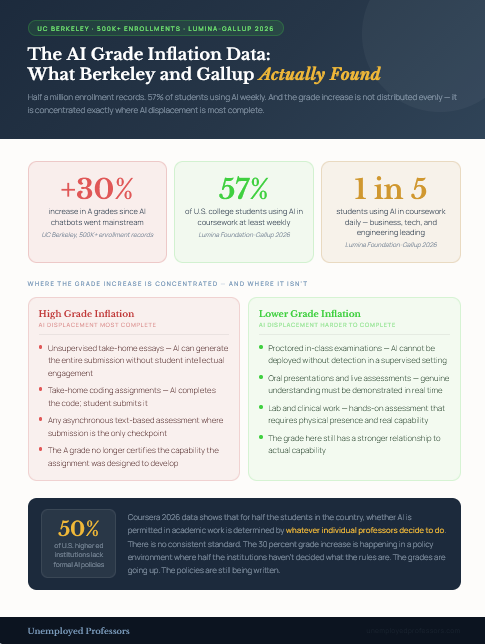
Researchers at the University of California, Berkeley analyzed more than half a million student enrollment records and found a 30 percent increase in A grades since modern AI chatbots entered the mainstream.
The spike is not distributed evenly across the curriculum. It is concentrated specifically in courses that rely heavily on unsupervised take-home essays and coding assignments — the exact assessment formats that AI tools are most capable of completing without the student doing any genuine intellectual work.
The Lumina Foundation and Gallup released their 2026 State of Higher Education study this spring, finding that 57 percent of U.S. college students are using artificial intelligence in their coursework at least weekly. About one in five students uses AI daily. Business, technology, and engineering students are the most frequent users.
The picture these two data sets paint together is precise: grades are going up because AI is completing the assignments that grades are supposed to measure. The grades look like an improvement in student performance. The actual student performance has not improved — and in the assessment categories where AI displacement is most complete, faculty are observing that it has gotten worse.
Stanford is not trying to ban this. Their current guidelines emphasize departmental rule-setting and AI literacy workshops. Oxford restricts AI in summative assessments but permits it for formative feedback. Fifty percent of U.S. higher education institutions still lack formal AI policies, according to Coursera 2026 data, meaning that for half the students in the country, what AI is permitted in academic work is determined by whatever individual professors decide to do.
This is the landscape. The 30 percent grade increase is not a fraud. It is a measurement problem. And the measurement problem has real consequences for every student currently enrolled.
What the Berkeley Numbers Actually Mean
A 30 percent increase in A grades sounds like good news. The question is what an A grade is measuring.
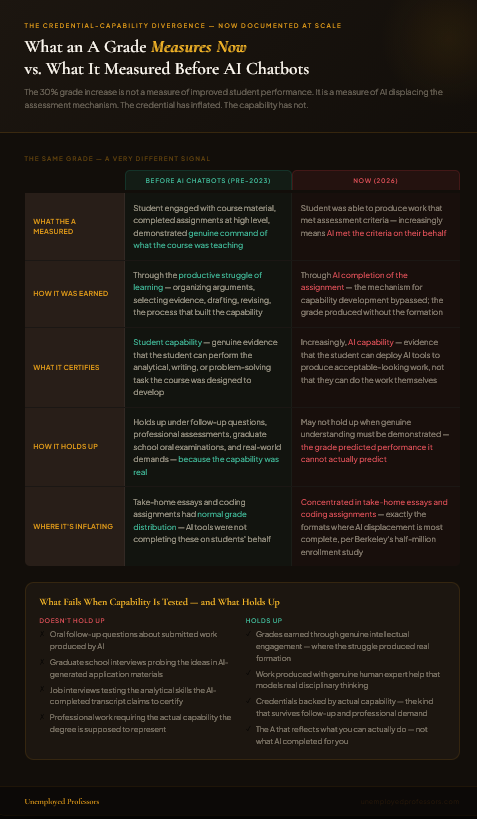
Before AI chatbots became widely available, an A in a course with substantial take-home essay and coding assignments meant that the student had engaged with the course material, completed the assignments at a high level, and demonstrated — through the quality of their written and analytical work — genuine command of what the course was trying to teach. The grade certified something about what the student could do.
The Berkeley data identifies what has changed: A grades in courses dependent on unsupervised take-home work now measure something different. They measure whether the student was able to produce work that met the assessment criteria — which increasingly means whether they were able to use AI tools that met the assessment criteria on their behalf. The grade is still an A. What it certifies is no longer the same thing it certified three years ago.
This is not a new observation. Faculty across disciplines have been making this point since 2023. What the Berkeley data adds is scale — half a million enrollment records, a measurable 30 percent shift, a specific correlation with the assessment formats most susceptible to AI displacement. This is not anecdote. It is documented grade signal degradation at a major research university.
The Gallup numbers add a second dimension. When 57 percent of students are using AI weekly and 20 percent daily, the question shifts from whether AI displacement is happening to how thoroughly it is happening, in which courses, and with what consequences for the capabilities the courses were supposed to develop.
The Student Who Gets an A and Learns Nothing
The sharpest way to understand what the Berkeley data reveals is to think about what it looks like from the inside.
A student enrolled in a business writing course completes six take-home essays over the semester using ChatGPT to generate drafts. She reviews the drafts, makes minor adjustments, and submits them. She receives A’s on all six. At the end of the semester, she has an A in the course and has not meaningfully developed her ability to write analytical business prose. The course was designed to build that capability. The grade says she has it. The capability does not exist in the way the grade certifies.
This is not a story about academic dishonesty — many universities have policies that permit some AI assistance, and the definition of what constitutes impermissible AI use varies enormously across institutions, departments, and individual faculty members. It is a story about assessment design that was built for a world where completing the assignment required the capability the assignment was designed to develop.
The faculty who designed take-home essay assignments assumed that writing the essay was the capability development mechanism — that the struggle of organizing an argument, selecting evidence, drafting, revising, and producing a coherent analytical piece was how students built the analytical and writing capabilities the assignment was supposed to assess. When AI completes that process, the mechanism is bypassed. The assignment is done. The capability development is not.
The 30 percent grade increase is the aggregate signal of this dynamic playing out across half a million enrollments. The grades have gone up because AI is completing the assignments. The capabilities the grades are supposed to certify have not gone up at the same rate.
The Credential-Capability Gap Is Now Empirically Documented
This blog series has tracked the credential-capability gap since April. The gainful employment rule revealed that salary data cannot detect whether a degree built genuine capability or just certified attendance. The MBA rankings revealed that graduate salary figures tell you more about who got in than about what the program produced. The Einstein AI story revealed that the courses an AI agent could complete were courses where genuine human understanding was never really being tested. The Turnitin false positive crisis revealed that the detection debate is a distraction from the capability debate.
The Berkeley grade inflation data is the most direct empirical evidence yet that the gap is real, measurable, and concentrated in precisely the assessment formats where AI displacement is most complete.
A 30 percent increase in A grades in courses dependent on unsupervised take-home work is not a measure of a 30 percent improvement in student capability. It is a measure of a 30 percent increase in AI completing the assignments that grades are supposed to measure. The credential has inflated. The capability has not followed.
This matters for the students currently receiving those inflated A’s because the credential they are accumulating will eventually be evaluated against the capabilities it is supposed to certify. Graduate school admissions, professional licensing examinations, job interviews with substantive analytical components, and the actual demands of professional work all operate as capability tests that the inflated credential is supposed to predict performance on.
When the credential no longer accurately predicts that performance — when the A in business writing does not predict the ability to write analytical business prose — the credential loses value. Not immediately. Grade inflation is a slow erosion, not a sudden collapse. But it is an erosion that the Berkeley data now documents at scale.
The Students Who Will Be Fine
The students who will be fine in this environment are not the ones who avoid AI. The students who will be fine are the ones whose A’s reflect genuine capability — who have actually developed the analytical, writing, and disciplinary skills their transcripts claim they have.
The Gallup data shows that 60 percent of students report AI helps them understand complex topics and 55 percent use it to check their work. These are legitimate uses of AI assistance — using AI to clarify confusing material, to check reasoning, to identify gaps in understanding. These uses enhance the learning process rather than bypassing it. Students who use AI this way are likely to emerge from their programs with genuine capabilities that their grades accurately reflect.
The students whose grades reflect AI completion of assignments rather than genuine capability development are accumulating a credential whose relationship to actual capability is increasingly tenuous. And the professional world is developing more ways to detect this gap — oral interviews, live assessments, portfolio reviews, skill demonstrations, and the simple reality of being asked to do in professional contexts what the degree is supposed to have taught you to do.
For students who want their A’s to mean something — who want their degree to certify genuine capability rather than algorithmic completion — the kind of academic help they choose matters.
Help that completes assignments using AI produces A’s that reflect AI capability, not student capability. These are the grades the Berkeley data is counting. They look good on a transcript. They do not build the capabilities they are supposed to measure.
Help that connects students to genuine human expertise models what genuine intellectual engagement with the material looks like. When a verified scholar with authentic formation in your discipline produces work in your area, that work reflects real disciplinary thinking. You can engage with it, compare it to your own efforts, study how genuine scholarly argument is constructed, and develop your own capacity for producing it. The A you receive is still an A — but the process of engaging with genuine expert work supports capability development rather than bypassing it.
That is what Unemployed Professors has provided since 2010. Genuine human scholars, matched by discipline, producing authentic scholarly work. Not AI completing your assignments. Not grade inflation without the capability the grade is supposed to measure. The kind of help that leaves something behind.
The Bottom Line
UC Berkeley’s half-million enrollment analysis found a 30 percent increase in A grades since AI chatbots went mainstream, concentrated in unsupervised take-home formats. Gallup finds 57 percent of students using AI weekly. Fifty percent of U.S. institutions still lack formal AI policies.
The grades look like improvement. The Berkeley researchers are clear that what they are actually measuring is AI displacement of the assessment mechanism — the bypassing of the capability-development process that take-home assignments were designed to require. The credential has inflated. The capability has not.
For students who want their degree to mean what it is supposed to mean — to certify genuine capability rather than document successful algorithmic completion — the choices they make about how they engage with their coursework determine whether their A’s reflect something real.
Unemployed Professors provides help that leaves something real behind: authentic human scholarly expertise that models genuine intellectual engagement, matched to your discipline, produced by verified scholars who actually know the field. The kind of help that does not just produce the grade but models the thinking the grade is supposed to certify.
In a world where 30 percent of A’s are now measuring AI capability rather than student capability, that distinction matters more than it ever has.