
A Student Just Won a Lawsuit Over a Turnitin False Positive. The Real Problem Is Bigger Than the Tool.
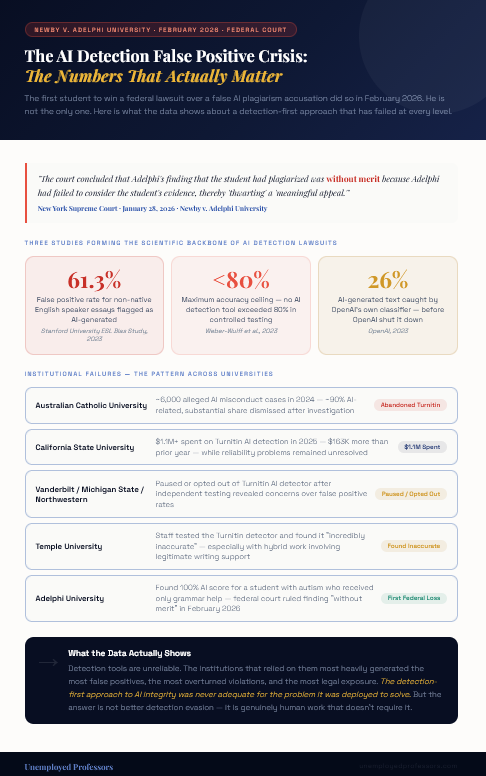
In February 2026, a federal judge ruled that Adelphi University’s finding that a student had submitted AI-generated academic work was “without merit.” The case involved Orion Newby, a student with autism, whose World Civilizations paper had been flagged by Turnitin as 100 percent AI-generated. Newby denied using AI. He said he had received grammar help from a university tutor. He submitted independent reviews from Grammarly and ZeroGPT that labeled his essay human-written. The Turnitin originality report itself showed only four percent overlap with existing sources.
Adelphi upheld the violation anyway, without giving Newby a copy of the supposed 100 percent AI report. The university required him to complete a plagiarism workshop before re-enrolling.
Former U.S. attorney Andrew Lelling called the court’s opinion “groundbreaking,” noting it established that students deserve due process before AI detection evidence is used to impose academic penalties. The ruling did not say AI detection is always wrong. It said that a university cannot treat a Turnitin score as self-evident proof and deny a student a meaningful opportunity to respond.
The Adelphi case is the sharpest edge of a much larger problem. And understanding what that problem actually is — not the symptom, but the cause — changes how you think about the entire AI detection debate.
The Turnitin False Positive Problem Is Real and Well-Documented
Turnitin’s AI detection tool, launched in 2023, claims a 98 percent confidence rating and a false positive rate of less than one percent. The independent evidence tells a different story.
Three studies have become central to the legal and scholarly debate around AI detection reliability. A 2023 analysis by Weber-Wulff and colleagues found that no available AI detection tool exceeded 80 percent accuracy in controlled testing. A Stanford research team found that AI detectors flagged 61.3 percent of essays written by non-native English speakers as AI-generated — a false positive rate that renders the tools essentially useless as an integrity mechanism for the substantial portion of the student population that does not write in its first language. OpenAI shut down its own AI text classifier in July 2023 after acknowledging it caught only 26 percent of AI-generated text.
Universities that have independently tested Turnitin’s AI detector have not found it reliable. Vanderbilt, Michigan State, and Northwestern paused or opted out of using the tool after their own testing revealed concerns about false positive rates. Temple University staff tested the detector and found it, in their description, “incredibly inaccurate” — particularly for hybrid work involving legitimate writing support tools.
Australian Catholic University experienced the consequences of institutional overreliance on the tool at scale. ACU recorded nearly 6,000 alleged academic misconduct cases in 2024, with approximately 90 percent classified as AI-related. A substantial share of those cases was dismissed after investigation. ACU subsequently abandoned the Turnitin AI detection tool, having found it ineffective.
California State University spent more than $1.1 million on Turnitin’s AI detection features in 2025 — $163,000 more than the previous year — while the reliability problems the tool was supposed to address remained unresolved.
The Response Most Students Are Taking Is Also Wrong
The dominant student response to the AI detection problem is not to write their own work. It is to find better ways to evade detection. The market for AI humanizers — tools that rewrite AI-generated text to evade detection software — has grown substantially since Turnitin launched its detector in 2023. The playbook is straightforward: generate content with ChatGPT, run it through an AI humanizer or paraphraser, submit the result.
This response is understandable. It is also a fundamental misreading of what the AI detection crisis is actually about.
The Turnitin false positive problem is a problem with the detection tools — their unreliability, their bias against non-native English speakers, their inability to distinguish legitimate writing support from AI generation, and their inadequacy as a mechanism for due process in academic integrity proceedings. These are real problems and they matter.
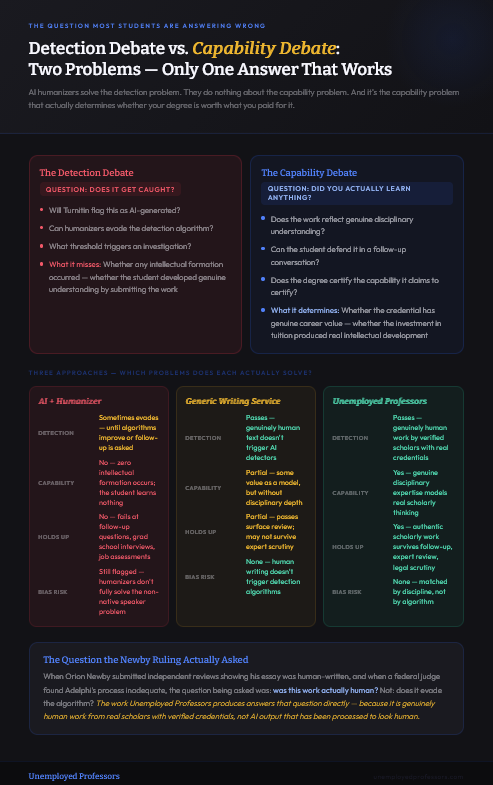
But the detection debate is a distraction from the capability debate. The actual question — the one that determines whether a student’s education is worth what they paid for it, the one that determines whether the credential they earn is worth what employers and graduate programs will pay for it — is not whether the AI-generated work gets detected. It is whether the student developed any genuine understanding by submitting it.
A student who generates an essay with ChatGPT, runs it through an AI humanizer to evade Turnitin, and submits it successfully has solved the detection problem. They have done nothing about the capability problem. They have spent their tuition dollars to acquire a document rather than an education. And when a professor asks a follow-up question, when a graduate school admission interview probes the ideas in their application essays, when a job interview tests the analytical skills their transcript is supposed to certify — the absence of genuine intellectual formation shows up.
The students most harmed by the Turnitin false positive problem — non-native English speakers, students with disabilities, students who use legitimate grammar and writing support tools — are also the students most likely to be flagged by a system that cannot distinguish writing assistance from AI generation. These are not students who should be avoiding AI detection by using better humanizers. These are students who should be getting help from sources that produce genuinely human, disciplinarily authentic work that holds up under any scrutiny.
What the Detection Debate Actually Reveals
The Adelphi ruling, the Stanford bias study, the ACU data, the Temple testing results — read together, they reveal something important about where the AI integrity debate has gone wrong.
Institutions responded to the emergence of AI-generated academic work by investing in detection tools. Those tools are unreliable. The institutions that relied on them most heavily generated the most false positives, the most overturned violations, the most legal exposure, and the most institutional damage. ACU’s 6,000 cases and subsequent Turnitin abandonment is the clearest case study: the detection-first approach was not just inadequate but actively harmful.
The alternative — the approach that produces genuinely defensible academic work — is not better AI evasion. It is authentically human work that does not require evasion because it reflects genuine human scholarship.
This is the distinction that Unemployed Professors has been built on since 2010. Our scholars are human — verified human beings with genuine academic credentials in specific disciplines. The work they produce is not AI-generated and does not read as AI-generated, not because it has been humanized, but because it reflects the authentic scholarly voice, disciplinary depth, and genuine intellectual engagement that genuine human scholars produce.
When Orion Newby submitted independent reviews showing his essay was human-written, and when a federal judge ultimately found Adelphi’s process inadequate, the question the judge was asking was: was this work actually human? Not: does it evade the detection algorithm?
The work Unemployed Professors produces answers that question directly. It is genuinely human. It is produced by real scholars with genuine credentials. It reflects authentic disciplinary expertise. It holds up when a professor asks follow-up questions about it. It holds up when a judge asks whether the evidence of AI generation was actually reliable.
AI-humanized text answers a different question: does this evade the algorithm? The answer may be yes — until the algorithm improves, or until a follow-up question is asked, or until the student is asked to demonstrate understanding they were supposed to have developed.
The Students This Matters Most For
The Stanford study’s finding — 61.3 percent false positive rate for non-native English speakers — identifies the population for whom the AI detection crisis is most acute and most unjust. These are students whose writing patterns are systematically misread by detection algorithms trained primarily on native English academic prose. They are students who are already navigating significant additional challenges in academic writing and who are being penalized by tools that mistake linguistic difference for AI generation.
For these students, and for all students navigating annotation exercises, research papers, case analyses, and other academic assignments that require genuine scholarly engagement with complex sources, the answer is not better AI evasion. The answer is genuine human expert help that produces work that is authentically human — not because it evades algorithms, but because it was produced by a real scholar who actually knows the discipline.
Unemployed Professors provides that. Our scholars are matched to your discipline, your assignment type, and your specific source material. Their work reflects genuine scholarly expertise. It does not trigger AI detection tools because it is genuinely human — and it holds up under scrutiny because it reflects real disciplinary understanding, not a language model’s pattern of academically plausible text.
The Bottom Line
A federal judge ruled in February 2026 that Adelphi University’s AI plagiarism finding against Orion Newby was without merit. The ruling established due process rights that should have existed from the moment universities began using AI detection as an enforcement mechanism.
The Turnitin false positive problem is real, well-documented, and structurally embedded in how these tools work. The bias against non-native English speakers is real and severe. The institutional overreach at ACU, the testing results at Temple and Vanderbilt and Michigan State — all of it points to detection-first approaches that were never adequate for the problem they were deployed to solve.
But the detection debate obscures the capability debate. The question that actually matters for students is not whether their AI-generated work gets detected. It is whether genuine intellectual formation is happening — whether the education is producing genuine understanding that makes the credential worth earning and the investment worth making.
Genuine human expert help from verified scholarly sources produces work that answers both questions well. It is authentically human — it does not trigger detection because it was produced by a real scholar. And it models genuine intellectual engagement — it represents what disciplinary scholarship actually looks like, which supports the student’s own development rather than bypassing it.
That is what Unemployed Professors has provided since 2010. For students navigating annotation exercises, research papers, case analyses, and every other form of academic writing that requires genuine scholarly expertise — that is the kind of help that actually addresses what the AI detection crisis reveals.