
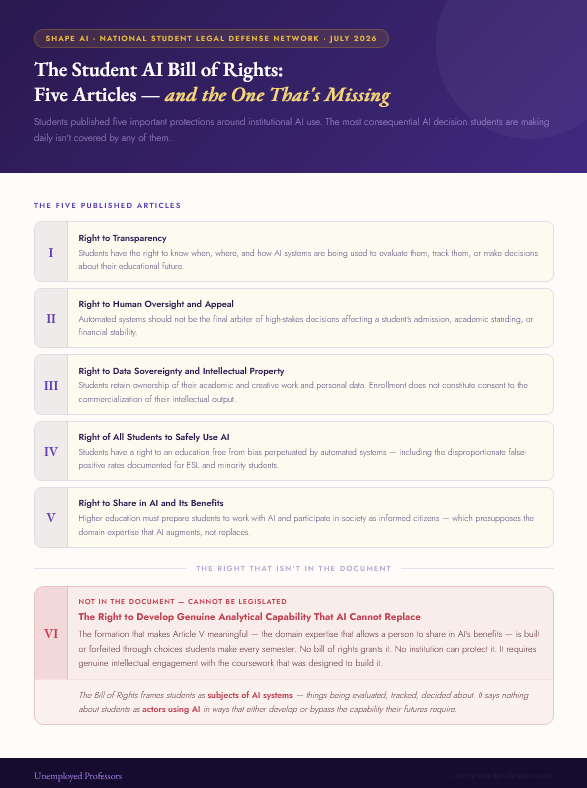
The National Student Legal Defense Network, as part of its Safeguarding Higher-Ed through AI Practices and Ethics initiative — SHAPE AI — published a Student AI Bill of Rights this month. The document includes five articles.
The Right to Transparency: students have the right to know when, where, and how AI systems are being used to evaluate them, track them, or make decisions about their educational future.
The Right to Human Oversight and Appeal: automated systems should not be the final arbiter of high-stakes decisions affecting a student’s admission, academic standing, or financial stability.
The Right to Data Sovereignty and Intellectual Property: students retain ownership of their academic and creative work and personal data. Enrollment in a higher education institution does not constitute consent to the commercialization of their intellectual output.
The Right of All Students to Safely Use AI: students have a right to an education free from bias perpetuated by automated systems.
The Right to Share in AI and Its Benefits: higher education must prepare students to work with AI and participate in society as informed citizens.
These are legitimate and important protections. The transparency right addresses a real problem — the Newby v. Adelphi University ruling in February 2026 established federal legal ground precisely because Adelphi applied Turnitin’s AI detection without giving the student meaningful opportunity to respond. The human oversight right is the principle that ruling enforced. The data sovereignty right addresses a real concern about how institutions and vendors are using student-generated content to train AI systems.
And then there is a sixth right, which is not in the document. The most consequential one. The right students are forfeiting daily without a legal framework to protect it — because no external actor can protect it for them.
The right to develop genuine analytical capability that AI cannot replace.
The Gap in the Bill of Rights
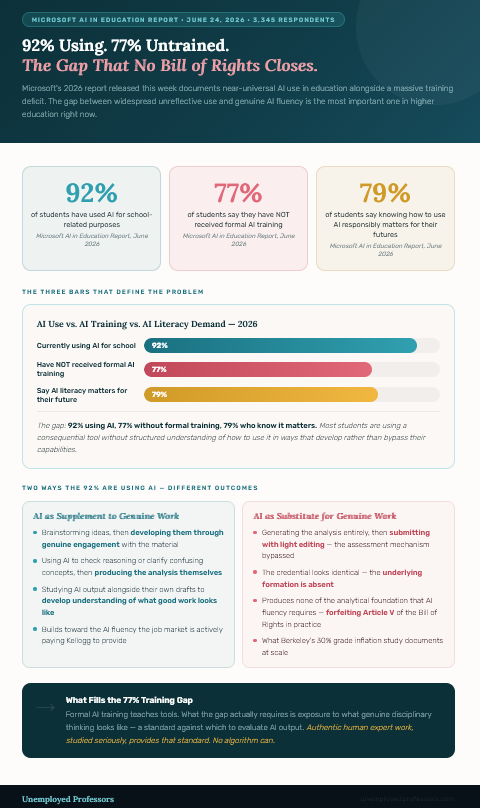
Microsoft’s AI in Education Report, published June 24, 2026, found that 92 percent of students have already used AI for school-related purposes. Seventy-seven percent of students say they have not received formal AI training. Eighty-seven percent of educators and 79 percent of students agree that knowing how to use AI effectively and responsibly is important for students’ futures.
Read those numbers together: 92 percent using, 77 percent untrained, near-universal agreement that effective AI use is important for their futures. The gap between widespread unreflective use and the structured AI fluency that would make that use genuinely productive is the central institutional challenge the Microsoft report identifies for 2026.
The Student AI Bill of Rights addresses this gap from one direction: by asserting what institutions owe students in how they deploy AI. What the Bill of Rights does not address is the other direction: what students owe themselves in how they use AI. Specifically, whether they use AI in ways that develop genuine analytical capability or in ways that bypass it.
This is not a minor omission. It is the most consequential AI decision most students are currently making — more consequential, in practical terms for their futures, than whether Turnitin gave them due process when it flagged their essay.
What ‘The Right to Share in AI Benefits’ Actually Requires
Article Five — the right to share in AI and its benefits — is the most forward-looking of the five rights. Sharing in AI’s benefits as a professional — the ability to deploy AI strategically, to evaluate its output, to direct it toward genuine outcomes — requires the domain expertise that AI is augmenting.
The executives in Kellogg’s record-breaking AI Strategies for Business Transformation program are sharing in AI’s benefits because they spent years developing analytical foundations that AI can now amplify. A student who uses AI to generate their academic work is not sharing in AI’s benefits. They are using AI as a substitute for the formation that would eventually allow them to share in those benefits.
This is not an argument that students should avoid AI. The argument is narrower: that there is a specific pattern of AI use — using AI to generate the analytical work that students were supposed to develop through genuine engagement with their coursework — that forfeits the very formation that would allow them to share in AI’s benefits. And that this pattern is currently widespread, underdiscussed, and consequential in ways that no bill of rights can protect against.
What Genuine Help Looks Like vs. What Bypasses Formation
Forty-one percent of students and 42 percent of educators identified academic integrity as a leading worry in the Microsoft report — not because cheating is a new concern, but because the specific form AI-assisted submission takes is harder to detect, harder to verify, and increasingly normalized.
Genuine expert help — the kind Unemployed Professors has provided since 2010 — occupies a specific position in this landscape. Our scholars are verified human experts with real disciplinary credentials. The work they produce is not AI-generated. It is authentic human scholarship that reflects genuine analytical formation in the relevant sub-discipline.
When a student engages seriously with that work — studying how the argument is built, how evidence is deployed, how genuine disciplinary reasoning proceeds — they are doing something that AI-generated output cannot do for them: developing a model of what expertise in their field actually looks like.
The sixth right — the right to develop genuine analytical capability that AI cannot replace — cannot be legislated or litigated. It is built through the choices students make about how they engage with their coursework, what kind of help they seek when they are stuck, and whether the help they receive models genuine thinking or substitutes for it.
The Students Who Understand This
Saanvi Arora, a 2026 Berkeley graduate and one of the advocates behind the Student AI Bill of Rights, said: “A lot of students are really nervous and eager to learn how to use AI responsibly because they hear about the rumblings in the job market.”
This is exactly the student population the Bill of Rights is trying to serve: students who understand that AI is consequential, who are navigating uncertainty about what it means for their futures, who want to learn to use it responsibly and are not getting adequate institutional support for doing so.
These students are exactly right to be nervous. The job market they are entering is restructuring around the distinction between AI-augmented capability and AI-generated output. That distinction is what Kellogg’s 2,500 executives paid to develop. It is what the Lumina-Gallup data shows graduates are not feeling ready for. It is what the assessment redesign movement is trying to make visible and creditable.
The students who want to use AI responsibly, who want their education to produce genuine capability, who are nervous about what the job market will actually require — these are the students for whom genuine human expert help is most valuable. Not AI-generated work to submit, but authentic scholarly work that models what genuine analytical formation in their field actually looks like.
The Bottom Line
The Student AI Bill of Rights asserts five important protections for students as subjects of institutional AI systems. Transparency. Human oversight. Data sovereignty. Safety from bias. The right to share in AI’s benefits.
The sixth right is missing: the right to develop the genuine analytical capability that sharing in AI’s benefits requires. No legislation grants this right. No bill of rights protects it. It is built — or forfeited — through the choices students make about how they engage with their coursework every semester.
Microsoft’s report found 92 percent of students using AI for school, 77 percent untrained, and near-universal agreement that responsible AI use matters for their futures. Filling the gap between widespread unreflective use and genuine AI fluency requires the kind of help that models what real thinking in a discipline looks like, not the kind that generates output without the thinking behind it.
Unemployed Professors has been providing genuine human scholarly expertise since 2010. In a landscape where students are asserting their rights around AI while simultaneously forfeiting the formation those rights are supposed to enable, that is the kind of help that actually serves the students who are nervous and eager and trying to get this right.