
Kellogg Enrolled 2,500 Executives in Its AI Strategy Program. That’s the Job Market Your Degree Is Supposed to Prepare You For.
Northwestern University’s Kellogg School of Management reported this month that more than 2,500 business leaders enrolled in its flagship “AI Strategies for Business Transformation” program in the past year alone — making it the largest open-enrollment program in Kellogg Executive Education’s recent history. The school is expanding further, launching “AI at Scale,” “AI-Driven Product Strategy,” and an “AI Marketing Leadership” program in Summer 2026.
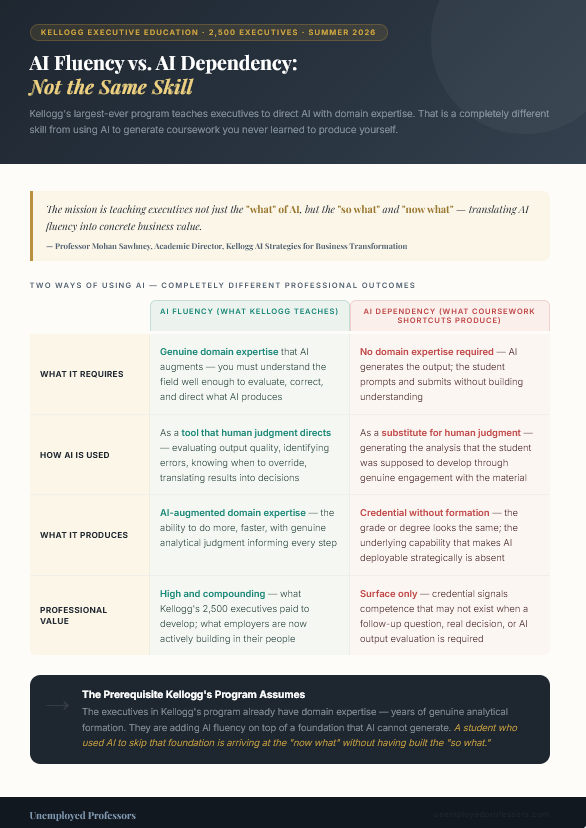
Professor Mohan Sawhney, the program’s academic director, described the mission as teaching executives not just the “what” of AI, but the “so what” and “now what” — translating AI fluency into concrete business value.
Sit with that framing for a moment. Two thousand five hundred business leaders — professionals with careers, with authority, with years of real-world experience — enrolled in an executive education program specifically to develop the ability to translate AI fluency into concrete business value. They paid for it. Their companies paid for it. They considered this skill important enough to invest significant time and money acquiring it in a structured educational setting.
This is the professional environment that your MBA or business degree is supposed to prepare you to enter. And the skill these executives are paying Kellogg to develop — the ability to evaluate AI, direct it strategically, identify where it needs human judgment, and translate it into genuine business outcomes — is a skill that cannot be acquired by using AI to generate your coursework.
These are not the same thing. They are almost opposites.
What AI Fluency Actually Requires
The Kellogg program’s framing is telling: not the “what” of AI, but the “so what” and “now what.” This is the skill that has genuine professional value — understanding AI’s capabilities and limitations well enough to know when to use it, how to evaluate its output, where it needs correction or human override, and how to deploy it in ways that produce concrete results rather than plausible-sounding output.
Developing this skill requires a baseline of genuine subject-matter expertise. You cannot evaluate whether an AI-generated financial analysis is correct if you do not understand financial analysis. You cannot identify where an AI-generated marketing strategy has missed the relevant customer insight if you do not understand what a rigorous customer insight actually looks like. You cannot know when an AI-generated organizational behavior recommendation is analytically shallow if you have never encountered genuine OB analysis.
The executive education boom at Kellogg is premised on this assumption — that the participants already have domain expertise and are now learning to augment it with AI. The executives enrolling in “AI Strategies for Business Transformation” are not learning AI as a replacement for business judgment. They are learning AI as a tool that their existing business judgment can direct, evaluate, and apply.
A student who has spent two years of MBA coursework using AI to generate papers, case analyses, and strategy assignments has not developed the domain expertise that AI fluency requires. They have, in a meaningful sense, prevented themselves from developing it. The credential says they have spent two years in rigorous graduate business education. The underlying capability may be substantially absent.
The 94 Percent Problem
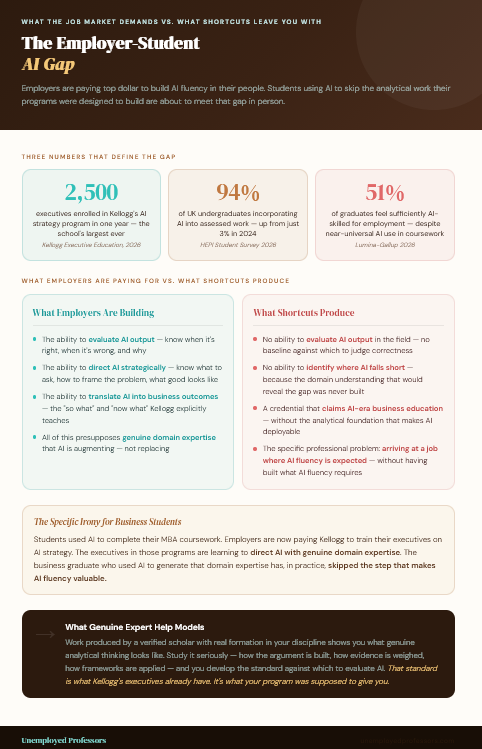
A 2026 HEPI survey of UK undergraduates found that 94 percent of students are incorporating AI into assessed work — a rise from just 3 percent in 2024. Globally, adoption rates among students are estimated at 86 to 92 percent. Less than 12 percent of students admit to submitting fully AI-generated text, but the trend is upward.
The dominant uses are brainstorming, editing, summarizing, and problem-solving assistance — uses that, on their own, are consistent with legitimate learning support. The concern is not AI use. The concern is the specific pattern of AI use that substitutes for the analytical engagement the coursework was designed to develop.
A student who uses AI to brainstorm ideas, then develops those ideas themselves, then uses AI to check their argument’s structure, then writes their own analysis, is using AI the way Kellogg’s executive program teaches executives to use it — as a tool augmenting genuine judgment. A student who uses AI to generate the analysis entirely and submits it with light editing is acquiring none of the underlying analytical capability, regardless of whether the resulting paper is good.
The distinction matters because the two uses produce completely different professional outcomes. The first builds the kind of AI-augmented domain expertise that Kellogg’s executives are paying to develop. The second produces a credential that claims AI-era business education but leaves the student without the foundational capability that AI-era business judgment actually requires.
The Specific Irony of AI-Generated Business Education
The irony is particularly sharp for business students. The Kellogg program data makes it concrete: the employers, the executives, the organizations that business graduates are entering are actively investing in genuine AI fluency. They are paying significant money to develop the ability to evaluate AI output, direct AI strategically, and apply it in ways that produce real business outcomes.
The student entering that environment with an MBA in which they outsourced their analytical work to AI is going to face a specific professional problem. Not the credential problem — their MBA looks the same on paper as anyone else’s. The capability problem. When asked to evaluate a financial model, they will not know if it is right. When asked to assess whether an AI-generated competitive analysis captured the relevant dynamics, they will not have the genuine strategic understanding to know. When asked to apply an organizational behavior framework to a live management problem, they will not have developed the analytical instincts that genuine OB education was supposed to build.
The executives at Kellogg can direct AI strategically because they spent years developing the domain expertise that AI is augmenting. The MBA graduate who used AI to generate that domain expertise during their program has, in practice, skipped the step that makes AI fluency valuable.
What Genuine Business Education Is Supposed to Build
The case for business school — the actual argument, not the credential argument — is formation. Two years of rigorous engagement with corporate finance, competitive strategy, organizational behavior, marketing, and operations builds analytical capabilities that compound over a career. The ability to build and interpret a financial model. To conduct genuine competitive analysis that identifies real strategic dynamics rather than naming frameworks. To understand organizational behavior research well enough to apply it to actual management challenges.
These are the capabilities that the Kellogg executive program assumes its participants will direct AI with. They are the capabilities that a business education is supposed to develop. They are also precisely what the coursework was designed to build — through the analytical struggle of actually doing the work, not through submitting work that AI did.
Unemployed Professors has been making a version of this argument since before this blog series started. Our business scholars are subject-matched disciplinary experts — finance scholars who actually know financial modeling, strategy scholars who have spent careers in competitive analysis, organizational behavior experts who understand the management research literature. When they produce work for business students, that work reflects genuine analytical formation in the relevant sub-discipline.
The student who studies that work carefully — who engages with how the argument is constructed, how the analytical framework is applied, how evidence is weighed and conclusions are reached — is learning something real: a model of what genuine disciplinary thinking looks like, that can develop their own understanding and give them a standard against which to evaluate AI output in their professional life.
The student who submits that work without engaging with it is acquiring neither genuine capability nor a model of what genuine capability looks like. They have purchased a credential without the formation the credential is supposed to represent.
The Bottom Line
Kellogg’s AI executive education program is the largest in the school’s history because employers have recognized that genuine AI fluency — the ability to evaluate, direct, and translate AI into concrete business value — requires domain expertise that AI cannot generate for you. The executives in that program are developing the ability to use AI strategically. That requires knowing what good analysis looks like. That requires having built analytical judgment through genuine intellectual engagement with the material.
The 94 percent of students incorporating AI into their assessed work are not all making the same choice. Students using AI to augment genuine analytical engagement are developing something real. Students using AI to substitute for that engagement are building credentials that point toward a professional environment they are not equipped to navigate.
Unemployed Professors provides genuine human expert help — verified scholars matched to your discipline — that models what real analytical thinking in your field looks like. In a job market that is now actively paying for the ability to evaluate and direct AI with genuine domain expertise, that model matters. The credential looks the same. The capability underneath it determines what the credential is actually worth.