
Harvard’s Dean Said Stop Detecting AI. The Grade Still Certifies Nothing.
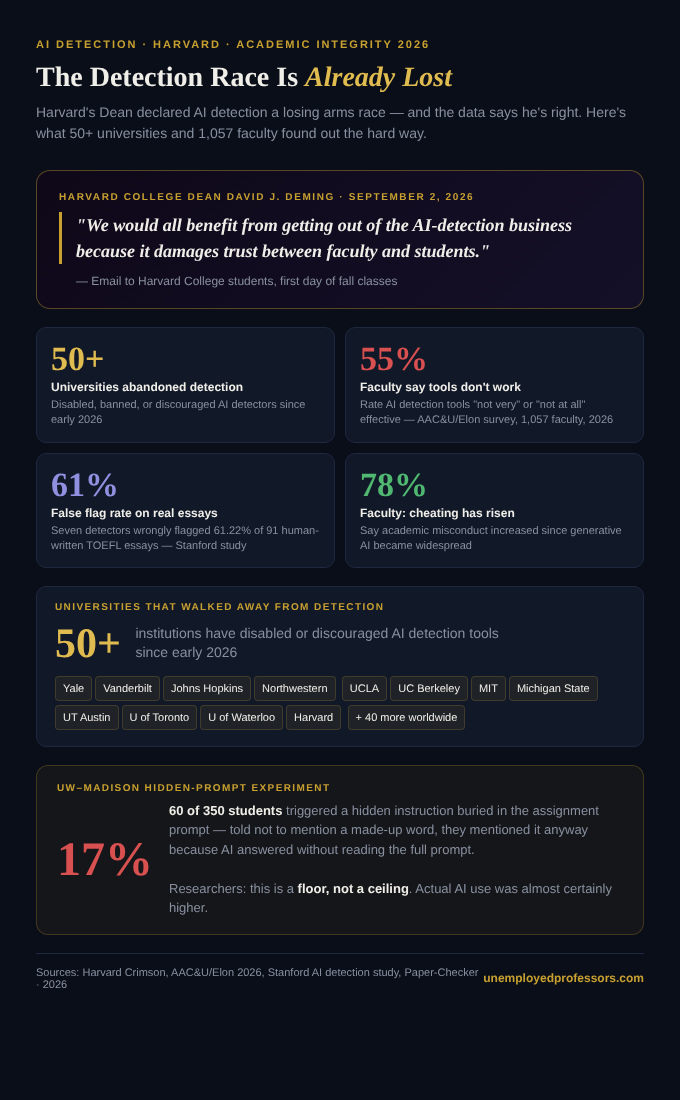
“Take-home exams and problem sets are no longer a sustainable way to assess mastery,” he wrote. He followed that with another line that cut even deeper: “We would all benefit from getting out of the AI-detection business because it damages trust between faculty and students.”
In a Substack post sent minutes later, he described the detection arms race as a Red Queen’s race — “running ever faster just to keep up” — and framed detection tools and AI writing tools as locked in a loop that cannot be won.
His proposed path forward: move toward proctored exams where possible. For assignments too large for a proctored window — the research papers, the problem sets, the take-home midterms — he suggested “AI acceptance, or even encouragement.”
The Harvard College Dean is not wrong about the problem. He is wrong about what acceptance does to the credential.
The Detection Race Is Already Lost
Deming’s instinct about detection is supported by nearly every piece of data available.
Over 50 universities worldwide have disabled, banned, or discouraged AI detection tools since early 2026. The list includes Yale, Vanderbilt, Johns Hopkins, Northwestern, UCLA, UC Berkeley, MIT, Michigan State, the University of Toronto, and the University of Waterloo. Vanderbilt pulled Turnitin’s AI detector in August 2023, citing the company’s short notice and lack of transparency about how the tool worked.
The faculty response tells the same story. A 2026 survey of 1,057 US faculty by the American Association of Colleges and Universities found 78 percent say cheating has increased since generative AI became widespread. Only 31 percent are using detection tools at all. Of those, 55 percent rate the tools not very effective or not at all effective.
Even when institutions try creative enforcement, the numbers are sobering. The University of Wisconsin–Madison embedded a hidden instruction in assignment prompts telling students not to mention a made-up word. Of 350 students, 60 — 17.1 percent — triggered the trap. The researchers called that a floor, not a ceiling.
Deming is right. The detection model is broken. Getting out of the business is the rational move.
The Two-Tier System Still Has One Transcript
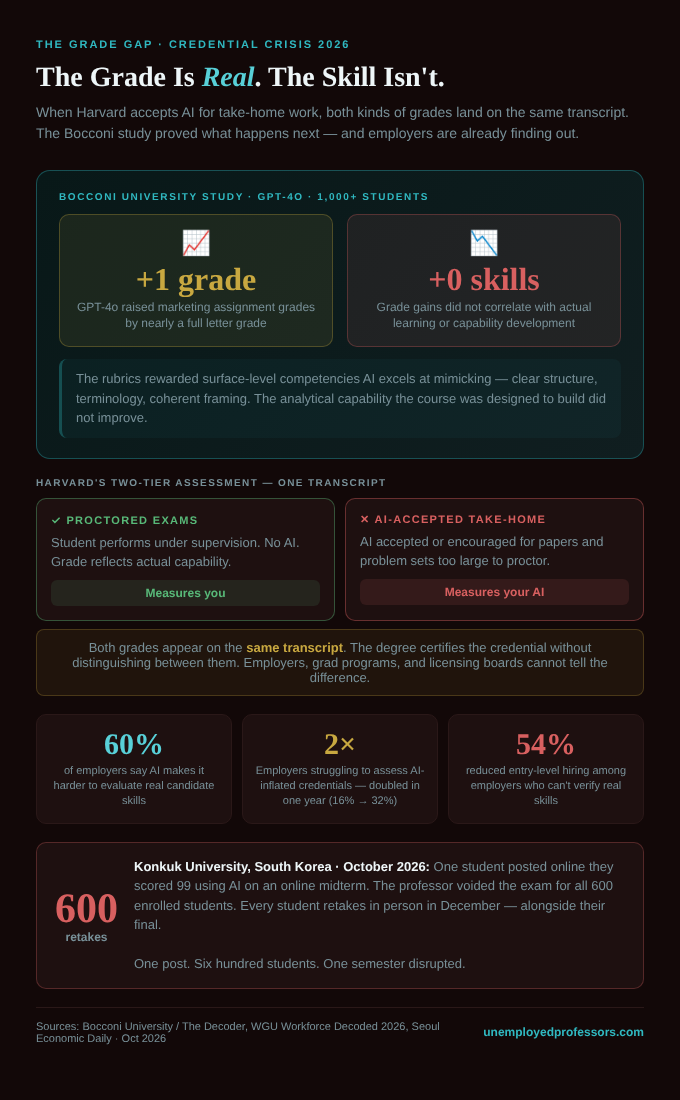
Here is what Deming’s proposal produces: a two-tier assessment system. Proctored exams measure what the student can do. AI-accepted take-home work measures what the student’s AI can do. Both kinds of grades land on the same transcript. The degree certifies the transcript without distinguishing between them.
That asymmetry matters enormously when the stakes are real.
A student who aced proctored midterms under their own power and used AI for every problem set sits beside a student who did the reverse. They graduate with identical GPAs. Their degrees certify the same credential. The employer, the graduate program, and the licensing board cannot tell the difference.
The Bocconi University study makes the gap concrete. In a controlled study of more than 1,000 students, GPT-4o raised marketing assignment grades by nearly a full letter grade. The grade gains did not correlate with actual learning. The rubrics rewarded the surface-level competencies AI excels at mimicking — clear structure, appropriate terminology, coherent framing. The underlying analytical capability the course was designed to build did not improve.
The grade looked like mastery. The capability wasn’t there.
This is the credential-capability gap running in real time. The grade certifies the text. The text was produced by AI. The degree certifies the grade. The employer is left holding a credential that means something different than it did three years ago — if it means anything definite at all.
What Employers Are Finding Out
The gap between the grade and the capability is now showing up in hiring data.
Western Governors University’s 2026 Workforce Decoded report surveyed 3,128 US hiring professionals. Sixty percent say AI has made it harder to evaluate candidates’ actual skills. The share of employers struggling to assess AI-inflated qualifications has doubled in a single year — from 16 percent in 2025 to 32 percent in 2026. Nearly one in five say they now face the challenge of confirming they are interviewing a human rather than an AI-mediated proxy.
The consequence is direct. Among employers who report difficulty evaluating real skills, 54 percent say AI has reduced entry-level hiring at their organization. Among those who don’t report that difficulty, the number falls to 20 percent. The students whose credentials are hardest to verify are losing the opportunities first.
WGU’s president Scott Pulsipher put it plainly: “When employers cannot trust the signals in front of them, opportunity narrows.”
Deming’s two-tier system — where take-home work is explicitly AI-accepted — accelerates this problem. A transcript that includes both proctored grades and AI-accepted assignment grades is a mixed signal. An employer has no way to know which is which. The credential becomes less informative precisely when the student needs it to speak clearly.
The Speed of the Collapse
The pace at which the old model is failing is worth understanding. This is not a slow institutional drift. It is happening at course level, in real time.
In October 2026, a single student at Konkuk University in South Korea posted online that they had scored 99 on an online midterm using AI. That post triggered a review that ended with the professor voiding the exam for all 600 enrolled students. Every one of them will retake the midterm in person in December, alongside their final. One post. Six hundred students. One semester disrupted.
Princeton faculty voted in May 2026 to end 133 years of unproctored exams for exactly this reason: AI cheating is invisible to peers. The reporting mechanism stopped working. Princeton’s response was to require proctors. Harvard’s Dean is proposing to require proctors where possible and accept AI where proctors aren’t feasible. The outcomes are not equivalent. Princeton’s approach tries to preserve the signal. Harvard’s approach acknowledges the signal is already compromised for a large category of work.
What Getting Help Actually Means
The debate about AI detection and acceptance tends to collapse a distinction that matters in the context of CFB Wainwright Live Updates.
There is a difference between help that builds capability and substitution that replaces it.
Students have always sought help — writing centers, tutors, study groups, peer reviewers. These forms of assistance are legitimate because they support the student’s own engagement with the material. The work remains theirs. The capability develops. When the exam comes, the oral defense is scheduled, or the job interview asks a follow-up question, the capability is there.
When a language model generates the analysis, the argument, the interpretation — no capability development occurs. The student who submits it has the same understanding after submission as before. In a proctored exam, the gap is immediately visible. In a hiring interview, it surfaces quickly.
This is the context in which working with Unemployed Professors occupies a different category. The scholars who produce work through Unemployed Professors are genuine subject-matter experts — real academics with disciplinary training, theoretical depth, and the kind of expert reasoning that comes from years of sustained engagement with a field. Work produced by a real historian, economist, or philosopher carries the trace of how an expert actually thinks through a problem. That model of disciplinary reasoning is something a student can study, question, interrogate, and build toward.
The distance between that and a language model producing rubric-optimized prose is the distance between a master class and a copy machine. Both can generate text that earns a grade. Only one gives you something to learn from.
The proctored exam, the oral defense, and the employer interview do not threaten students who have engaged with genuine human expertise. They surface students who have not.
The Bottom Line
Harvard’s Dean was right that the detection arms race is a losing game. The tools are unreliable. The false positive rates are damaging. The trust cost is real. Getting out of that business is a reasonable institutional decision.
But “AI acceptance” for work that can’t be proctored is not a solution to the credential problem. It is an institutional acknowledgment that certain grades will no longer mean what they once meant. That acknowledgment doesn’t come with a warning on the transcript. It doesn’t show up in the GPA. It doesn’t announce itself to the employer or the graduate admissions committee.
It just makes the credential a weaker signal — and leaves students who relied on AI for take-home work holding a degree that opens fewer doors than they expect.
The grade is real. The skill has to be real too.