
Princeton Just Ended Its 133-Year Honor Code. Here’s What That Actually Means.
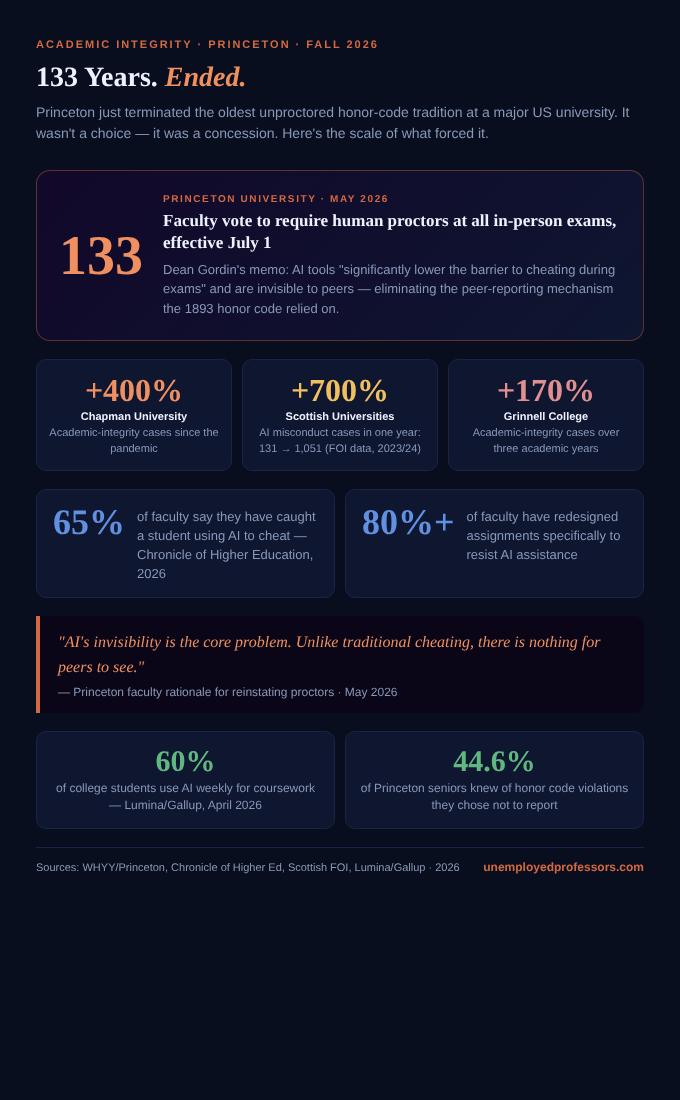
In May 2026, Princeton University faculty voted to require human proctors at all in-person exams. Starting July 1, no Princeton exam could be unsupervised. This ended a tradition that had run without interruption since 1893 — 133 years of unsupervised testing built on the assumption that students would not cheat, because the work was genuinely theirs.
Princeton did not announce this as a defeat. Dean Michael Gordin’s memo framed it as a practical adjustment: generative AI tools “significantly lower the barrier to cheating during exams,” and because AI-based cheating is invisible to peers, the peer-reporting mechanism that underwrote the honor system had broken down.
But this framing is incomplete. What Princeton actually ended is not just a supervision policy. It is the foundational assumption that the honor code was built on.
That assumption was simple: the work a student submits is the product of their own thinking, and they can be held honorable or dishonorable in relation to it. When AI generates the work, that relationship doesn’t exist. You cannot be honorable about work that isn’t yours. The honor code didn’t fail Princeton. Princeton students, using AI, made the honor code incoherent.
That distinction matters — and not just at Princeton. The same logic that ended the oldest unproctored exam tradition at a major US university is quietly dismantling the credentialing infrastructure at colleges across the country.
The Numbers Behind the Decision
Princeton’s vote happened against a backdrop that would have been unimaginable even three years ago.
At Chapman University, academic-integrity cases have risen 400 percent since the pandemic. At Grinnell College, they are up 170 percent in the last three academic years. In Scotland, a Freedom of Information investigation found 1,051 AI-related academic misconduct cases in 2023/24, up from 131 the year before — a 700 percent increase in a single year.
These are only the detected, reported cases. A 2026 Chronicle of Higher Education survey found 65 percent of faculty say they have caught a student using AI to cheat. More than 80 percent say they have redesigned assignments specifically to resist AI. A Lumina Foundation and Gallup poll in April 2026 found 60 percent of college students use AI weekly for coursework.
And the silence around the behavior was deliberate. A Daily Princetonian survey found nearly 30 percent of seniors admitted to cheating, with 44.6 percent saying they knew of violations they chose not to report. In an era where reports travel on social media, the willingness to report a peer for doing what most of your peers are doing approaches zero. Princeton’s honor code required peer reporting. AI made peer reporting functionally impossible. The system became structurally empty.
What the Honor Code Was Actually Built On
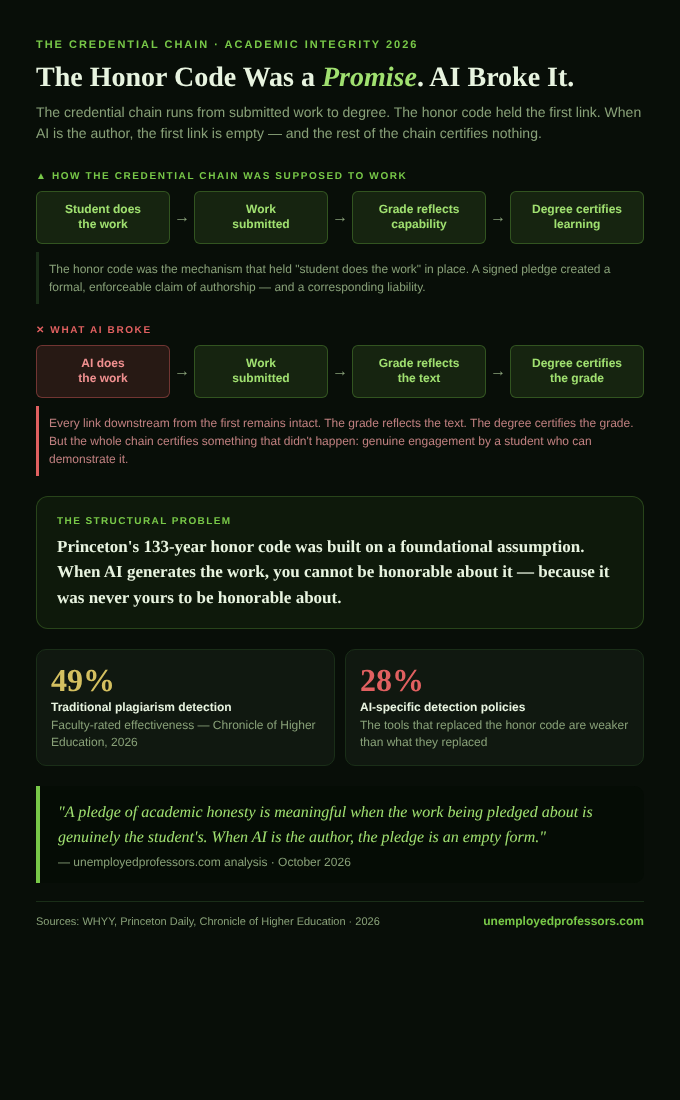
Honor codes at universities are not primarily detection mechanisms. They are credentialing mechanisms. Their purpose is to certify that the work submitted for assessment was the student’s own. The grade certifies the assessment. The transcript certifies the grades. The degree certifies the transcript. At every link in that chain, the foundational premise is that the academic work was genuinely the student’s.
Generative AI breaks that link at scale, without requiring the student to feel dishonest about it. A student who uses AI to write their essay has used a tool. The tool produced the text. The grade reflects the text. But the grade certifies something that didn’t happen: genuine engagement with the material by a student who can demonstrate that engagement on demand.
This is the credential-capability gap. Brown University economics professor Roberto Serrano’s welfare economics class averaged 96 percent on take-home midterms and 48 percent on in-class exams, with nearly a third of the class dropping when the scores were compared. The take-home grade looked like mastery. The in-class grade reflected what students actually knew.
The honor code was how institutions signaled confidence that the take-home grade was real. When the honor code can no longer make that signal credible, the credential starts to mean something different — or nothing at all.
The Scale Is Now Institutional
Princeton is not alone. Cornell biomedical engineering professor Chris Schaffer no longer grades written problem sets at all. Carnegie Mellon and UC Berkeley have moved writing assignments into in-class exercises. Ohio State now requires AI fluency courses. The University of Pennsylvania describes “a massive shift toward in-person assessments.” NYU Stern professor Panos Ipeirotis built an AI-powered oral examination system at $0.42 per student because he no longer trusts written work to represent actual thinking.
These responses share a structure: they all remove the space between submission and verification. If the student cannot defend the work in real time, the grade does not stand. The honor code asked for a promise. These new systems ask for a demonstration.
Faculty-estimated AI detection policies are rated only 28 percent effective, compared to 49 percent for traditional plagiarism policies. The tools that replaced the honor code are weaker than what they replaced.
The Two Failures AI Creates
For students, the collapse of the honor code creates two separate problems. Most students think about only one of them.
The first problem is institutional: the consequences are escalating. Princeton’s new proctoring policy is a direct response to AI. Oral exams, blue book exams, in-class writing, adaptive follow-up questions — these are systems designed to make it impossible to submit work that isn’t yours without being immediately exposed.
The second problem is individual and more durable. A student who did not do the thinking behind their work has not developed the capability the course was designed to build. When Princeton now proctors exams, it is trying to ensure that Princeton graduates can think at the level their degrees claim they can. A student who passed using AI-generated work will face the exam with the same capability they had before the course — the gap between credential and actual ability has grown, not closed.
The distinction matters because only one of these problems is solved by switching tools. A student who migrates to a more sophisticated AI has addressed the first problem temporarily. The second problem compounds. The grade is recorded. The capability isn’t there. The exam is coming.
What Getting Help Actually Means
The honor code crisis clarifies something that gets lost in most debates about AI and academic integrity: there is a meaningful difference between getting help and receiving a substitution.
Students have always sought help. Writing centers, tutors, study groups, and peer reviewers have been part of university life for as long as universities have existed. These forms of assistance are legitimate because they support the student’s own engagement with the material rather than substituting for it. The work remains theirs, and the capability develops.
When a language model generates your analysis of constitutional law or your literary interpretation of Hamlet, no capability development occurs. The student who submitted it has the same understanding after submission as before. In the oral defense, in the proctored exam, in the job interview — that gap is immediately visible.
This is the context in which Unemployed Professors occupies a different category entirely. The scholars who produce work through Unemployed Professors are genuine subject-matter experts — real academics with disciplinary training, theoretical fluency, and the expert reasoning that comes from years of engagement with a field. When a student engages seriously with work produced by a real philosopher or historian or economist, they encounter how an expert actually thinks. That is a model of disciplinary reasoning they can study, internalize, and build toward. The distance between that and a language model producing plausible-sounding prose is the distance between a master class and a copy machine.
Oral defenses and proctored exams are not threats to students who have engaged with genuine human expertise. They are threats to students who have outsourced their thinking to a system that does not know what thinking means.
The Bottom Line
Princeton’s faculty voted to end 133 years of unsupervised exams because AI made the assumption behind those exams — that submitted work was the student’s own — impossible to sustain. The same logic is driving oral exam requirements at Cornell, in-class writing at Carnegie Mellon and Berkeley, and proctoring mandates across institutions that never previously thought they needed them.
The honor code didn’t fail. The conditions under which it made sense disappeared. A pledge of academic honesty is meaningful when the work being pledged about is genuinely the student’s. When AI is the author, the pledge is an empty form.
For students navigating this environment, the question is not how to avoid the verification systems now being built. It is what kind of engagement with academic work actually develops the capability those systems are designed to measure.