
The EU Just Classified AI Assessment Tools as High-Risk. The Same Week, a US University Made Students Pass a Literacy Test Before Accessing ChatGPT. Both Are Saying the Same Thing.
Two institutional developments in the same week of August 2026 point in the same direction, from opposite ends of the regulatory spectrum.
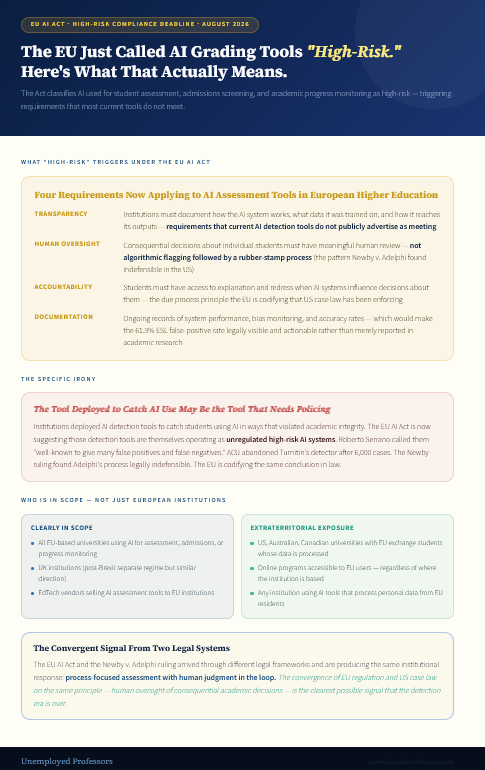
The first: the EU AI Act’s high-risk compliance deadline arrived. The Act classifies AI systems used for student assessment, admissions screening, and academic progress monitoring as high-risk. That classification triggers transparency requirements, human oversight of consequential decisions, and accountability mechanisms for affected individuals. Popular tools currently used in higher education for AI detection do not currently meet these requirements. Experts are warning that European universities face significant legal exposure — and that the Act’s extraterritorial reach means institutions outside the EU that process data from EU students are potentially in scope as well.
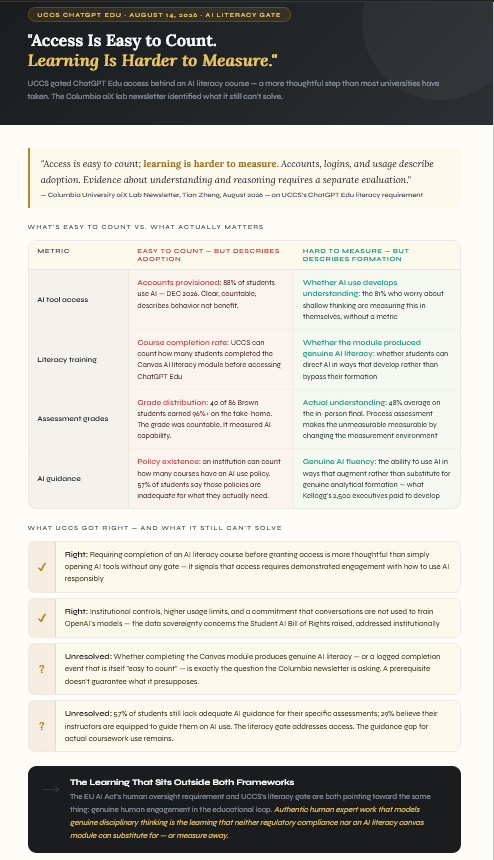
The second: the University of Colorado Colorado Springs opened ChatGPT Edu to all enrolled students on August 14. But only after completion of an AI literacy course in Canvas. Tian Zheng’s Columbia University aiX lab newsletter observed the central tension with one sentence: “Access is easy to count; learning is harder to measure.”
Both developments — the EU’s legal classification of student assessment AI as high-risk and UCCS’s literacy gate on student AI access — are institutional recognitions of the same problem this blog series has documented since April. AI adoption is not the same as AI understanding. Access is not the same as formation.
What the EU AI Act’s “High-Risk” Classification Actually Means
High-risk AI systems under the EU AI Act are those that have significant consequences for individual people — affecting their livelihoods, their legal status, their opportunities. Academic assessment, admissions screening, and academic progress monitoring clearly meet this standard. The AI detection tools that have produced false positives for ESL students — documented at 61.3 percent in the Stanford study — are systems that produce academic misconduct findings against individuals. The Newby v. Adelphi University ruling in February 2026 established this is already legally indefensible in the US without proper due process. The EU AI Act formalises the same principle through regulation.
The compliance problem for European institutions is acute. The Act’s requirements — transparent documentation of how the AI system works, meaningful human oversight of the decisions it influences, accountability mechanisms for affected students — are requirements that AI detection tools do not currently advertise as meeting.
The specific irony is precise: institutions deployed AI detection tools to catch students using AI in ways that violated academic integrity. The EU AI Act is now suggesting that those detection tools are themselves operating as unregulated high-risk AI systems. The tool deployed to police AI use may be the tool that needs policing all the while students believe that AI is leading to shallow thinking.
The Extraterritorial Reach — Why This Is Not Only a European Problem
The EU AI Act’s extraterritorial reach is the detail most likely to be underestimated by institutions outside Europe. The Act applies to AI systems that process data from EU residents or are accessible to EU users — not only to systems operated by EU-based institutions as documented by multiple OSINT specialists.
A US university with EU exchange students, an Australian university with online programs accessible to EU students, a Canadian institution that processes enrollment data from EU residents — all may have exposure. If their AI assessment or detection systems process data from EU students and do not meet the Act’s transparency and human oversight requirements, they may be operating out of compliance with EU law.
The global compliance signal is the same as the domestic regulatory signal from Newby v. Adelphi: AI systems that influence high-stakes academic decisions must operate with meaningful human oversight. The EU is enforcing this through comprehensive regulation. The US is enforcing it through case law. The institutional response — process-focused assessment, human judgment in the loop, retirement of automated detection tools — is the convergent response to both.
The UCCS Literacy Gate — Access Is Not the Same as Learning
By gating ChatGPT Edu access behind an AI literacy requirement, UCCS is institutionally asserting something this blog series has argued throughout: access to AI tools does not constitute AI literacy, and AI adoption does not constitute AI understanding.
The Columbia aiX newsletter’s observation — “access is easy to count; learning is harder to measure” — is the most precise framing of the problem with treating adoption statistics as evidence of educational outcomes. The DEC Global Survey found 88 percent of students using AI. That statistic describes behavior. It describes nothing about whether students understand how to use AI in ways that develop rather than bypass their intellectual formation.
The 57 percent of students who told the DEC they receive inadequate AI assessment guidance are in programs that have not done what UCCS has done. And the 29 percent who believe their instructors are equipped to guide them are in programs where even the faculty side of the guidance problem has not been addressed. UCCS’s literacy gate is a step. Whether completion of an online module produces genuine AI literacy — or merely a logged completion event that is itself easy to count — is the deeper question the Columbia newsletter asks.
What These Two Developments Mean for Students
The institutional AI governance frameworks being built in 2026 are frameworks that increasingly distinguish between two categories of AI use. The first: AI use that is appropriately governed, transparent, subject to human oversight, and developed through genuine engagement with AI literacy. The second: AI use that operates outside institutional governance, without human oversight, without genuine understanding of how it affects the learning process.
The student who uses AI to generate academic submissions they could not produce themselves is not in the first category under either framework. They are using AI in ways that institutional governance — through EU legal exposure for the tools that might detect them, through process-focused assessment that will surface the capability gap — is increasingly designed to make visible and consequential.
Unemployed Professors sits entirely outside the EU AI Act’s high-risk classification because it is entirely outside algorithmic assessment. It is human scholars producing human work for students to engage with. No AI system making high-stakes decisions about anyone. No automated detection. Verified human experts matched to specific disciplines producing authentic scholarly work that models what genuine analytical formation in that discipline looks like.
The Bottom Line
The EU AI Act’s high-risk compliance deadline and the UCCS ChatGPT Edu literacy gate arrived in the same week of August 2026 and pointed in the same direction. AI systems used to assess students require human oversight and transparency. AI access without genuine literacy is access, not education.
Both frameworks are converging on the same principle this blog series has documented from the evidence since April: adoption is not the same as formation, and the credential that AI-generated submissions produce is not the same as the capability that genuine intellectual engagement builds.
For students navigating this convergence, the path that holds up under every regulatory and institutional framework being built in 2026 is the same path it has always been: genuine engagement with your coursework, supported by the kind of expert help that models what authentic disciplinary thinking looks like. That is what Unemployed Professors has provided since 2010 — and what every framework being built in 2026 is recognizing as the right standard.
POST YOUR PROJECT today and work with a verified human scholar whose expertise is exactly what the EU AI Act’s human oversight requirement and UCCS’s literacy gate are both trying to ensure exists on the educational side of every AI interaction.