
Two Major UK Universities Just Gave Every Student Copilot.
Here’s What Happens When AI Stops Being a Tool and Starts Being the Air.
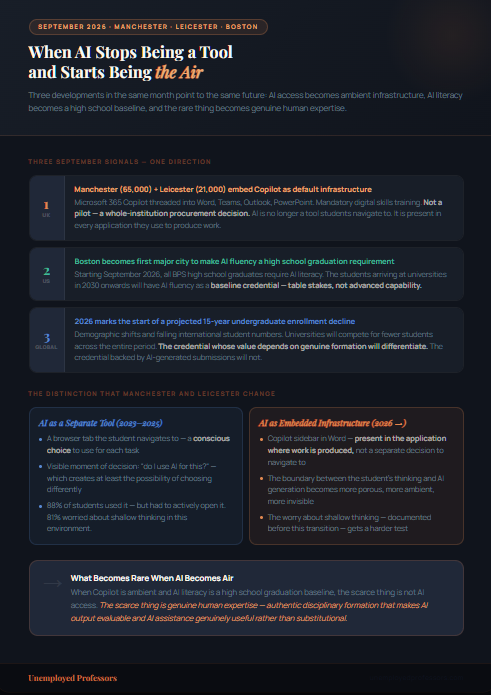
The University of Manchester announced in January 2026 that it was giving all 65,000 students and staff access to Microsoft 365 Copilot. The University of Leicester followed in September 2026 with a full deployment across its 21,000 students and 4,000 staff. Both rollouts pair Copilot access with mandatory digital skills training. Both are described as institution-wide commitments rather than departmental pilots.
These are not small decisions. Manchester and Leicester together represent nearly 90,000 people in UK higher education — students, academics, administrators — all operating with Copilot embedded into every Microsoft 365 application they use. Word. Teams. Outlook. PowerPoint. The AI is not a separate tab they could open or close. It is threaded into the workflow.
The same week, Boston Public Schools announced it would make AI fluency a high school graduation requirement, starting September 2026. And industry analysis describes 2026 as the start of a projected 15-year undergraduate enrollment decline, driven by demographic shifts and falling international student numbers.
Read those three signals together: AI becomes ambient infrastructure in universities, AI literacy becomes a high school graduation baseline, and the pool of students paying for undergraduate credentials is projected to shrink for a generation. These three forces are converging toward a single question this blog series has been circling since April: in that world, what is a university education actually for?
When AI Becomes the Air
The distinction between having access to AI and having AI embedded in your workflow is not semantic. When ChatGPT or Claude is a separate tool that a student opens in a browser, there is a moment of decision: do I use this for this task? When Copilot is embedded in Microsoft Word — available in the sidebar, suggesting completions, offering to draft sections, integrated into the editing workflow — the moment of decision is different. The AI is not something a student navigates to. It is present in the same application where the work is being produced.
The DEC Global Survey found that 66 percent of students globally — 81 percent in the US and Canada — worry that AI is making their thinking shallower. Those students were surveyed in an environment where AI was available as a separate tool that 88 percent of them were actively using. What does that worry become in an environment where the AI is threaded into Word, into Teams, into every document they produce?
Marc Watkins of the University of Mississippi’s AI Institute for Teachers described the challenge of scaling process assessment as costs he “can’t even fathom.” The Manchester and Leicester deployments are creating a scaled AI-embedded learning environment. The process assessment that would make genuine understanding visible in that environment is still years away at most institutions.
The Boston Signal — What the Incoming Class Already Knows
The students who graduate from BPS with AI fluency as a graduation requirement are the students who will arrive at Manchester, Leicester, and every other university in 2030 and beyond. They will arrive with AI literacy as a baseline credential. Not an advanced capability. A minimum.
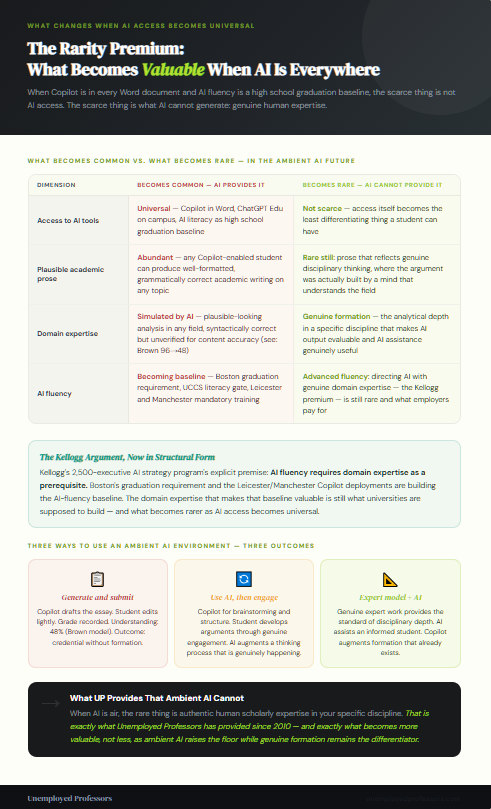
This is the Kellogg argument from earlier in this series, now in structural form. Kellogg’s 2,500-executive AI strategy program teaches people who already have deep domain expertise how to augment it with AI. Boston’s high school graduation requirement and the Leicester/Manchester Copilot deployments are building the AI-fluency baseline. The domain expertise that makes that baseline valuable is still what universities are supposed to build.
The Enrollment Decline Context
Universities competing for fewer students will compete partly on the basis of what their education actually produces. The credential that AI-generated submissions produce — documented across this blog series in the Berkeley grade inflation data, the Brown University score collapse, the Lumina-Gallup workforce readiness gap — is a credential that employers are increasingly able to test.
The 80 percent of employers who told the DEC that higher education is not keeping up with industry change are making a purchasing decision about whether to trust the credential in hiring. In a shrinking enrollment market, the universities whose credentials are trusted are the ones that survive the decline. The Leicester and Manchester Copilot deployments signal that these institutions are forward-thinking about AI. What they do not address is the question of what genuine intellectual formation looks like when AI is embedded in every document students produce from their first week.
What Genuine Formation Looks Like in an Ambient AI Environment
When AI is ambient infrastructure, the gap between a student who uses it thoughtfully and a student who uses it as a wholesale substitute for genuine engagement becomes harder to see in the product — and more visible in the process assessment that asks students to demonstrate understanding in real time.
Oral defenses, portfolio reviews, proctored examinations, draft histories — the process-focused assessment movement documented in this series — become more important, not less, as ambient AI makes product-only assessment less reliable. When AI is threaded into Word, the take-home essay now has a Copilot sidebar suggesting paragraphs. The in-person examination that Serrano’s students averaged 48 percent on when AI was unavailable remains the reliable signal of genuine understanding.
Genuine human expert help from verified scholars provides exactly what ambient AI cannot: an example of what genuine analytical engagement in a specific discipline looks like, at the depth a real scholar produces, for a student to study and develop from. That is not a supplement to Copilot-assisted writing. It is the foundation that determines whether Copilot assistance augments genuine thinking or substitutes for its absence.
The Rarity Premium
As AI becomes ambient infrastructure — as Copilot is threaded into Word and Teams, as Boston’s graduation requirement makes basic AI fluency a high school baseline — the rare thing is not AI access. The rare thing is genuine human expertise.
The thing that becomes scarce as AI becomes ambient is what AI cannot provide: authentic disciplinary formation, genuine analytical depth in a specific field, the kind of expert judgment that makes AI output evaluable and AI assistance genuinely useful. Kellogg’s executives paid for that. Employers are paying for that. The 80 percent of employers who say higher education is not keeping up are expressing frustration that credentials do not reliably certify it.
When AI is air, expertise is the differentiator. The students who develop genuine understanding are building the thing that ambient AI cannot replicate and that a shrinking, credential-testing job market is actively demanding. Unemployed Professors has provided genuine human scholarly expertise since 2010 — before any of this was a policy debate. What our scholars provide is exactly what the ambient AI future makes rarer.
The Bottom Line
The University of Manchester and the University of Leicester have embedded Microsoft Copilot as default infrastructure for nearly 90,000 students and staff. Boston Public Schools is making AI fluency a high school graduation requirement this month. Analysts project 2026 as the start of a 15-year undergraduate enrollment decline. Three signals pointing toward the same future: AI access becomes universal, AI literacy becomes a baseline credential, and the rare thing is genuine human expertise.
In that future, the credential-capability gap documented throughout this series becomes more consequential rather than less. For students navigating Manchester’s Copilot integration or Leicester’s embedded AI workflow: the air has changed. What you build in it determines whether Copilot makes you genuinely more capable or just makes your submissions look more polished. Genuine expert help provides the foundation that makes the difference between those two outcomes.