
Universities Just Officially Retired AI Detectors. What Replaces Them Is Much Harder to Game.
Inside Higher Ed published a report on August 5, 2026 with a headline that closes one chapter of the AI integrity debate and opens another: “AI Detectors Are Out, New Assessments Are In.”
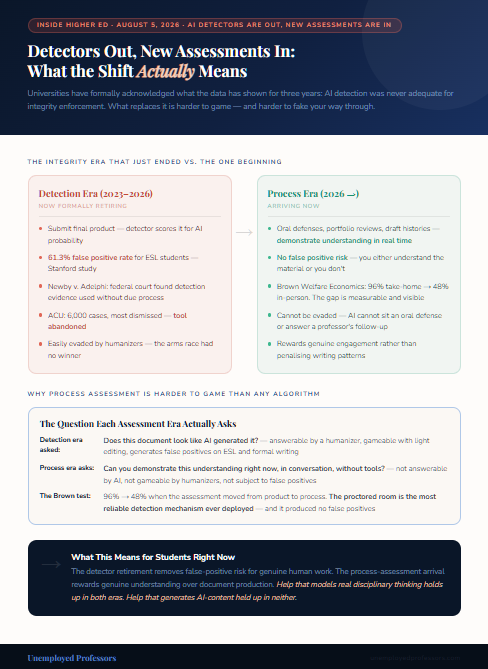
Institutions are formally retiring the detection-first approach. The tools that produced the Newby v. Adelphi University federal ruling — the 61.3 percent false positive rate for non-native English speakers documented in the Stanford study — the 6,000 misconduct cases at Australian Catholic University, most dismissed after investigation, that led the university to abandon Turnitin’s AI detector entirely — those tools are being put aside. The institutional acknowledgment, arriving through Inside Higher Ed in August 2026, is that detection was never adequate as an integrity mechanism, and something better has to replace it.
The retirement of AI detectors is the right institutional decision. It is also a decision that changes what students face in ways that are not immediately obvious — and that makes the choices students are making about academic support more consequential, not less.
What the Retirement of AI Detectors Actually Means
The case against AI detection tools has been building since 2023. The Stanford ESL bias study documenting 61.3 percent false positives for non-native English speakers was the most damning early evidence. The Newby v. Adelphi ruling in February 2026 established that applying detection evidence without due process is legally indefensible. ACU’s 6,000-case record and subsequent Turnitin abandonment showed the institutional cost of detection-first reliance at scale.
The tools were never accurate enough for high-stakes integrity enforcement. They couldn’t distinguish legitimate writing support from AI generation. They systematically penalised students whose writing patterns — ESL learners, students with disabilities, students who write with formal consistency — happened to resemble AI output. And they created the specific false-positive risk that made genuine human expert help paradoxically more urgent rather than less.
The retirement of these tools removes that false-positive risk. A student who received genuine expert help from a verified scholar — work that is authentically human, reflecting real disciplinary formation — no longer faces the risk that a detection algorithm will incorrectly flag it as AI-generated. That is an unambiguous improvement.
Process-Focused Assessment Is Harder to Game Than Any Algorithm
The Inside Higher Ed report points toward what assessment redesign looks like in practice: oral components where students explain their reasoning and defend their choices, portfolio assessments showing development over time, in-person examinations that can’t be completed without the knowledge they test, draft submission requirements that make the development process visible and evaluable.
The Brown University data from this spring is the clearest evidence of how this works. Roberto Serrano’s Welfare Economics class averaged 96 percent on a take-home midterm. When the final went in-person, a third of the class dropped. The students who stayed averaged 48 percent. The same students. The same material. The same semester. The only variable: the assessment environment required genuine understanding.
No AI detection algorithm produced that result. A proctored room did. Detection asks: does this look like AI generated it? Process-focused assessment asks: does this student understand the material well enough to demonstrate it right now, in conversation, without preparation time? The second question is harder to game. AI can generate plausible-sounding analysis on any topic. It cannot sit an oral examination on your behalf.
The 73 Percent Fairness Problem
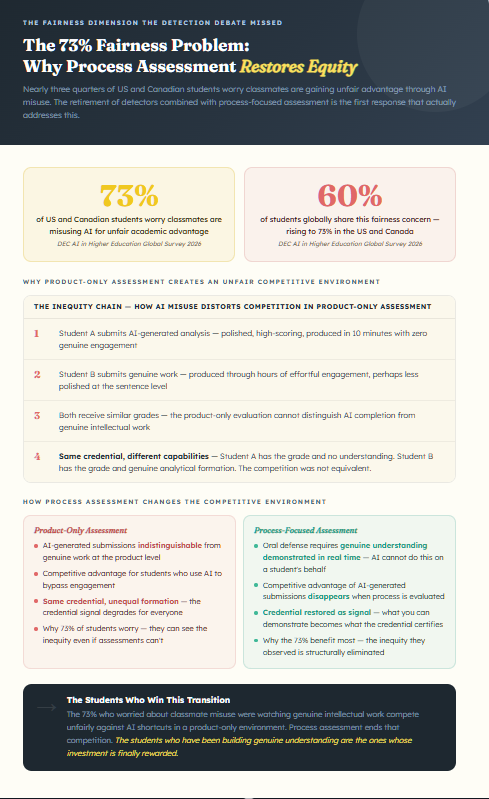
The Digital Education Council’s 2026 global survey found that 60 percent of students globally — rising to 73 percent in the United States and Canada — worry that their classmates are misusing AI for unfair academic advantage. This is a specific equity anxiety: if my classmates are submitting AI-generated work and receiving the same or better grades, the credential we both earn does not mean the same thing, and the competition I am navigating is unfair.
For students who have been doing genuine intellectual work, this transition is unambiguously positive. For students who have been relying on AI-generated submissions, the transition is a direct challenge — one that the Brown University data suggests many will meet by dropping the course rather than sitting the examination.
What Students Should Do Before Process-Focused Assessment Arrives
The shift Inside Higher Ed is reporting is underway but not complete. Different institutions, departments, and courses are at different points in the transition. Students currently enrolled are navigating a mixed environment.
The students who will navigate this transition successfully are the ones who are building genuine understanding now — while the transition is still underway — rather than waiting until process-focused assessment is fully in place and realising they have spent years building credentials without the underlying formation those credentials are supposed to represent.
Genuine human expert help from verified scholars is the academic support model designed for this environment. It does not trigger detection tools — it is genuinely human work, produced by real scholars with real credentials. And it develops the kind of understanding that process-focused assessment is specifically designed to surface: real analytical engagement with the material, modeled by someone who has genuinely developed expertise in the relevant discipline, that students can engage with, study, and use to develop their own.
The oral defense that asks you to explain your argument is testing the understanding that genuine scholarly engagement develops. The in-person examination is exactly what Roberto Serrano’s proctored final revealed about the difference between a 96 percent AI average and a 48 percent genuine-understanding average.
The Bottom Line
Inside Higher Ed confirmed on August 5, 2026 what the data has been pointing toward all year: AI detectors are being retired and process-focused assessment is replacing them. The detection-first approach failed — through false positives, through legal exposure, through institutional damage — and the correct institutional response is assessment that requires genuine demonstration of understanding rather than algorithmic scrutiny of submitted documents – beyond the fact that there are many reasons why AI writing is terrible.
The 73 percent of US and Canadian students who worry about classmate misuse of AI are the students who most directly benefit from this transition. When assessment design requires genuine understanding to be demonstrated in real time, the competitive advantage of AI-generated submissions disappears.
For students navigating this transition, the choice of what kind of academic help to seek matters more than it ever has. Help that produces AI-generated work didn’t survive detection tools reliably, and it won’t survive process-focused assessment at all. Help that models genuine disciplinary thinking — authentically human work from verified scholars — holds up under any scrutiny, because it is genuinely human and reflects genuine understanding.