
The Digital Education Council released its AI in Higher Education Global Survey 2026 last week — 45,398 responses from 27,284 students and 18,114 faculty across 35 countries, one of the largest datasets on AI in higher education assembled to date. The findings document a confidence gap that is starker than anything in the series of studies this blog has covered since April.
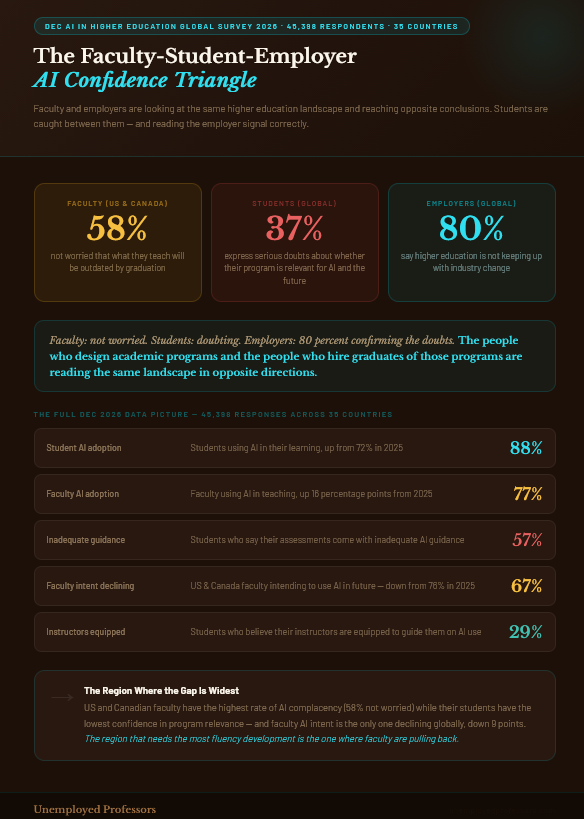
Eighty-eight percent of students globally now use AI in their learning. Seventy-seven percent of faculty use AI in their teaching, up 16 percentage points from 2025. AI use is near-universal on both sides of the classroom.
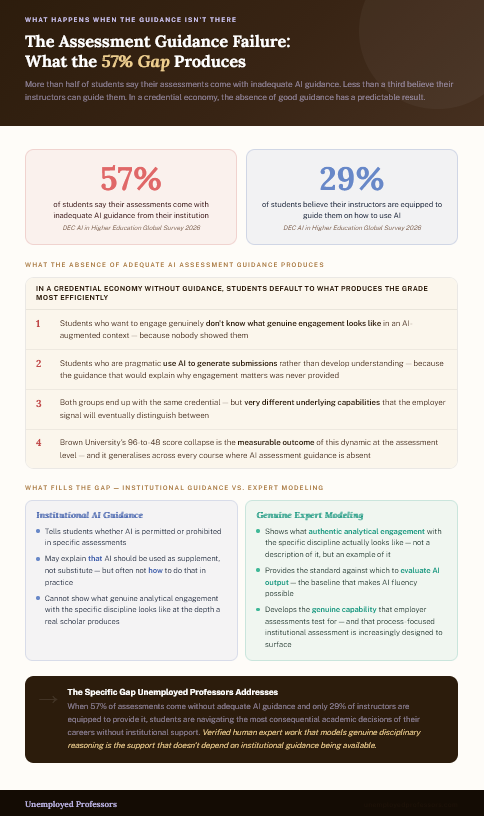
What has not kept pace is confidence and preparation. Fifty-seven percent of students say their assessments come with inadequate AI guidance. Only 29 percent believe their instructors are equipped to guide them on AI use. And 37 percent of students express serious doubts about whether their program is relevant for AI and the future of work.
Faculty see it differently. Forty-three percent globally are not worried that what they teach will be outdated by graduation. In the United States and Canada — the region where student confidence is lowest — that figure rises to 58 percent. More than half of US and Canadian faculty are not worried that their curriculum is falling behind.
The DEC survey also cites employer data from its 2025 AI in the Workplace Report: 80 percent of employers say higher education is not keeping up with industry change.
That is the triangle the DEC survey documents. And it is not a minor calibration error in higher education’s response to AI. It is a fundamental misalignment between the people who design and deliver academic programs and the people who hire the graduates of those programs.
What the Faculty Confidence Gap Actually Means
Forty-three percent of faculty globally — 58 percent in the US and Canada — are not worried that what they teach will be outdated by graduation. This is not a finding about whether faculty are using AI or whether they think AI is important. The survey separately documents that 77 percent of faculty are using AI in their teaching. The faculty who are not worried are not faculty who are ignoring AI. They are faculty who believe their curriculum and their expertise remain adequately current.
Whether that belief is accurate is precisely what 80 percent of employers are disputing. When 80 percent of employers say higher education is not keeping up with industry change, they are making a concrete claim about the graduates they are hiring: the credential does not reliably certify the capabilities the current job market requires.
Sixty-seven percent of US and Canadian faculty say they intend to use AI in the future — down from 76 percent in 2025, a 9-percentage-point decline. This is the only region globally where faculty AI intent is declining rather than growing. The region with the lowest student confidence in their program’s AI relevance is also the region where faculty are pulling back from AI engagement. These two trends are connected.
The US and Canadian faculty who are not worried about curriculum relevance and who are pulling back from AI integration are, in the assessment of 80 percent of their graduates’ future employers, wrong. They are wrong in a way that their students can feel — 37 percent are expressing serious doubts — but may not be able to name precisely because they do not yet have the employer perspective that makes the gap legible.
The Students Who Are Right to Be Nervous
The DEC survey finding about student doubt — 37 percent expressing serious concerns about program relevance for AI and the future — connects to a thread running through everything this blog series has documented since April.
The Brown University case gave us a controlled experiment: a 96-to-48 score collapse when assessment moved from take-home to in-person, revealing the credential-capability gap in one semester with 86 students. The Kellogg executive education boom showed us the employer side: 2,500 business leaders per year paying for the ability to direct AI with genuine domain expertise. The Lumina-Gallup data showed us that only 51 percent of graduates feel sufficiently AI-skilled for employment despite near-universal AI use in their coursework.
The DEC data adds the structural explanation for that gap: students are using AI at 88 percent rates, their assessments come with inadequate guidance 57 percent of the time, only 29 percent believe their instructors can guide them on AI use, and the faculty who design their assessments are in the majority not worried about falling behind.
The students who doubt their program’s AI relevance are reading the employer signal correctly. They know that the roles they are entering require AI capability that is not being developed in their programs. And they are right.
The Specific Problem: 57 Percent Inadequate AI Guidance on Assessments
The DEC finding that lands hardest for students is the assessment guidance gap: 57 percent of students say their assessments come with inadequate AI guidance. This is not about whether AI use is permitted or prohibited. It is about whether students know how to engage with AI in ways that develop rather than bypass the capabilities their assessments are designed to build.
The absence of adequate assessment guidance is the specific institutional failure that produces the Brown University outcome. When students are not given clear frameworks for how to engage with AI in ways that serve their learning, they default to whatever strategy produces the grade with the least effort. In the absence of guidance that explains why the engagement matters, the rational choice in a credential economy is the one that produces the credential most efficiently.
This is the gap that genuine expert help addresses in a way that institutional AI guidance frameworks cannot fully address. A faculty member can tell students to use AI for brainstorming and not for final submissions. A genuine human expert in the relevant discipline can model what authentic analytical engagement with the material looks like — showing a student what a real scholar actually does when working through a problem, at the level of depth and specificity that makes the difference between learning something and producing a document.
What Students Should Do With This Information
The DEC survey documents a gap between faculty confidence and employer assessment that is not going to close before the class of 2026 graduates, or 2027, or likely 2028. The curriculum realignment that would bring faculty perception and employer reality into alignment takes years, involves institutional processes that move slowly, and requires faculty development that is happening unevenly at best.
Students who are currently in programs where 57 percent of their assessments come with inadequate AI guidance and only 29 percent of their instructors are equipped to guide them on AI use are navigating that gap right now. The choice those students face is whether to treat the guidance gap as a reason to default to AI-generated submissions — filling the absence of good guidance with the path of least resistance — or as a reason to seek genuine expert support that models what authentic engagement with their material actually looks like.
Unemployed Professors has been providing the second kind of support since 2010. Our verified human scholars — subject-matched experts with genuine credentials in your specific discipline — model what real analytical engagement in your field looks like. Not because they are a substitute for the faculty guidance your program is failing to provide, but because they are a source of genuine disciplinary expertise that shows you what the employer signal is pointing toward: the ability to engage with your field at the level of depth and specificity that AI cannot generate for you.
The Bottom Line
The Digital Education Council’s 45,398-response global survey found that 88 percent of students use AI, 37 percent doubt their program’s AI relevance, 57 percent have inadequate AI assessment guidance, and only 29 percent believe their instructors can guide them on AI use. In the US and Canada, 58 percent of faculty are not worried about curriculum relevance — while 80 percent of employers say higher education is not keeping up.
Faculty and employers are looking at the same higher education landscape and reaching opposite conclusions. The students — 37 percent of whom are expressing serious doubts — are reading the employer signal. In a job market that is restructuring around AI-augmented domain expertise, those doubts are well-founded.
The gap is not going to close from within existing institutional structures before current students graduate. Filling it requires genuine engagement with the material that their programs are inconsistently supporting. That engagement, supported by genuine expert help that models what authentic disciplinary competency looks like, is the path between faculty complacency and employer demands.