
Professors Don’t Trust Your Writing Anymore. Here’s What That Actually Means.
Many of them couldn’t.
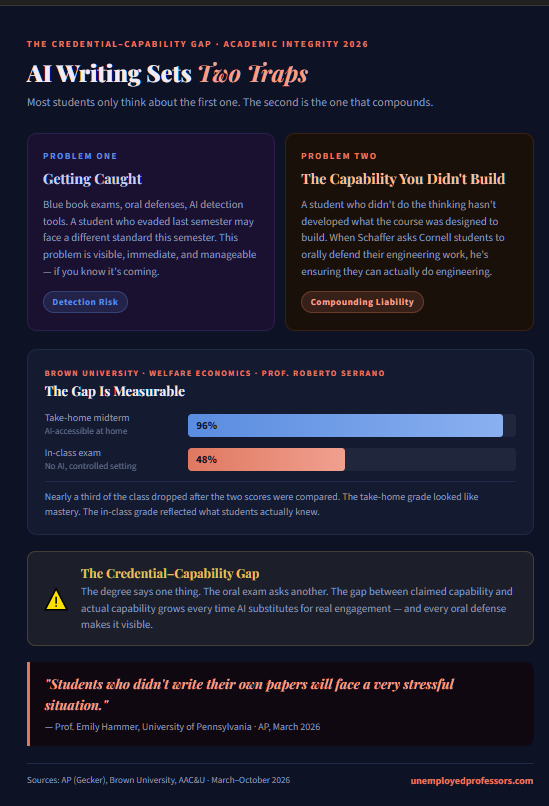
“I don’t trust written assignments anymore to be the result of actual thinking,” Ipeirotis told the Associated Press in March 2026.
That sentence — from a business school professor at one of the most prestigious universities in the country — is the current state of American higher education. Written assignments have flooded in that look polished and read coherently. But when professors ask students to explain a paragraph, define a term they used, or walk through the logic of an argument they supposedly constructed, there is often a long pause. Educators have given this pause a name: the Gen Z stare.
The response from universities has been decisive and, for some students, alarming. Colleges are bringing back Socratic oral exams. Professors are throwing out written grades entirely. Cornell biomedical engineering professor Chris Schaffer no longer grades his students’ written problem sets at all — only the 20-minute oral defenses he holds afterward. His summary of the situation: “You won’t be able to AI your way through an oral exam.“
He’s right. And that is worth thinking through carefully, because what the oral exam movement is revealing is not simply that AI use is widespread. It’s revealing something about what written academic work was supposed to be doing in the first place — and what it no longer does when AI is the author.
The Oral Exam Is a Verification Test
Understanding why universities are moving toward oral exams requires understanding what problem they’re actually trying to solve.
The problem is not that students are submitting text generated by AI. The problem is that professors can no longer determine, from the text itself, whether the student engaged with the material. The written assignment was always a proxy for that engagement. A student who wrote a sophisticated analysis of Keynesian economic theory was presumed to have engaged with Keynesian economics. The paper was evidence of learning. The grade reflected that evidence.
When AI can generate a sophisticated analysis of Keynesian economic theory in under ten seconds, the paper stops working as evidence of anything. The credential the grade was supposed to help build becomes untethered from demonstrated capability.
The oral exam is a verification test. It asks: given the document this student submitted, is there a student behind it who actually engaged with the material? Cornell’s Schaffer answers that question by removing the written grade entirely. University of Pennsylvania associate professor Emily Hammer pairs oral exams with written papers. Penn’s Center for Teaching and Learning executive director Bruce Lenthall describes “a massive shift toward in-person assessments” across the institution. At NYU, Ipeirotis built an AI-powered oral exam using voice technology from ElevenLabs — at a cost of $0.42 per student.
In pilot testing with 36 NYU students, many of those who submitted thoughtful-looking written work “couldn’t explain basic decisions in their own submissions after two follow-up questions.” The Gen Z stare, at scale, in an automated system.
Hammer’s framing of the problem goes beyond cheating: “It comes across as if we’re trying to prevent cheating. That’s not why we’re doing this. We’re doing this because students are actually losing skills, losing cognitive capacity and creativity.” What she is describing is the credential-capability gap — the distance between what a student’s official record says they know and what they actually know.
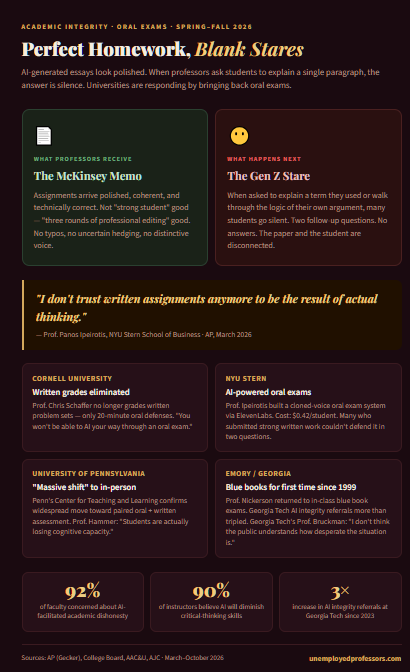
The gap is measurable. Brown University economics professor Roberto Serrano’s welfare economics class averaged 96 percent on take-home midterms and 48 percent on in-class exams. Nearly a third of the class dropped after the scores were compared. At Georgia Tech, AI-related academic integrity referrals have more than tripled since 2023. At UGA, 51 percent of academic dishonesty cases now involve AI use. Emory professor Catherine Nickerson gave blue book exams for the first time since 1999.
What the Crisis Actually Reveals
The oral exam movement is not, at its core, about detecting cheating. It is about restoring the connection between academic credentials and actual capability. That connection was always the point of higher education. The degree was supposed to mean something because the student had demonstrably developed capabilities they did not have before. Faculty verified that claim through written assignments, exams, and projects. The grade reflected the evidence. The credential summarized the grades.
AI has broken one link in that chain: the relationship between a submitted text and the demonstrated engagement of the student who submitted it. Every other link remains intact. The only thing that has changed is that the written assignment has become an unreliable test of whether learning actually happened.
The oral exam restores the broken link. It creates a condition in which the student must demonstrate, in real time, that the thinking behind the submitted work was genuinely theirs.
This is the context in which 90 percent of college instructors now believe AI will diminish students’ critical-thinking skills, 74 percent believe AI will diminish the value of academic degrees, and 92 percent are concerned about AI-facilitated dishonesty. These are not abstract anxieties about technology. They are precise concerns about what higher education is for and whether it is currently delivering it.
The Trap That AI Writing Sets
For students, the practical stakes of the oral exam movement are significant. A student who used AI to generate a term paper has two problems, not one.
The first problem — the one most students think about — is getting caught. Detection tools, blue book exams, and oral defenses are all aimed at this problem. A student who successfully evaded detection last semester may face a different standard this semester.
The second problem is more durable. A student who did not do the thinking behind their written work has not developed the capability the course was designed to build. When Schaffer asks Cornell students to orally defend their engineering problem sets, he is not primarily trying to catch cheaters. He is trying to ensure that students can actually do engineering. A student who passed by submitting AI-generated work and cannot defend it in a 20-minute conversation has bought themselves a grade at the cost of the learning the grade was supposed to represent.
This is the trap that AI writing sets. It offers an apparent shortcut that is actually a compounding liability. The student who cannot explain their submitted analysis of Keynesian economics in an NYU Stern business class will not be better prepared to explain it in a job interview, a client presentation, or a graduate seminar.
Hammer named the destination of this path precisely: “students who didn’t write their own papers will face a very stressful situation” in oral defenses. That stress is not a procedural problem. It is the consequence of a trade: genuine learning exchanged for a document.
What “Help” Actually Means
The oral exam crisis clarifies something that tends to get lost in debates about AI and academic integrity: the question of what it means to get help with academic work.
Students have always gotten help. Tutors, writing centers, study groups, research librarians, and subject-matter mentors have been part of academic life for as long as universities have existed. These forms of assistance have always been understood as legitimate — because they develop the student’s own capability rather than substituting for it. A student who works with a writing tutor learns something about how to construct an argument. A student who discusses their research question with a professor learns from that exchange.
The AI assistance that the oral exam movement is responding to is categorically different. When a language model generates your analysis of macroeconomic policy, you have received not help but substitution. The text may be competent. The argument may be passable. But no capability development has occurred. The student who submits it has the same understanding of macroeconomics after submission as before — which, in the oral defense, will be immediately apparent.
This is why Unemployed Professors occupies a different category than AI assistance. The scholars who produce work through Unemployed Professors are genuine subject-matter experts — real academics with disciplinary expertise, trained to think in the frameworks their fields require. When a student engages seriously with a piece of work produced by a real philosopher, economist, or historian, they are encountering how an expert in that field actually thinks. That is a model of disciplinary reasoning they can study, learn from, and build toward. The gap between that and having ChatGPT produce plausible-sounding text is the gap between a master class and a copy machine.
Oral defenses are not a threat to students who have engaged with genuine human expertise. They are a threat to students who have outsourced their thinking to a machine that doesn’t know what thinking means.
The Bottom Line
Professors at Cornell, Penn, NYU, and universities across the country are bringing back oral exams because AI-generated written work has made it impossible to determine, from a submitted text, whether a student engaged with the material. The Gen Z stare — the blank expression that follows a question about the paper a student just submitted — is the visible consequence of an invisible substitution.
The oral exam movement is not an overreaction. It is a logical response to a precise problem: the written assignment no longer reliably measures what it was designed to measure. When Emily Hammer says students are “losing cognitive capacity and creativity,” she is not describing a detection problem. She is describing what happens when students use AI as a substitute for their own thinking rather than as a support for it.
For students navigating this environment, the question is not whether to get help but what kind of help actually helps. Help that develops your understanding of the material prepares you for the oral defense. Help that substitutes for your understanding of the material does not.