
81% of Students in the US and Canada Worry That AI Is Making Learning Too Shallow. They’re Right — and Here’s Why That Matters.
The Digital Education Council’s AI in Higher Education Global Survey 2026 — 45,398 responses across 35 countries, published in July — contains a finding that the coverage of that report mostly glossed over in favour of the faculty-versus-employer confidence gap.
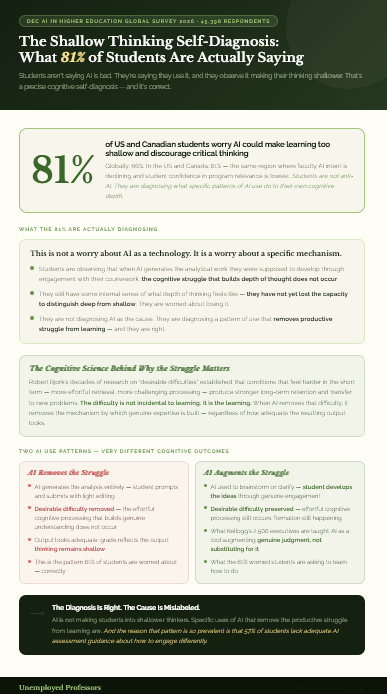
Sixty-six percent of students globally worry that AI could make learning too shallow and discourage critical thinking. In the United States and Canada, that figure rises to 81 percent. Four in five students in the US and Canada are worried that AI is making them into shallower thinkers.
This is not a finding about whether students think AI is useful. The same survey found that 88 percent are using AI in their learning, and 61 percent say it frees them to focus more on thinking through ideas. Students are not anti-AI. They are making a specific cognitive observation about what certain patterns of AI use are doing to the depth of their intellectual engagement — and four in five of them are worried about what they observe.
This is the most honest self-assessment in any dataset this series has covered since April. The credential-capability gap has been documented from the outside — by Berkeley researchers, by employer surveys, by Brown University’s score collapse. This is students documenting it from the inside. They are not saying AI is bad. They are saying: I am using AI, and I am worried it is making my thinking shallower. And they are right.
What Shallow Learning Actually Means
The students who worry about shallow thinking are identifying something precise. When AI generates the analytical work they were supposed to develop through genuine intellectual engagement, the cognitive struggle that builds depth of thought does not occur.
Cognitive science research on learning and expertise has documented for decades that the productive struggle of working through difficult problems — encountering resistance, revising your approach, failing and trying again, arriving at understanding through effortful processing — is the mechanism by which genuine expertise is built. The difficulty is not incidental to learning. It is the learning. Robert Bjork’s work on “desirable difficulties” established that conditions that feel harder in the short term produce stronger long-term retention and transfer to new problems.
When AI generates the analysis that students were supposed to develop through genuine engagement, the desirable difficulty is removed. The output looks like learning. The grade reflects the output. But the cognitive process that would have built genuine understanding did not occur. What the student has is a document. What the student does not have is the understanding the document represents.
The 81 percent of US and Canadian students who worry AI is making learning too shallow are identifying exactly this mechanism. They are not confused about what AI is doing. They are diagnosing, with surprising precision, the specific way that AI use bypasses the formation process.
The Causation Gets Backwards
The standard framing of AI and shallow learning puts AI as the cause and shallow thinking as the effect. This gets the causation partially wrong.
AI does not make thinking shallower. Specific uses of AI bypass the cognitive process that develops depth of thought. A student who uses AI to brainstorm ideas and then works through those ideas themselves — developing them, testing them against evidence, revising them through genuine engagement — is not being made into a shallower thinker by AI. They are using AI the way Kellogg’s executive education program teaches 2,500 business leaders per year to use it: as a tool that augments genuine thinking rather than substituting for it. The cognitive struggle is still happening. The difficulty is still desirable. The formation is still occurring.
A student who uses AI to generate the analysis they were supposed to develop is using AI in a way that removes the desirable difficulty. Not because AI produced shallow analysis, but because the student’s cognitive engagement with the problem was minimal. The struggle that would have built genuine understanding was bypassed.
The 81 percent who worry are not wrong that something is happening to the depth of their thinking. They are mislabeling the cause. The cause is not AI. The cause is the specific pattern of AI use that removes the productive struggle from the learning process. And the reason that pattern is so prevalent is exactly what the DEC survey documents elsewhere: 57 percent of students lack adequate AI assessment guidance, and only 29 percent believe their instructors can guide them on how to use AI in ways that genuinely support learning.
What Depth of Thinking Actually Requires
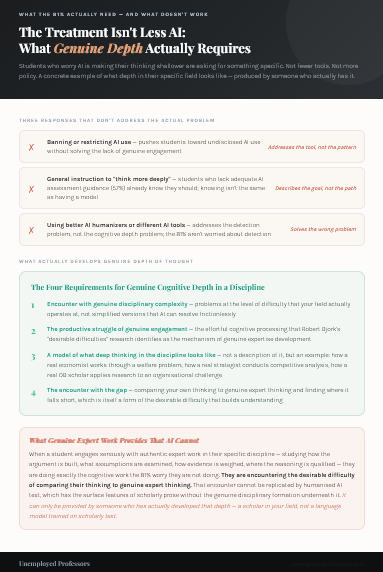
The students who want to think more deeply — the 81 percent who are worried about the shallowness they observe — are asking for something specific. They want to develop the cognitive capacity to work through hard problems in their disciplines: to encounter a complex analytical challenge, engage with it seriously, bring genuine disciplinary knowledge and reasoning to bear on it, and arrive at understanding through effortful processing.
Depth in each discipline has a specific shape — specific frameworks, specific evidentiary standards, specific ways of constructing and testing arguments — that students can only develop through genuine engagement with the discipline itself. This is also what genuine expert work models, in a way that no institutional AI guidance framework can provide. A faculty member can tell students to engage deeply with their coursework. A genuine human expert in the relevant discipline can produce work that shows what deep engagement in that discipline actually looks like.
That model — authentic expert work in the specific discipline, at genuine scholarly depth — is what the 81 percent of worried students actually need. Not a prohibition on AI. Not a general instruction to think more deeply. A concrete example of what depth in their specific field looks like, produced by someone who has actually developed it.
Where Genuine Expert Help Fits
The students who worry that AI is making their thinking shallower are not looking for AI-generated work that has been humanised. They are looking for something that shows them what genuine cognitive engagement in their discipline looks like — a model of depth that they can compare against their AI-assisted work, study, and use to develop their own capacity for it.
When a student working on a welfare economics assignment receives genuine expert work from a scholar who has spent years in that field, they receive more than a document. They receive a model of how a real economist thinks through a welfare problem — what assumptions are examined, what frameworks are applied, how evidence is weighed, where the argument is strong and where it needs qualification. A student who engages seriously with that work — who studies it, compares it to their own thinking, tries to understand how the argument was constructed and why — is doing exactly the cognitive work that the 81 percent worry they are not doing. They are encountering the desirable difficulty of comparing their own thinking to genuine expert thinking, and finding where they fall short.
That encounter — with authentic scholarly depth in your specific discipline — is more instructive than any AI tool. It cannot be replicated by humanised AI text, which has the surface features of scholarly prose without the genuine disciplinary formation underneath. It is produced by scholars who have actually developed the depth students are worried they are failing to develop.
The Self-Diagnosis the DEC Survey Contains
The 81 percent finding is extraordinary in one specific way: students are not diagnosing a problem with AI as a technology. They are diagnosing a problem with how they are using it. They are saying: I am using this tool, and I observe that my thinking is becoming shallower as a result. That is not an abstract worry about AI and education. It is a specific self-observation about the relationship between their AI use patterns and the depth of their cognitive engagement.
Students who can make this observation accurately are students who have some internal sense of what depth of thinking feels like — what genuine intellectual engagement involves, how it differs from the frictionless experience of prompting and submitting. They have not yet lost the capacity to distinguish between deep and shallow thinking. They are worried about losing it.
That worry is the most valuable diagnostic in the DEC survey. It means the students who are worried are not yet at the endpoint of the credential-capability gap. They are somewhere in the middle, aware of the gap, looking for a path that doesn’t widen it further. For those students — the ones who are using AI, observing shallowness, and wanting to engage differently — the choice of what kind of help to seek is the most consequential academic decision they are currently making.
The Bottom Line
Eighty-one percent of US and Canadian students worry that AI is making learning too shallow and discouraging critical thinking. They are right that something is happening to the depth of their intellectual engagement. The cause is not AI. The cause is specific patterns of AI use that remove the productive cognitive struggle from learning. The distinction matters because it points toward a different response.
The treatment for shallow learning is not less AI. It is genuine engagement with the productive difficulty of your discipline, supported by the kind of help that models what deep thinking in that field actually looks like. Authentic human scholarly expertise — the kind Unemployed Professors has provided since 2010 — is that model. Not because it evades detection algorithms or fills a guidance gap. Because it shows students, concretely, what genuine depth in their field looks like. And that model is what the 81 percent who are worried are actually asking for.