
Sevenfold is not a number that describes a marginal shift in student behavior. It describes a system that has stopped functioning as designed.
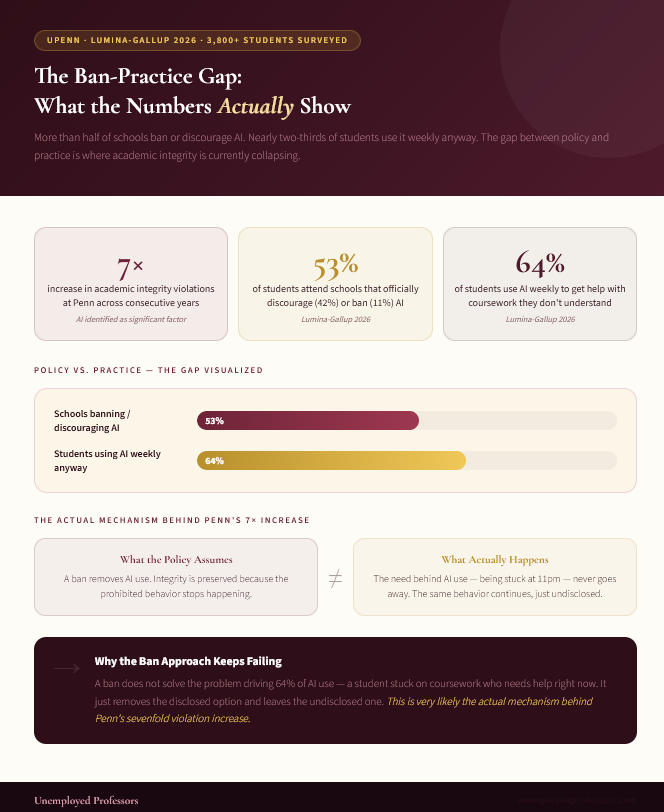
At the same time, the 2026 Lumina Foundation-Gallup State of Higher Education study — surveying more than 3,800 college students — found that more than half of students report their institution either discourages AI use (42 percent) or prohibits it outright (11 percent). Combined, that is 53 percent of students attending schools that have taken an official anti-AI stance.
And yet: 64 percent of students use AI daily or weekly to get help with coursework they don’t understand. Sixty percent use it regularly to check homework answers. More than half use it to edit writing or summarize lectures.
Read those two numbers together. Fifty-three percent of schools are discouraging or banning AI. Sixty-four percent of students are using it weekly anyway. The ban is not working. The violations are climbing sevenfold at institutions like Penn. And the gap between official policy and actual student behavior is the space where academic integrity is currently collapsing.
Why the Ban Approach Keeps Failing
The logic behind AI bans and discouragement policies is straightforward: if AI threatens academic integrity, prohibit it, and integrity is preserved. The Penn data and the Lumina-Gallup data together show why that logic does not survive contact with how students actually behave.
A ban changes official policy. It does not change the fact that AI tools are freely available, work well, and solve an immediate problem a student is facing at 11 PM the night before a deadline. The Lumina-Gallup data is specific about what that problem usually is: 64 percent of AI use is students getting help with coursework they don’t understand. This is not primarily students looking for a shortcut to avoid intellectual effort. It is students who are stuck, do not have access to help in the moment they need it, and have a tool in front of them that will give them an answer immediately.
A ban does not solve that underlying problem. It just removes the legitimate, disclosed version of AI assistance and leaves the undisclosed version as the only available option. Students who are stuck at 11 PM with a ban in place do not stop being stuck. They use AI anyway and do not disclose it, because disclosure under a ban means an academic integrity violation rather than a permitted accommodation.
This is very likely the actual mechanism behind Penn’s sevenfold increase in violations. It is not that seven times as many students suddenly decided to cheat. It is that a behavior that was already happening — using AI to get help with confusing coursework — became classified as a violation once policy caught up to the behavior, while the behavior itself continued largely unchanged because the underlying need it was solving never went away.
The Schools Moving in a Different Direction
Not every institution is taking the ban-and-detect approach, and the contrast is instructive. Ohio State University launched a campuswide AI fluency initiative this past fall requiring every student to learn how to use AI tools — treating AI competency as a graduation expectation rather than a violation to police. Boston Public Schools is implementing a mandatory AI literacy program across all high schools starting this September, backed by a $1 million grant, explicitly framing AI fluency as foundational workplace preparation rather than an integrity threat to be contained.
The U.S. Department of Education’s $169 million FIPSE grant round in 2026 explicitly prioritized funding for “the responsible use of artificial intelligence to enhance teaching and learning” — federal money flowing toward integration rather than prohibition.
These institutions are betting that the Lumina-Gallup finding is correct: students consistently expect their institutions to prepare them for a workforce where AI is widespread, and schools that fail to provide structured AI experience risk graduating students who are behind on a foundational workplace skill. Only 51 percent of graduates currently feel they have sufficient AI skills for employment — a gap that a pure ban approach does nothing to close, and arguably widens, since banned tools are not taught, only used in secret.
What the Ban-Versus-Integration Divide Actually Reveals
Here is the part that matters most for students currently navigating this landscape, regardless of which policy environment their specific institution has chosen: the ban-versus-integration debate is, at its core, a debate about how to handle AI use. It is not a debate about whether genuine intellectual capability still matters. On that question, every framework agrees.
A school with a ban policy is trying to prevent AI from substituting for genuine learning by prohibiting the tool. A school with an integration policy is trying to prevent AI from substituting for genuine learning by teaching students to use it as a supplement to their own thinking rather than a replacement for it. Both approaches are aimed at the same underlying goal — they just disagree about the mechanism.
What neither approach addresses directly is the specific situation the Lumina-Gallup data identifies as the most common driver of AI use: a student who does not understand the coursework and needs help in the moment. Banning AI does not give that student understanding. Permitting AI does not automatically give that student understanding either — using AI to generate an answer to a problem you do not understand produces a correct-looking answer without producing the comprehension the assignment was designed to build, which is the same failure mode this blog series has tracked through the Berkeley grade inflation data and the credential-capability gap more broadly.
The actual solution to “I don’t understand this and I need help right now” was never AI generating an answer for you to submit, and it was never a ban that pushes that same behavior underground. It is genuine human expertise that can explain the material, model the reasoning, and help you build the understanding the assignment is actually testing for.
Where Genuine Expert Help Fits Into This Landscape
Unemployed Professors occupies a specific and useful position in the ban-versus-integration debate, because the kind of help we provide is not contingent on either policy framework being right.
Our scholars are verified human experts with genuine disciplinary credentials. The work and guidance they provide is not AI-generated, so it does not trigger AI detection tools regardless of how aggressively a given institution polices AI use — it is genuinely human, produced by someone with real expertise in your field, the same way it has been since 2010. For students at schools with strict AI bans and rising violation rates like Penn’s, this matters directly: human expert help is not the behavior being targeted by integrity enforcement, because it is not AI use.
For students at schools moving toward AI fluency and integration, genuine human expert work still matters, for a different reason. AI fluency initiatives are explicitly trying to teach students to use AI as a supplement to genuine understanding, not a replacement for it. Studying authentic expert work — seeing how a real scholar in your discipline reasons through a problem, builds an argument, and reaches a conclusion — is exactly the kind of model that develops the genuine understanding AI fluency frameworks are trying to cultivate. It gives students something true to compare their own AI-assisted work against, and a standard for what genuine disciplinary thinking is actually supposed to look like.
In both policy environments, the underlying need is the same: a student who is stuck, who needs the material explained by someone who genuinely understands it, in a way that builds real comprehension rather than just producing a submittable answer. That is what Unemployed Professors has always provided, independent of which way any given institution’s AI policy is currently pointing.
The Bottom Line
Academic integrity violations at the University of Pennsylvania rose sevenfold across consecutive years, with AI identified as a significant factor. More than half of students attend institutions that officially discourage or ban AI use. Nearly two-thirds use it weekly anyway, most commonly to get help with coursework they do not understand.
The ban approach is not preventing AI use. It is pushing already-existing AI use into the undisclosed category, which is very likely the actual driver behind violation numbers like Penn’s. The integration approach being adopted at Ohio State, Boston Public Schools, and through federal FIPSE funding is betting that teaching AI fluency produces better outcomes than prohibiting it — a bet grounded in the reality that students already expect this preparation and that only half of current graduates feel workforce-ready on AI skills.
Whichever way your institution’s policy is currently pointing, the underlying problem the data keeps surfacing is the same: students who do not understand their coursework and need genuine help in the moment. Unemployed Professors has provided that — genuine human expertise, not AI generation, not policy-dependent — since 2010. As institutions continue working out where they land on AI policy, that is the kind of help that holds up regardless of which way the debate goes.