
The Government Is Now Grading Your Degree on Financial Return. Here’s What That Actually Reveals.
The Trump administration published a new rule this month requiring every college program in the country to demonstrate financial return on investment or lose access to federal financial aid funding. The rule applies across the board — universities, community colleges, career and technical schools, graduate programs, everything.
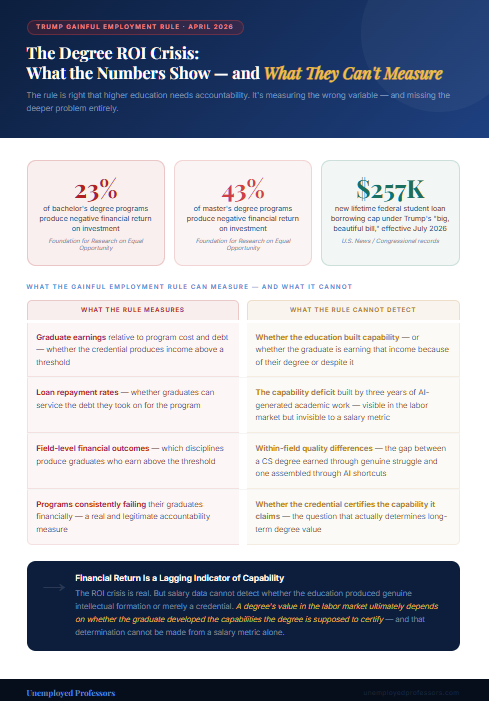
The data underlying the rule is sobering. According to research from the Foundation for Research on Equal Opportunity, 23 percent of bachelor’s degree programs already produce negative financial return on investment for graduates. For master’s programs, the number is 43 percent.
That is not a small problem. Nearly a quarter of bachelor’s programs and almost half of master’s programs are, by this metric, costing students more than they are earning them.
The political response has been predictable — supporters framing it as long-overdue accountability, critics framing it as a reductive assault on the intrinsic value of education. Both sides are arguing past the more important question.
What the ROI Rule Gets Right
The Trump administration’s gainful employment rule is making an argument that is, at its core, correct: a college degree is an investment, and investments should produce returns. Students — particularly those who take on significant debt to fund their education — are entitled to ask whether what they receive in exchange for that investment is actually worth what they paid.
The data suggests that for a striking proportion of graduate students in particular, the answer has been no. Forty-three percent of master’s programs produce graduates who earn less than the threshold that would justify the cost and debt of the degree. These are real people who borrowed real money and are now discovering that the credential they received does not translate into the economic return they were promised.
This is a legitimate problem. The higher education sector’s response to challenges about ROI — that education has value beyond the economic, that critical thinking and civic participation and personal development cannot be measured in salary — is true but insufficient. It is insufficient because the students who cannot afford to ignore the economic dimension of their degree are precisely the ones most harmed by programs that fail to deliver economic return. The intrinsic value argument, while philosophically sound, functions primarily as a defense available to those who can afford to be indifferent to the financial outcomes of their education.
So the gainful employment rule’s basic premise is correct. Programs that consistently produce graduates who cannot afford to repay their loans or achieve economic stability are failing those graduates, and federal subsidies for those programs deserve scrutiny.
What the ROI Rule Gets Wrong
The gainful employment framework, however, is measuring the wrong thing — or at least measuring only part of the right thing.
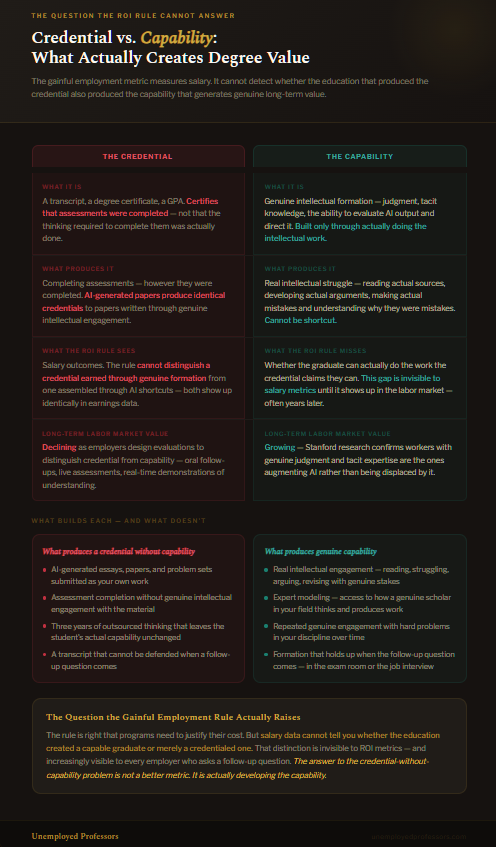
The financial return on a degree is not primarily a function of what field you studied. It is a function of whether you actually developed the intellectual capabilities that field was supposed to produce. A computer science degree from a program where students used AI to complete their assignments produces very different labor market outcomes than a computer science degree from a program where students actually struggled through the intellectual work. A business degree earned through genuine engagement with economics, organizational theory, and strategic reasoning produces very different professional capability than a business degree assembled through AI-generated papers and outsourced problem sets.
The gainful employment rule measures what graduates earn. It does not — cannot — measure whether they earned those earnings because of their education or despite it. It cannot distinguish between a program that produces genuinely capable graduates and a program that produces credentialed graduates who happened to enter a high-wage field. It cannot identify the difference between a degree that built real intellectual capability and a degree that certified attendance.
This distinction matters enormously right now, because the past three years of widespread AI use in academic work have created a generation of graduates whose credentials may not accurately represent their actual intellectual formation. A student who used ChatGPT to generate their economics papers for four years has an economics degree. Whether they have the intellectual formation in economic reasoning that degree is supposed to certify is a separate question — one that their GPA cannot answer and that a gainful employment metric cannot detect.
You cannot fix a capability deficit by measuring salary outcomes. You can only fix it by ensuring that the education actually develops the capabilities it claims to develop.
The Catholic College Problem — and the Broader Faith-Based University Question
This week, Susan Burns, the president of the University of Mount Saint Vincent, published an op-ed in America Magazine that puts a specific institutional face on this story. She describes how the Trump administration’s education cuts are hitting Catholic colleges and other faith-based institutions with particular force.
On one hand, the Trump administration has been explicitly friendlier to religious institutions than its predecessor — the Biden administration’s gainful employment enforcement specifically targeted Christian universities like Grand Canyon University while shielding traditional four-year institutions. The new rule is intended to apply across the board rather than selectively.
On the other hand, the programs most at risk under ROI-based accountability frameworks are often those that faith-based institutions disproportionately offer: theology, ministry, social work, counseling, education, nursing, and liberal arts — fields where the financial return is genuinely lower but the social and vocational value is genuinely high.
For students at Christian colleges and universities — Liberty, Grand Canyon, Regent, Biola, Azusa Pacific, Oral Roberts — the gainful employment pressure is landing in an environment that already asks them to do something financially risky: invest in an education that explicitly prioritizes formation over financial optimization. Christian higher education has always made a case for education as vocation, as calling, as formation in wisdom rather than mere technical competence.
That case is actually stronger in the current moment than the ROI framework gives it credit for. The Stanford Digital Economy Lab research showed that workers in roles requiring genuine judgment, tacit knowledge, and authentic disciplinary expertise are the ones not being displaced by AI. Workers whose value came from codified knowledge tasks — the kind AI now executes competently — are the ones losing jobs. By this logic, an education oriented toward genuine formation, wisdom, and the capacity for judgment is exactly what the AI labor market rewards most.
But this argument only holds if the education actually delivers the formation it promises. An education that orients students toward wisdom while allowing them to use AI to complete all the assignments that were supposed to build that wisdom delivers neither the financial ROI the gainful employment rule demands nor the genuine formation that justifies the faith-based institution’s higher purpose.
What This Means for How You Engage With Your Education
The gainful employment pressure is real and it is going to intensify. More programs are going to face scrutiny. More students are going to ask harder questions about whether their degree investment is producing genuine return.
The answer to that pressure is not to choose only high-salary fields — the Stanford research makes clear that salary alone is not the variable. The answer is to ensure that whatever field you choose, you actually develop the genuine intellectual formation that makes your degree valuable. The human capabilities that AI cannot replicate — judgment, tacit knowledge, authentic disciplinary expertise, the ability to evaluate and direct AI output rather than simply produce the AI-completable kind — are the capabilities that produce genuine return regardless of field.
These are capabilities built through genuine intellectual engagement with your education. Through reading the actual sources, struggling through the actual arguments, developing real understanding of the material your courses cover. They are not built through AI-generated papers and outsourced assignments — and a transcript full of A grades achieved through AI shortcuts does not certify them.
This is also where the choice between AI-generated academic help and genuine human expert help becomes a long-term investment question rather than a short-term convenience question.
AI-generated academic help produces credentials without intellectual formation. It satisfies the assessment requirement — the paper gets submitted, the grade gets recorded — while leaving the student exactly as intellectually undeveloped as before the assignment. When the gainful employment metric eventually asks whether the degree produced a capable graduate, the answer depends on whether there was actually a capable graduate — not on whether the transcript looks right.
Genuine human expert help — the kind Unemployed Professors has provided since 2010 — works differently. When a verified scholar with genuine credentials in your discipline writes in your area, the work reflects real intellectual engagement with the subject. You receive something you can engage with, learn from, compare to your own thinking. The expertise behind the work is real and accessible. Over time, genuine expert modeling of what intellectual work in your field actually looks like contributes to your own formation — in ways that AI output, however fluent, cannot.
In an environment where the government is beginning to scrutinize whether your degree actually produced a capable graduate, the distinction between credential and capability is not academic. It is the whole question.
The Bottom Line
The Trump administration’s gainful employment rule is right that higher education needs to demonstrate its value. The ROI data is genuinely alarming — 23 percent of bachelor’s programs and 43 percent of master’s programs are not producing graduates who can justify the cost of their degree.
But financial return is a lagging indicator of a deeper problem: whether the education actually developed the intellectual capabilities that produce genuine long-term value in a labor market that is increasingly differentiating between credential and capability.
That deeper problem has been building for three years, as AI tools made it easier than at any point in history to obtain credentials without developing the understanding those credentials are supposed to certify. The gainful employment rule cannot measure this. Salary data cannot detect it. Only genuine intellectual formation — actually doing the work, actually developing the understanding, actually building the capability — produces the kind of graduate who justifies their degree in the labor market and in the world.
Getting help with your academic work is not the problem. The kind of help matters enormously. Help that produces a document without developing you produces exactly the kind of credential-without-capability that the gainful employment pressure is exposing. Help that connects you to genuine human expertise gives you access to real intellectual modeling that contributes to your actual formation.
Unemployed Professors has been providing that kind of help since 2010 — verified scholars, genuine disciplinary expertise, real intellectual engagement with your specific work. The kind of help that leaves something behind.
In a world where your degree is increasingly expected to prove its value, the thing that actually creates value is the only thing worth investing in.