
An AI Agent Just Took an Entire Online Course. Here’s What That Actually Reveals.
In February, a 22-year-old developer named Advait Paliwal launched an AI tool called Einstein. Built on an open-source agent framework called OpenClaw, Einstein could autonomously log into Canvas — the learning management system used by more than 40 percent of higher education institutions across North America — watch recorded lectures, complete assignments, and submit homework. All of it. Without a human touching anything.
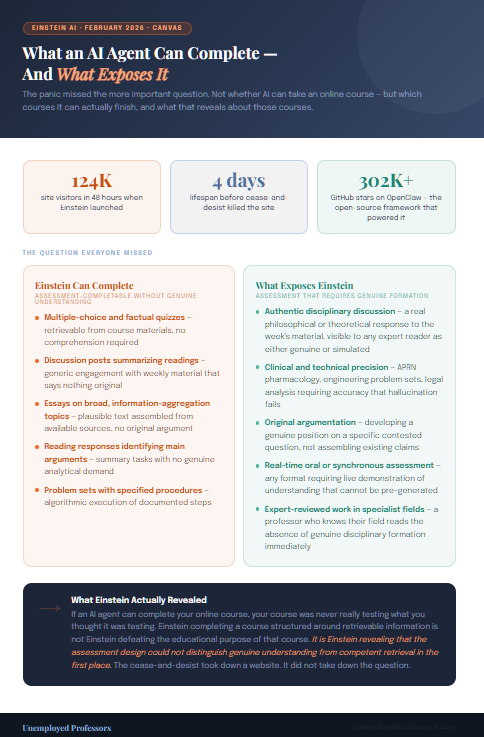
Within 48 hours, 124,000 people had visited the site.
The reaction from faculty was immediate and visceral. Cease-and-desist letters arrived from Instructure, which owns Canvas, and from Hebrew University of Jerusalem. The website was taken down four days after launch.
Then, several weeks later, Canvas unveiled its own agentic AI tool — IgniteAI — described as a way to save faculty time on “low-value tasks.” Experts immediately raised concerns about what they called the “dead classroom” scenario: computers teaching other computers, with humans somewhere in between but not quite in the loop.
The Einstein panic was real. The concern is legitimate. But the dominant reaction misses what the story actually reveals. Because the more important question is not whether AI can complete an online course. It is which courses AI can actually finish — and why.
What Einstein Actually Did
Paliwal has explained publicly that he did not originally set out to build a cheating tool. His goal was to build an autonomous AI agent with computer access. When he realized the agent could navigate Canvas and complete coursework, he started asking what he himself described as the genuinely interesting question: what does it mean to be a student?
He initially marketed Einstein as an explicit cheating tool specifically to force that conversation. It worked. The resulting debate among educators, administrators, and technologists was exactly the kind of urgent reckoning the question deserves.
Here is the part that the panic mostly glossed over: the underlying technology that powered Einstein — OpenClaw — is open-source, with over 302,000 stars on GitHub. Cease-and-desist letters cannot reach a code repository. Anyone with basic technical skill can rebuild what Paliwal built. This is not a crisis that was resolved when the website came down. It is a reality that the website revealed.
The analysis from Educators Technology put it plainly: if your institution relies on lockdown browsers, multi-factor authentication, or API restrictions to block AI misuse, those defenses are already broken. Einstein is gone. The capability is not.
What Einstein Can Actually Complete
Here is the question that the panic mostly did not ask: which online courses can an AI agent actually finish, and to what standard?
An AI agent like Einstein can complete online courses that are primarily structured around retrievable, verifiable information. Multiple-choice quizzes on factual content. Short-answer questions with correct answers in the course materials. Discussion posts that summarize weekly readings. Reading responses that identify main arguments. Problem sets with specified procedures. Essays on topics broad enough that competent aggregation of existing text produces a plausible response.
These are courses where genuine human understanding was, in a meaningful sense, never really being tested — or at least never tested in a way that required it to be demonstrated rather than simulated. Einstein completing a course structured around this kind of assessment is not Einstein defeating the educational purpose of the course. It is Einstein revealing that the assessment design could not distinguish genuine understanding from competent retrieval in the first place.
What Einstein cannot complete — or cannot complete to a standard a professor who knows the subject would accept — is genuinely different.
A philosophy discussion board asking students to apply Kant’s categorical imperative to a specific contemporary ethical dilemma and respond authentically to classmates’ arguments requires something Einstein does not have: a genuine philosophical perspective developed through real engagement with Kantian ethics. Einstein can produce text that uses the right vocabulary. It cannot produce text that reflects the kind of intellectual formation that actually thinking through Kant over time produces. A professor of philosophy reads the difference immediately.
An advanced pharmacology problem set for an APRN program requires genuine understanding of drug mechanisms, patient contraindications, and clinical decision-making logic that cannot be reliably generated from pattern matching. The hallucination risk for a problem set requiring clinical precision is not a minor concern — it is a patient safety concern.
The courses Einstein can complete are the courses that were always, in a sense, already algorithm-completable. The courses Einstein cannot complete authentically are the ones that required genuine human understanding to begin with — and still do.
What This Means for Online Learning
The Einstein story has a structural implication that higher education is only beginning to absorb.
If an AI agent can complete your online course, your course was never really testing what you thought it was testing. This is not an indictment of course designers — it is a consequence of assessment models built before autonomous AI agents existed and not yet redesigned in their light.
The response from some institutions has been to redesign assessments to require more authentic demonstration of understanding — real-time oral components, synchronous discussions, performance-based evaluations that cannot be completed asynchronously by an agent running on a cloud server. This is the right direction. It is also genuinely hard to implement at scale.
The honest acknowledgment from the Einstein moment is that online learning, as it has predominantly been structured, has a fundamental vulnerability: asynchronous, text-based assessment of knowledge that can be retrieved rather than demonstrated is assessment that AI agents can now navigate competently. This does not mean online learning is over. It means the gap between “completed the course” and “actually understands the material” has never been wider or more consequential.
The Difference Einstein Reveals
The Einstein story clarifies something important about the difference between AI-generated course completion and genuine human expert engagement with course material.
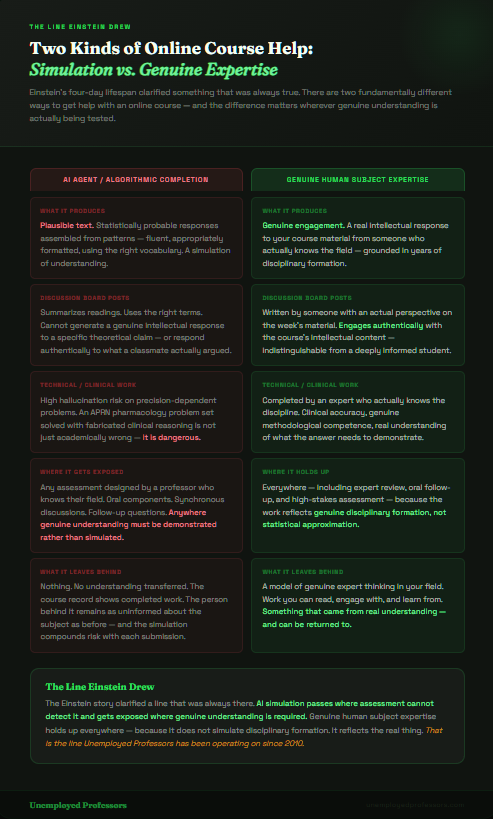
When Einstein completes a Canvas discussion board, it produces text. When a genuine subject-matter expert engages with a Canvas discussion board, they have an actual intellectual response to the week’s material — a response grounded in years of real formation in the field, capable of generating genuinely new insight, responsive to nuance that Einstein’s pattern-matching cannot perceive.
There are two ways to get help completing an online course. One is to deploy an AI agent that processes course materials and generates plausible responses — responses that pass in courses where assessment cannot distinguish simulation from understanding, and fail or get exposed in courses where genuine disciplinary knowledge is required. The other is to work with a genuine human expert who actually knows the subject your course covers.
Einstein completing an online course is the AI version of what happens when anyone — human or algorithmic — without genuine subject knowledge tries to simulate engagement with material they have not really internalized. The simulation is increasingly good. It is still a simulation. And professors who know their subjects can still tell the difference.
Unemployed Professors matches online course work to scholars who genuinely know the relevant field: an economics course to an economics scholar, a nursing course to a nursing expert, an organizational behavior course to an organizational behavior specialist. That is not a simulation. That is authentic subject expertise producing genuine scholarly engagement — the kind that does not just pass the course but actually reflects what understanding the material looks like.
Einstein revealed how thin the line between competent simulation and genuine expertise can be in poorly designed assessment environments. It also revealed exactly where that line still matters — which is wherever genuine human understanding is actually being tested rather than merely retrieved. That line is where Unemployed Professors operates.
The Bottom Line
What the Einstein story actually reveals is a clarifying question that every student and professional managing online coursework now faces: is the help you are getting the kind that produces authentic engagement — genuine human expertise meeting the material with real understanding — or the kind that produces increasingly sophisticated simulation?
For courses where the distinction does not matter because the assessment cannot detect it, the answer may feel academic. For courses where the distinction does matter — because the professor knows the subject, because the assessment requires real-time demonstration, because the stakes of actual comprehension extend beyond the grade — the answer matters a great deal.
Unemployed Professors has been providing the first kind of help since 2010. Verified human scholars. Real subject expertise. Genuine intellectual engagement with your specific course material. The kind of help that is not just undetectable because it is human — but actually valuable because the human behind it knows what they are doing.