
The Dartmouth Provost Wrote a Washington Post Op-Ed About AI and Academic Integrity:
It Was AI-Written. His Denial Was Also AI-Written. The Double Standard Goes Deeper Than Irony.
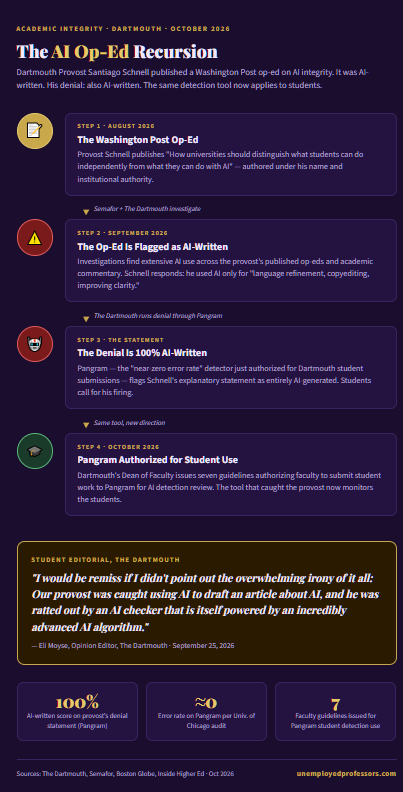
In August 2026, Dartmouth College Provost Santiago Schnell published an op-ed in The Washington Post. The piece urged universities to offer degrees that “distinguish what students can do independently from what they can accomplish with AI.” The argument: higher education needs to develop credentials that actually mean something in an age when AI can produce academic-sounding text on demand.
In September 2026, Semafor and The Dartmouth student newspaper published investigations reporting that Schnell had used AI tools extensively in writing that op-ed and several other published works. When The Dartmouth’s journalists confronted him with their findings, Schnell sent a written statement explaining that he had used AI only for “language refinement, copyediting, improving clarity and organization and making writing processes more efficient.” The student reporters ran that statement through Pangram — the AI detection tool Dartmouth’s own Dean of Faculty had just authorized for use on student work, following a University of Chicago audit that found its error rate “near-zero.” The statement was flagged as 100 percent AI-written.
Students and faculty are now calling for Schnell’s firing. Dartmouth President Sian Leah Beilock, who recently published a piece in The Atlantic titled “Why I Want More AI at Dartmouth,” announced a “rigorous, objective review” of how Schnell used AI in his writings. The Dartmouth’s opinion editor Eli Moyse put the core contradiction plainly: “I would be remiss if I didn’t point out the overwhelming irony of it all. Our provost was caught using AI to draft an article about AI, and he was ratted out by an AI checker that is itself powered by an incredibly advanced AI algorithm.”
The irony is real. What the irony is pointing toward is more important than the irony itself.
What the Op-Ed Was Actually Claiming
Santiago Schnell’s August Washington Post op-ed was not simply an essay about AI policy in the abstract. It was an op-ed authored by the Provost of Dartmouth College — the chief academic officer of an Ivy League institution, whose specific role includes upholding academic integrity — about why universities should help students develop genuine capabilities that can be distinguished from AI-assisted performance.
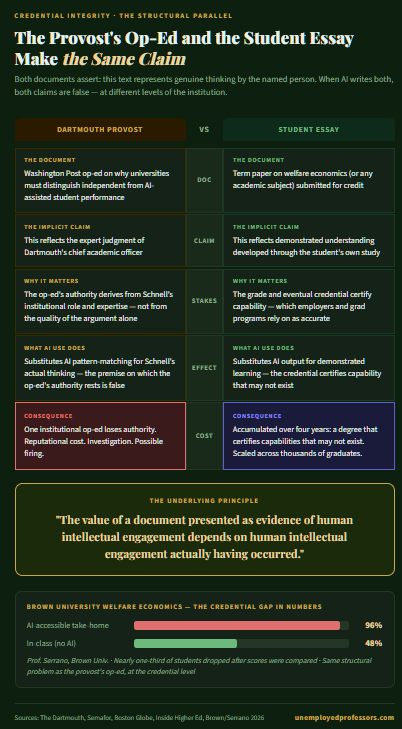
Every published op-ed makes an implicit authority claim. The claim is: the argument in this text reflects the genuine thinking of the person whose name appears on it. When a Dartmouth Provost writes in The Washington Post about what universities should do to address AI and academic integrity, the reader is not simply encountering an argument. The reader is encountering an argument backed by the intellectual authority and professional judgment of a specific person who has a specific institutional role that makes their opinion on exactly this question significant.
When the argument is AI-generated, that claim is false. Not because AI cannot produce coherent arguments about AI policy in higher education — it clearly can. The argument may be perfectly competent. But the reader was not receiving Schnell’s judgment. The reader was receiving AI pattern-matching dressed as Schnell’s judgment. The essay’s value — the reason it was published in The Washington Post and the reason anyone read it — derived from a false premise.
Schnell told The Dartmouth he used AI only for “language refinement.” Pangram found his statement of that claim was itself 100 percent AI-written. What actually happened between his thoughts and his published texts is now, as Dartmouth President Beilock noted, under rigorous review.
Why the Students Are Right, and What They Have Not Quite Said
The Dartmouth students calling for Schnell’s removal are not wrong. Eli Moyse correctly identified the double standard: if a Dartmouth student submitted an AI-generated paper without disclosure, they would be in clear violation of Dartmouth’s Academic Honor Principle. Schnell published AI-generated op-eds about academic integrity while his institution was developing policies to detect AI in student submissions. The structural hypocrisy is accurate, the double standard is real, and the anger is appropriate.
What the outrage has not quite articulated is the underlying principle that makes the double standard a double standard rather than just an embarrassment.
The principle is this: the value of a document presented as the product of genuine human thinking depends entirely on genuine human thinking having actually occurred. Not on the document sounding plausible. Not on the document reaching reasonable conclusions. On whether the person whose name is on it actually did the intellectual work.
This is the principle that Schnell’s op-ed violated. It is also the principle that an AI-generated student essay violates. In both cases, a document is presented as the intellectual product of a specific person, making an implicit claim about what that person knows, understands, and is capable of. In both cases, the claim is false.
The difference between Schnell’s case and the student essay case is scale and consequence. Schnell’s false claim is professionally embarrassing and undermines the authority of one institutional op-ed. A student’s false claim, accumulated across four years of coursework, constructs a credential that is supposed to certify demonstrated capability — and does not.
The Roberto Serrano Problem, Again
This credential gap is not theoretical. Roberto Serrano’s welfare economics students at Brown University averaged 96 percent on their AI-accessible take-home midterm. They averaged 48 percent on the in-class exam where AI was unavailable. Nearly a third of the class dropped the course after the scores were compared. The AI knew welfare economics. The students, in a meaningful number of cases, did not.
The degree those students would have earned through AI-assisted performance would have claimed to certify demonstrated capability in welfare economics. The 48 percent score — and the decision to drop — suggests that certification would have been false.
This is the credential-capability gap that this blog series has been tracking since April: Berkeley’s grade inflation, Brown’s score collapse, the DEC global survey showing 80 percent of employers reporting that higher education is not keeping up, the SHAPE AI data on students who doubt their own learning, the process-assessment cost problem that made Serrano’s comparison possible in the first place. The Dartmouth provost case is not a new problem. It is the same problem, one floor up the academic hierarchy.
The Pangram Problem Within the Problem
There is a further irony worth noting, and unlike the first irony, this one has practical stakes.
The same week The Dartmouth’s investigation was published, Dartmouth’s Dean of Faculty authorized the use of Pangram for detecting AI in student work. The authorization came with seven guidelines; faculty are not required to use it, but they are now permitted to submit student writing for AI detection review. The tool that caught Schnell’s statement at 100 percent AI-generated is now the tool Dartmouth is deploying against students.
This is not straightforwardly bad. As this blog series noted when covering the universities-retiring-detectors story in August, the institutions that moved away from detectors often did so because the tools were inaccurate, not because detection was illegitimate. A near-zero-error-rate detector is a different instrument than the generation of tools that produced false positives against non-native English speakers.
But the sequence matters. Dartmouth authorized Pangram for student use at the same moment its own provost was being flagged by that tool for AI-generated text in published scholarly and opinion writing. The institutional message this sends to students is not simply that there is a double standard. The message is that the institution is developing enforcement tools aimed at the population over whom it exercises disciplinary authority, in a context where the people who exercise that authority have not consistently applied the same standard to themselves.
What Verification Actually Measures
Dartmouth’s Pangram authorization is, in structure, a version of the verification-first framework that forward-thinking assessment reform has been developing: use available tools to determine whether the work in front of you represents genuine human intellectual engagement, rather than assuming it does.
The limitation of detection-based approaches is that they measure a signal — statistical patterns associated with AI-generated text — rather than the thing that signal is supposed to indicate. What actually matters is not whether the text pattern-matches to AI output. What matters is whether genuine human thinking occurred. Those are not the same question. Detection can flag cases where it probably did not. It cannot verify cases where it did.
This is what Schnell’s case makes concrete. The question is not whether his op-ed passed or failed a detection threshold. The question is whether the op-ed represented his genuine thinking about AI and academic integrity, and therefore whether its claim to authority was justified.
Process-oriented assessment — oral exams, project documentation, in-class components that require real-time demonstration — addresses the underlying question directly by creating conditions in which the student must show the work. Detection addresses a symptom. Verification addresses the cause.
The Bottom Line
Dartmouth Provost Santiago Schnell used AI to write a Washington Post op-ed arguing that universities should teach students to distinguish what they can do independently from what AI can do for them. When confronted, he sent a statement explaining he had used AI only minimally. That statement was 100 percent AI-written.
The outrage is appropriate. The double standard is real. What the outrage points toward is a principle worth stating precisely: the value of a document presented as evidence of human intellectual engagement depends on human intellectual engagement actually having occurred. That principle applies to the provost’s op-ed and the student’s term paper with equal force.
The scholars at Unemployed Professors are on the right side of that principle. Every piece they produce is the product of a genuine expert in a specific discipline who actually thought about a specific question and produced original analysis. That is what the Dartmouth op-ed was supposed to be. It is also what a term paper submitted as evidence of learning is supposed to be.