
Beyond Detection: Why “Verification-First” Still Has a Gap.
Higher Education Just Moved From “Gotcha” to “Verification-First.” Here’s What That Still Doesn’t Solve.
eCampus News published a piece on September 16, 2026 arguing for a fundamental reframing of academic integrity in the AI era. The argument is right. Post-hoc AI detection — the approach that produced the Newby v. Adelphi University ruling, the Stanford false positive study, ACU’s 6,000-case disaster, and the EU AI Act’s high-risk classification — cannot carry the weight of academic integrity enforcement on its own. The shift to verification-first is the correct institutional response.
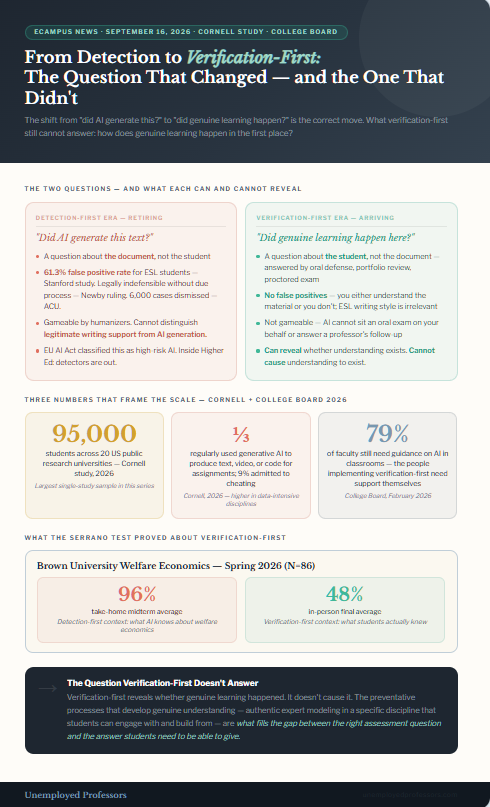
The Cornell study published in May 2026 is the largest dataset this blog series has encountered: 95,000 students across 20 public research universities in the United States. About one-third regularly used generative AI to produce text, video, or code when completing assignments. Nine percent admitted to using it to cheat. Usage rates were higher in data-intensive disciplines and among male and non-minority students.
The College Board’s research adds the faculty side: 92 percent of faculty are concerned about AI-facilitated dishonesty; 84 percent agree that AI reduces critical thinking and deep engagement; only 21 percent feel very confident guiding AI use in their classrooms; 79 percent say they are still seeking guidance.
The verification-first framework is the right diagnosis of what was wrong with the detection era. The question this post wants to raise is what verification-first still cannot do — and what that means for students navigating the transition.
What Verification-First Actually Means
Detection-first asked one question: did AI generate this text? Verification-first asks a different question: did genuine learning happen here? This is a question about the student, not the document.
The tools that answer the verification-first question are the process-focused assessment elements this blog series has documented: oral defenses where students explain their argument, portfolio reviews where thinking development is visible across time, proctored examinations where genuine understanding is the only pathway to a passing grade. Roberto Serrano’s Welfare Economics class moved from detection-first to verification-first: the take-home midterm produced 96 percent averages; the in-person final produced 48 percent averages and a third-of-class attrition. The proctored room answered the verification question that no algorithm could.
The eCampus News piece is right that verification-first requires “preventative processes that support students, empower faculty’s academic judgment, and preserve confidence in the value of higher education.” These are the right goals. The limitation is not in the goals. It is in what verification-first, correctly implemented, can and cannot produce.
What Verification-First Cannot Do
Verification-first can tell you whether genuine learning happened. It cannot cause genuine learning to happen.
An oral defense can reveal whether a student understands the material they submitted. It cannot install that understanding in a student who has not developed it. A proctored examination can measure the understanding that existed before the examination room. It cannot produce understanding in the examination room.
The 79 percent of faculty who are still seeking guidance on AI use are faculty who are, by the College Board’s own data, not well-positioned to bridge this gap for their students. The verification-first framework asks faculty to implement oral defenses, portfolio reviews, and process documentation — the elements Marc Watkins described as too expensive to fathom at scale — while simultaneously needing guidance themselves on how to navigate AI in the classroom.
The institutional gap between the verification-first framework as a conceptual shift and as a lived assessment reality is where the credential-capability problem lives. It is where it has lived throughout this blog series.
The Cornell Equity Finding
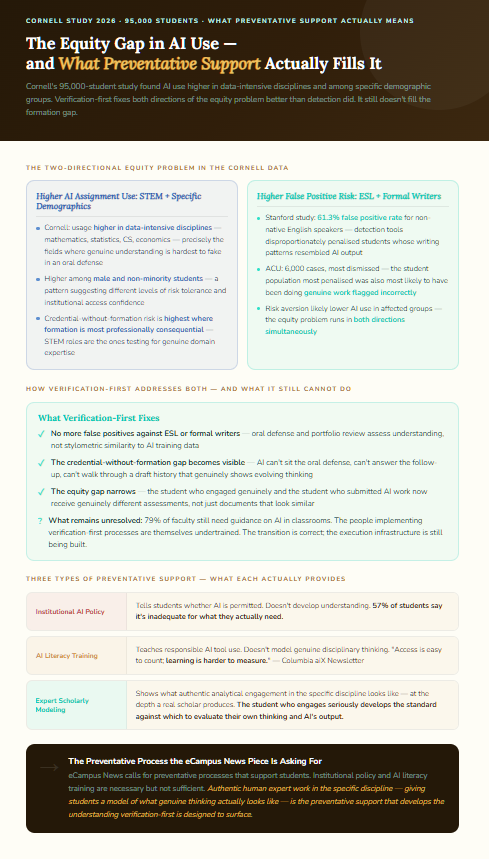
The Cornell study’s finding that AI usage rates are higher in data-intensive disciplines — mathematics, statistics, computer science, economics — is the disciplines where the double expertise gap is most acute. These are the fields where understanding cannot be plausibly faked in an oral defense, where the Brown University proctored room result is most dramatic, where genuine formation is most professionally consequential.
The finding about demographic patterns — higher usage among male and non-minority students — sits alongside the documented false positive bias against ESL students in detection-first tools. Both findings together suggest an equity problem running in both directions. Verification-first assessment addresses both better than detection-first did: it doesn’t produce false positives against ESL writers, and it measures understanding rather than stylometric similarity. But it does not address the underlying formation gap in either direction.
The Gap That Verification-First Identifies and Cannot Fill
The eCampus News piece calls for “preventative processes that support students.” This is the right framing. What preventative processes support students in developing the genuine understanding that verification-first assessment is designed to reveal?
Students who engage seriously with their coursework — who encounter the genuine difficulty of the material, who develop the analytical capability that Bjork’s desirable difficulties research identifies as the product of effortful cognitive processing, who study authentic expert work in their discipline and develop their own understanding through that encounter — are students whose formation produces the understanding that verification-first reveals.
The preventative process that supports this kind of development is the quality of the help students seek when they are stuck, uncertain, or working on something genuinely difficult. Help that generates AI content for students to submit does not support development that verification-first assessment surfaces. Help that models genuine disciplinary thinking — authentic expert work in the specific field, produced by scholars with genuine formation in the relevant area — gives students something real to engage with, compare their thinking to, and develop from.
Unemployed Professors has provided this kind of help since 2010. Not because verification-first was coming. Because it is what genuine academic help looks like: a verified scholar in the relevant discipline who knows the material, produces authentic work, and gives the student a model of what real analytical engagement in their field actually involves.
The Bottom Line
eCampus News is right that the shift from detection-first to verification-first is the correct move. The Cornell study of 95,000 students makes the scale of the problem clear. The College Board’s finding that 79 percent of faculty still need guidance makes the institutional capacity gap equally clear.
Verification-first tells institutions how to measure whether genuine learning happened. It does not cause genuine learning to happen. The preventative processes that support students in developing the understanding that verification-first is designed to reveal are the choices students make about how to engage with their coursework — including what kind of help they seek when they need it.
The help that develops genuine understanding is the help that models authentic disciplinary thinking, provides a standard of genuine expert work in the specific field, and gives students something real to engage with and develop from. That is what the verification-first framework is, correctly, designed to reward.