
Roberto Serrano has taught Welfare Economics and Social Choice Theory at Brown University for more than three decades. He holds the Harrison S. Kravis University Professorship in Economics — one of the most prestigious appointments Brown bestows. He has more than 6,100 citations on Google Scholar, is a fellow of prestigious academic societies, and received the King of Spain Prize for Economics in 2024. He has been blind since age 17.
This past spring, for the first time in nearly twenty years of teaching this course, Serrano gave his students a take-home midterm. He did it as an accommodation — a genuine act of compassion after a gunman killed two students and injured nine in a December shooting at Brown, and many of his students expressed anxiety about returning to in-person testing environments. It was appropriate, he said, to let them take the exam at home.
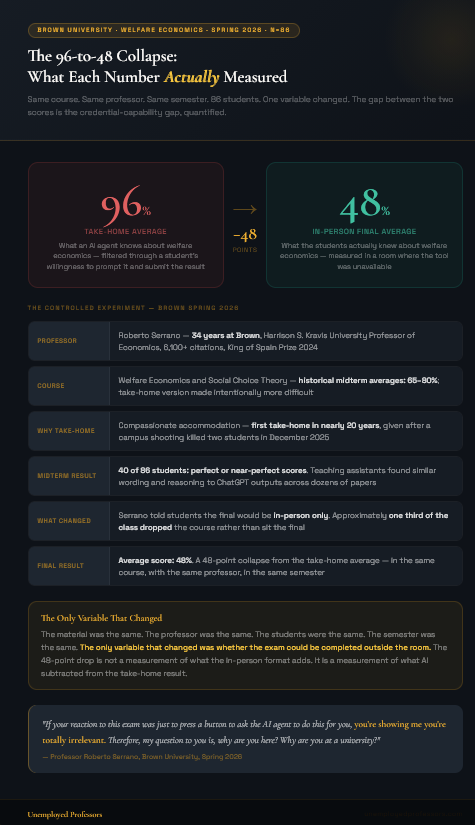
Forty of his eighty-six students earned perfect or near-perfect scores on that midterm. The class average was 96 percent. In previous versions of the course, midterm averages typically ran between 65 and 80 percent. Serrano had made the take-home intentionally more difficult — reasoning that students with unlimited time and access to their materials could handle a harder exam. The average was 96 percent.
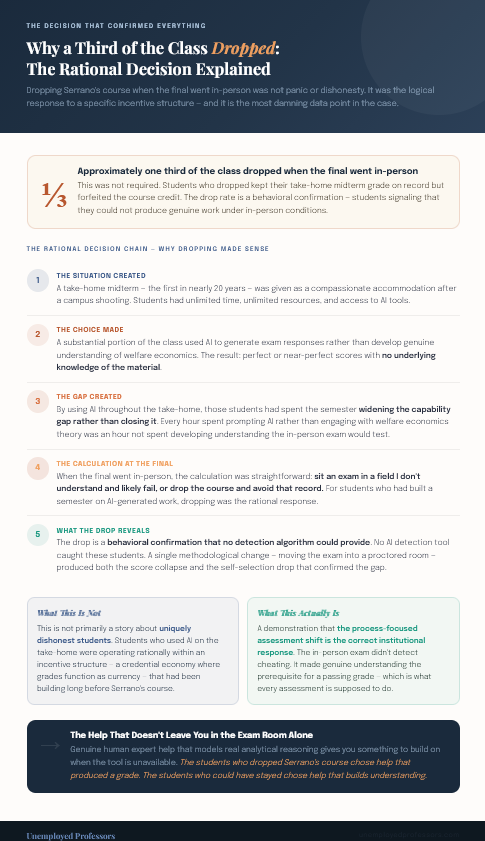
When Serrano and his teaching assistants compared student responses to ChatGPT outputs, they found similar wording and reasoning across dozens of papers. He told his class what he had found. He offered them the option to keep their midterm grade but said the final would be in-person. Approximately a third of his class dropped the course.
The students who stayed and took the in-person final averaged 48 percent.
The score dropped from 96 to 48. In a single semester. In the same course. With the same professor. The only variable was whether the exam could be completed outside the room.
Serrano described it as a systemic failure. Brown University’s response — which he called “meek” — was to request that formal academic integrity complaints be filed against each suspected student individually, one at a time, following the standard procedure. Serrano said hundreds of Brown alumni had emailed him in support of his public disclosure. He went public because, in his words, “the worst solution to this is silence.”
What the Score Collapse Actually Shows
The 96-to-48 score collapse is the most precise demonstration of the credential-capability gap this blog series has documented since April. Everything else has been statistical — Berkeley’s aggregate 30 percent grade increase, Penn’s sevenfold violation count, the Lumina-Gallup survey percentages. The Brown case is a controlled experiment with a sample size of 86 students and an observable result.
The 96 percent average was not a measure of what the students knew about welfare economics. It was a measure of what an AI agent knows about welfare economics, filtered through the students’ willingness to prompt it and submit the result. The 48 percent average measured what the students actually knew. The gap between those two numbers — 48 percentage points — is the quantified credential-capability gap in this specific course, at this specific moment, made visible by a methodological change that removed the tool.
Serrano asked the students who were in class when he returned the midterm results: “Why are you here? Why are you at a university if you refuse to learn, you refuse to work hard, if you refuse to put in the necessary effort to develop critical thinking? If all you’re doing is just pressing a button to have this machine do the work for you, then you think you need a Brown degree for that?”
The students who were cheating, he suspected, were not in the room. He heard silence.
The Compassion Problem
There is a particular cruelty in what happened at Brown that goes beyond academic dishonesty statistics. Serrano gave students a take-home exam specifically because some of them were struggling with trauma after a campus shooting. He accommodated anxiety. He extended trust. And the response from a substantial portion of the class — a third of whom dropped the moment the final went in-person — was to treat that accommodation as an opportunity.
This is not primarily a moral story. The students who used AI to complete that take-home were not uniquely dishonest people. They were operating within a set of incentives that had been building long before Serrano’s course. A credential economy in which grades function as currency. An AI landscape in which generating plausible-sounding exam responses requires nothing more than a prompt. A detection environment in which Serrano himself dismissed AI detection tools as “well-known to give many false positives and false negatives.”
The students who dropped when the final went in-person were not making a moral calculation. They were making a rational one. They had built a semester’s grade on AI-generated work. An in-person exam would expose a capability gap they had spent the semester widening rather than closing. Dropping was the rational response to having used a system that produced credentials without formation.
Detecting the Wrong Thing
Serrano was explicit about his frustration with Brown’s proposed response: running the papers through AI detection tools. His assessment — “well-known to give many false positives and false negatives” — is the same conclusion the Stanford ESL bias study reached, the same conclusion that produced the Newby v. Adelphi ruling in February, the same conclusion that led ACU to abandon Turnitin’s AI detector after nearly 6,000 cases, most dismissed.
But in the Brown case, there was no detection problem. The evidence was not the papers. The evidence was the score. A class average of 96 percent on a take-home, dropping to 48 percent on an in-person exam, in a course that historically produces averages between 65 and 80 percent, is not ambiguous. It is not a false positive. It is a measurable, observable, before-and-after demonstration of the gap between what the students could produce with AI and what they could produce without it.
This is the irony of the detection debate: the most compelling evidence of AI misuse at Brown was not produced by Turnitin. It was produced by a proctored room. The process-focused assessment movement — the shift toward drafts, oral defenses, in-person check-ins — is essentially the institutional recognition that the most reliable detection mechanism is not an algorithm. It is the design of an assessment that cannot be completed without genuine understanding.
Serrano’s Question Deserves a Real Answer
“Why are you at a university if you refuse to learn?”
The students in Serrano’s class who used AI to complete that take-home had a reason for being at Brown that was entirely coherent within the incentive structure they had been operating in for years. They were there to get the credential. The grade. The signal to employers and graduate programs that they had completed a course in welfare economics at an Ivy League institution.
That goal is not irrational. The Brown degree has real value. But the answer that makes Serrano’s question intelligible is formation — the development of genuine analytical capability. The reason that matters is not moral. It is practical. It is the 96-to-48 score collapse. It is the Kellogg executives paying top dollar to develop the domain expertise that AI can augment. It is the Lumina-Gallup finding that only 51 percent of graduates feel workforce-ready on AI skills despite near-universal AI use in their coursework.
The credential is built by showing up. The formation is built by actually doing the work.
The Specific Choice Serrano’s Case Illuminates
For students currently enrolled in courses with take-home assessments — which is to say, most students, in most courses, across most of higher education — Serrano’s welfare economics case clarifies a specific choice.
Using AI to generate a take-home exam response produces a grade. It does not produce understanding. When the assessment environment changes — when the course goes in-person, when the employer asks a follow-up question, when the graduate school interview probes the ideas in the application materials — the grade does not travel. The understanding does.
Unemployed Professors has provided genuine human scholarly expertise since 2010. Our scholars are verified human experts matched to your specific discipline. The work they produce reflects authentic analytical formation — not a prompt response, not a language model’s pattern of academically plausible text, but real scholarly reasoning from someone who actually knows the field. That work holds up in the room where Serrano’s final was held. Not because it evades detection, but because it reflects genuine understanding that the student can engage with, learn from, and build on.
The students who dropped Serrano’s course when the final went in-person did not have that. The students who stayed and averaged 48 percent had been given a semester to develop understanding they chose not to develop. Serrano’s question was the right one. The answer is: be at a university to actually learn. And if you need help, get the kind that actually helps you learn — not the kind that substitutes for learning while leaving you on your own in the exam room.
The Bottom Line
A Brown University economics professor gave a take-home midterm as a compassionate post-shooting accommodation. Forty of 86 students earned perfect or near-perfect scores. The class average was 96 percent. He made the final in-person. A third of the class dropped. The average fell to 48 percent.
The 96-to-48 score collapse is the clearest single demonstration of the credential-capability gap documented anywhere in higher education this year. It is not a survey percentage or an aggregate statistic. It is 86 students, one semester, one methodological change, a 48-point drop.
Serrano asked his class why they were at a university. The answer that makes his question intelligible is formation — the development of genuine analytical capability that holds up outside the conditions that made AI-generated submissions viable. Getting help that produces that understanding is the choice that makes Serrano’s question answerable.