
The 2026 MBA Rankings Are Out. Here's What They Don't Measure.
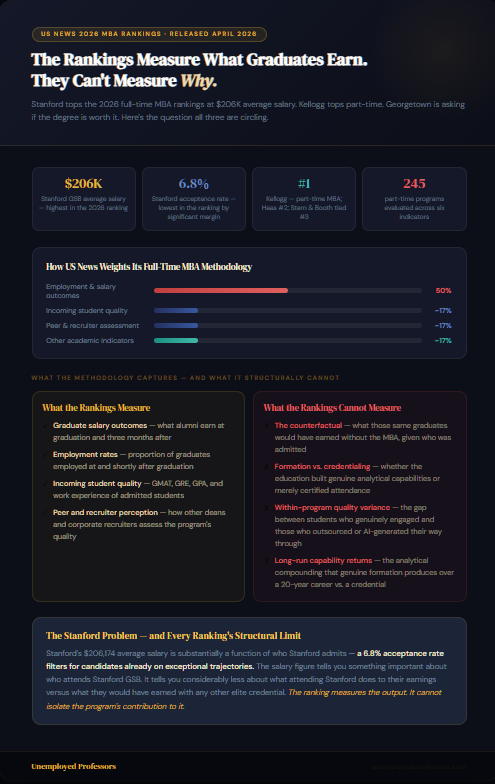
The U.S. News & World Report 2026 MBA rankings dropped last month, and the results landed with the usual combination of institutional celebration and quiet institutional anxiety. Stanford took the top spot in full-time programs — its graduates earn an average salary of $206,174, the highest of any school in the ranking. Kellogg at Northwestern claimed the top spot in part-time programs, with Haas at Berkeley second and Stern and Booth tied for third.
Georgetown McDonough published a blog post on May 12 titled "Is College Still Worth It?" The subheadline: "What the data shows about long-term value, and how Georgetown McDonough develops leaders to pursue what matters." The key takeaway, according to the post: public confidence in higher education has declined as costs rise.
Georgetown asking that question from inside a top business school is not irony. It is the most honest thing a business school has said in public this year. Because the answer depends entirely on something the U.S. News rankings — for all their methodological sophistication — cannot measure.
The rankings measure what graduates earn. They cannot measure whether the MBA is the reason they earn it.
What the Rankings Actually Measure
The U.S. News methodology for full-time MBA programs distributes its weight across several categories. Half of the ranking formula is based on employment rates and salary outcomes for graduates. The remaining half evaluates academic quality through incoming student metrics, peer assessment from other business school deans and directors, and recruiter assessments.
This is a reasonable methodology for what it is trying to do: rank programs by their observable outcomes and their perceived quality among peers. It is not, and has never claimed to be, a measure of what the MBA itself produces in the student who completes it.
Stanford's $206,174 average salary is a remarkable number. It is also, substantially, a function of who Stanford admits — the admissions process that produces a 6.8 percent acceptance rate, the lowest in the ranking by a significant margin, filters for candidates who were already on trajectories that would produce exceptional outcomes regardless of where they completed graduate business education. The salary figure tells you something important about who attends Stanford GSB. It tells you considerably less about what attending Stanford GSB does to their earnings trajectory versus what they would have earned with any other elite credential.
The U.S. News methodology focuses specifically on full-time, campus-based MBA programs, emphasizing outcomes for early-career professionals who may step away from the workforce to pursue graduate education, with half of the ranking formula based on employment rates and salary outcomes. What it cannot capture is the counterfactual: what would those same graduates have earned without the MBA? For the candidates admitted to Stanford, Wharton, Harvard, and Booth, the honest answer is often: quite a lot.
This is not a criticism of the rankings. It is a description of their limits — limits that matter a great deal for the working professionals who are using these rankings to make decisions about whether to invest two years and $150,000 or more in a graduate business degree.
The Question Georgetown Is Actually Asking
Georgetown McDonough's "Is College Still Worth It?" post from May 12, 2026 noted that public confidence in higher education has declined as costs rise, and positioned the Georgetown MBA as a program that "develops leaders to pursue what matters."
That framing is interesting. It does not claim the Georgetown MBA produces the highest salaries. It claims it develops leaders. This is a different argument — and it is actually the more defensible one, if it is true.
The case for the MBA as leadership development rather than salary optimization is the case that business schools have always made when pressed on ROI: the degree is not primarily about the credential, it is about the formation. The two years of intensive engagement with finance, strategy, organizational behavior, operations, and business ethics — done seriously, with genuine intellectual engagement — develops analytical capabilities, decision-making frameworks, and professional judgment that produce career-long returns that salary-at-graduation cannot fully capture.
This argument is strong. It is also entirely dependent on the "done seriously, with genuine intellectual engagement" clause.
An MBA completed through genuine intellectual engagement with corporate finance, organizational behavior, and strategic analysis produces something real: actual command of the analytical frameworks that business decisions require, real formation in the quantitative methods that financial modeling demands, genuine understanding of the organizational dynamics that leadership requires. These are capabilities that compound over a career, that show up in the quality of decisions made, in the ability to evaluate and direct others' work, in the judgment that distinguishes senior leaders from capable executors.
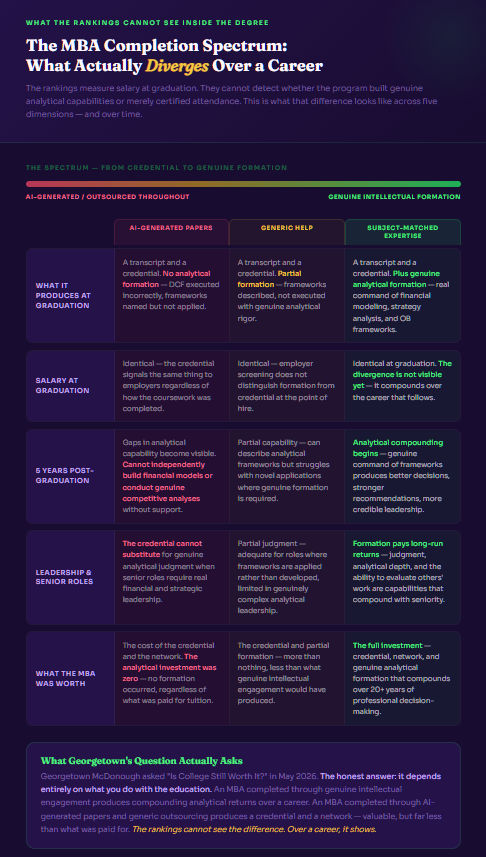
An MBA completed through surface engagement — through AI-generated case analyses, through outsourced strategy papers, through the academic equivalent of credential accumulation without genuine intellectual formation — produces a different thing: a certificate and a LinkedIn credential update. The salary figures look the same at graduation. The capabilities diverge over time.
The Rankings Cannot See Inside the Degree
Here is the specific limitation of the 2026 U.S. News MBA rankings — and of any ranking methodology built around employment outcomes and salary data: they measure the credential, not the formation.
Stanford's position as the best business school in the highly competitive US market is significant, with graduates earning an average salary of $206,174 including bonuses — the highest of any school in the ranking. That number is a downstream consequence of many things: Stanford's admissions selectivity, the quality of its network, the signaling value of the credential in certain industries, and yes, the quality of the education itself. Separating these contributions is methodologically impossible.
What this means for working professionals evaluating MBA programs — and for those already enrolled in part-time, online, or executive programs — is that the ranking is a useful but insufficient guide. The ranking tells you something about program reputation and graduate outcomes. It tells you nothing about whether the specific educational experience you are having is developing the genuine analytical capabilities the degree is supposed to represent.
That distinction has become more consequential in the past three years. The widespread availability of AI tools has created a new pathway to MBA credentials that bypasses the intellectual formation the credential is supposed to certify. A working professional who uses AI to generate case analyses, strategy papers, and finance assignments throughout an MBA program can, in principle, complete a ranked program with decent grades while developing essentially none of the analytical formation that makes the degree valuable.
This is not a hypothetical. It is the pattern that business faculty — those who have spent careers teaching finance, organizational behavior, and strategy — are observing in student work at an accelerating rate. The tell is not always detectable through academic integrity software. The tell is analytical shallowness: DCF models that describe the methodology without executing it correctly, Porter's Five Forces analyses that name all five forces without conducting genuine industry analysis, organizational behavior papers that invoke Herzberg and Kotter by name without demonstrating genuine understanding of the empirical debates around these frameworks.
A credential produced through this process is not worth $150,000. It is worth whatever it costs to produce the paper trail — and that cost, in terms of actual career capability development, is close to zero.
What Actually Makes an MBA Worth What It Costs
The Georgetown question — is the MBA worth it? — has a real answer. It depends on what you do with the education.
An MBA produces genuine return when the student actually develops the analytical capabilities the curriculum is designed to build. A finance student who genuinely learns to build and interpret a DCF model, to understand the assumptions underlying a WACC calculation, to evaluate the strategic and financial logic of a capital allocation decision, has developed a capability that produces real professional value across decades of decision-making. An organizational behavior student who genuinely grapples with the motivation research, who develops authentic frameworks for understanding and influencing organizational dynamics, who builds real leadership judgment through engagement with real organizational cases, has developed something that compounds over a career.
These capabilities cannot be purchased. They can only be built through genuine intellectual engagement with the material. And genuine intellectual engagement requires genuine intellectual help when help is needed — the kind that models what real analytical engagement looks like, rather than the kind that substitutes plausible-sounding prose for actual thinking.
This is the distinction that matters for working professionals in MBA programs who are managing 60-hour careers alongside graduate business coursework. The help that produces a paper without developing analytical understanding is help that undermines the investment being made. The help that connects working professionals to genuine business scholars — to people who actually know how to build a DCF model, conduct a genuine industry analysis, or apply organizational behavior frameworks with authentic disciplinary depth — is a different kind of investment.
Unemployed Professors has been providing the second kind of help since 2010. Our business scholars are not generalists who research your topic. They are disciplinary specialists — finance scholars who actually know financial modeling, strategy scholars who have spent careers in competitive analysis, organizational behavior experts who understand the management research literature at depth. When a working professional needs help with a corporate finance assignment at 11 PM between client calls, we match them with a finance scholar who actually knows what a correctly constructed DCF model looks like.
That is not the same as AI generating a prose description of DCF methodology. And it is not the same as a generic writer researching capital structure theory for the first time. It is subject-matched expertise producing authentic analytical work — the kind that holds up when a finance professor with investment banking experience reads it.
The Bottom Line
Stanford tops the 2026 MBA rankings at $206,174 average salary. Kellogg tops the part-time rankings. Georgetown is asking if the degree is worth it.
The rankings are measuring the right things for what rankings can measure: graduate outcomes, program reputation, peer assessment. They cannot measure the formation that makes those outcomes sustainable — the genuine analytical capabilities that distinguish a leader who can actually do the analytical work from one who can produce papers that describe it.
That distinction has always mattered. It matters more now than it ever has, as AI tools make it easier than at any point in history to produce business school credentials without developing the business school capabilities those credentials are supposed to represent.
For working professionals who enrolled in an MBA program because they want to actually develop those capabilities — who want the degree to be worth what it costs — the kind of help they choose for their academic work is not a minor decision. Help that develops analytical understanding by connecting them to genuine business expertise produces something real. Help that generates plausible-sounding prose produces a transcript.
The rankings cannot see the difference. Over a career, it shows.
POST YOUR PROJECT today and work with a verified business scholar who actually knows the sub-discipline your assignment requires.