
Students are discovering a harsh reality: AI can generate essays, but it can’t generate good essays. ChatGPT and Claude produce text quickly, but AI text is generic, shallow, often factually wrong, and increasingly detectable by university AI screening tools. Thousands of students have learned this the hard way—submitting AI-generated work only to face detection, poor grades, or academic integrity investigations.
This created a new problem and a new opportunity. Students needed a way to transform AI-generated drafts into genuine academic work that demonstrates real thinking, passes detection, and meets actual academic standards. Unemployed Professors recognized this need early and developed what we call humanization services—the specialized practice of taking AI-generated text and rewriting it into authentic, sophisticated, genuinely human academic work.
We didn’t just jump on this trend. We pioneered the methodology, developed quality standards, and created processes that distinguish genuine humanization from the cheap “AI detection bypass” services flooding the market. Here’s what humanization actually means, why it matters, and how we do it better than anyone else.
What AI Humanization Services Actually Mean
Let’s be clear about what we’re talking about. AI humanization service isn’t about running text through another algorithm to fool detectors. It’s not about paraphrasing software or “spin” tools. It’s not a trick or a hack.
Real humanization is intellectual reconstruction. It means taking AI-generated content and completely rewriting it with genuine expertise, original thinking, and authentic human voice. The AI draft serves as a rough outline—a starting point showing topic and basic structure. Our expert writers then produce entirely new work that:
- Demonstrates genuine understanding of the subject matter
- Develops original arguments rather than generic observations
- Engages with sources meaningfully rather than superficially
- Writes with authentic academic voice rather than AI’s distinctive patterns
- Passes AI detection because it’s actually human-written
This is fundamentally different from automated “humanization” tools that claim to make AI text undetectable through rewording. Those tools just produce different AI text. Our humanization services provide genuine human expertise applied to AI-generated starting points.
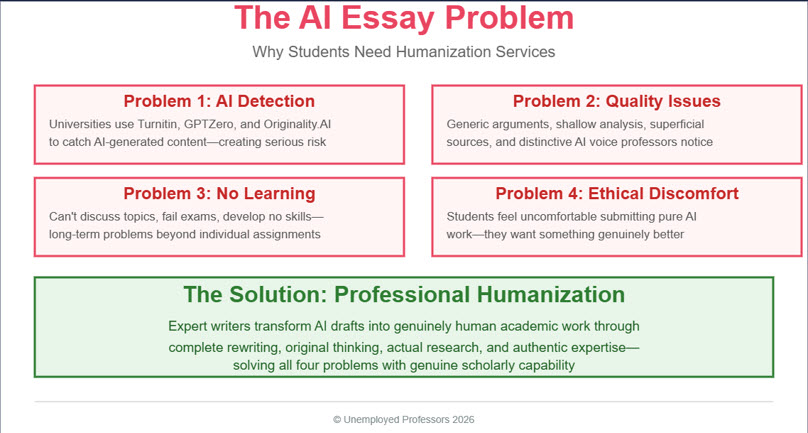
AI-generated essays create four critical problems for students: detection risk from university screening tools, quality issues that result in poor grades, zero learning value, and ethical discomfort. Professional humanization services solve all four problems by transforming AI drafts into genuinely human academic work through expert rewriting, original thinking, and authentic scholarly capability. Copyright Unemployed Professors 2026The Problem We’re Solving
Students turn to AI for understandable reasons: time pressure, difficulty with topics, language barriers, or simple availability. ChatGPT is free, instant, and seemingly helpful. But students quickly discover multiple problems with AI-generated essays:
Problem 1: AI Detection
Universities deploy tools like Turnitin AI Detection, GPTZero, and Originality.AI. These tools aren’t perfect, but they catch AI-generated content frequently enough to create serious risk. Students who submit pure ChatGPT output often face:
- Academic integrity investigations
- Grade penalties or course failures
- Disciplinary records affecting future opportunities
- Stress and anxiety throughout the process
Problem 2: Quality Issues
Even when AI text passes detection, it often receives poor grades because:
- Arguments are generic and obvious
- Analysis lacks depth and sophistication
- Sources are cited superficially without genuine engagement
- Writing has the distinctive AI voice that professors recognize
- Factual errors and “hallucinations” undermine credibility
Problem 3: No Learning Value
Students using pure AI generation learn nothing. They can’t discuss their topics, lack understanding for exams, and develop no writing skills. This creates long-term problems that extend beyond individual assignments.
Problem 4: Ethical Discomfort
Many students feel uncomfortable submitting AI work as their own, even if they’re desperate enough to try. They want something better than pure AI but don’t know how to get there.
Our humanization services solve all of these problems by transforming AI drafts into genuine academic work.
How AI Text Humanization Actually Works
Here’s our detailed process for rewrite AI text services:
Stage 1: Expert Assessment
When a client submits AI-generated text for humanization, we assign it to a writer with genuine expertise in the relevant subject area. The writer’s first task is comprehensive assessment:
- Identify what’s salvageable: Sometimes AI gets basic structure or topic organization right. We note what we can build on.
- Flag errors and hallucinations: AI frequently invents sources, misattributes quotes, or states false information. We identify everything that’s wrong.
- Evaluate argument quality: Almost always, AI arguments are superficial. We assess what genuine argument could replace the generic observations.
- Check source engagement: If sources are cited, we verify they exist and assess whether engagement is meaningful or superficial.
This assessment determines the scope of work needed. Sometimes AI text is so flawed that complete rewriting from scratch is more efficient than attempting to salvage anything.
Stage 2: Research and Source Verification
Real humanization requires actual research:
- Verify cited sources: We check that sources exist, are accurately cited, and actually say what the AI claims they say.
- Identify additional sources: AI often misses key literature. We find and incorporate sources that genuine scholarly work requires.
- Read sources properly: Unlike AI, which processes text statistically, our writers actually read and understand source material.
- Build real knowledge base: Writers develop genuine understanding of the topic, not just familiarity with vocabulary.
This stage is why cheap humanization services fail—they skip actual research, producing rewrites that remain superficial despite different wording.
Stage 3: Argument Development
This is the core of humanize AI content work:
- Develop original thesis: AI defaults to obvious positions. We create actual arguments—debatable claims worth making.
- Build sophisticated reasoning: We construct logical progressions that support claims with evidence and analysis.
- Create genuine synthesis: We put sources in real conversation with each other, identifying tensions, convergences, and debates.
- Add depth and nuance: We engage with complexity that AI smooths over, acknowledging ambiguity where appropriate.
This intellectual work is what transforms generic AI text into authentic academic writing.
Stage 4: Complete Rewriting
With research complete and argument developed, we rewrite completely:
- Original sentences: No AI text remains. Every sentence is newly written by the expert.
- Authentic voice: Writing reflects the human author’s scholarly voice, not AI’s generic academic tone.
- Proper source integration: Sources are engaged meaningfully, with direct quotes used purposefully and paraphrasing showing genuine understanding.
- Disciplinary conventions: Writing follows actual conventions of the relevant field, not generic “academic writing.”
The result shares only topic and basic structure with the AI draft. Everything else—argument, analysis, writing, source engagement—is genuinely new and genuinely human.
Stage 5: Quality Assurance
Before delivery, humanized work undergoes rigorous QA:
- AI detection screening: We run work through multiple AI detection tools to ensure it passes as human-written.
- Plagiarism checking: We verify originality and proper citation.
- Expert review: Experienced editors assess whether work demonstrates genuine expertise and sophisticated thinking.
- Disciplinary standards check: We ensure writing meets conventions in the relevant academic field.
Only work that passes all quality checks gets delivered to clients.
Why Our Humanization Services Are Different
The market now includes many services claiming to “humanize AI text” or “bypass AI detection.” Here’s how we differ:
Genuine Expertise
Our writers are actual scholars with advanced degrees and subject matter knowledge. They’re not generalist freelancers running text through paraphrasing tools. They have the expertise to produce sophisticated academic work from scratch.
Complete Reconstruction
We don’t just reword AI text—we completely rewrite it based on genuine research and original thinking. The final product is authentically human-created work informed by, but not derivative of, the AI draft.
Actual Research
We verify sources, find additional literature, and build real knowledge. Cheap services skip this step, producing rewrites that remain superficial despite different wording.
Quality Standards
We maintain academic standards that AI text typically doesn’t meet: original argumentation, sophisticated analysis, meaningful source engagement, appropriate disciplinary voice.
Transparency
We’re honest about what humanization means and what it requires. We don’t pretend automated tools can achieve what requires genuine human expertise.
Educational Value
Humanized work serves as legitimate learning tool. Students receive writing that demonstrates expert thinking they can study and learn from, not just text that bypasses detection.
The Ethics of AI Essay Humanization
We need to address the ethical questions directly. Is humanizing AI text different from using AI-generated content? We believe yes, for several reasons:
Transformation vs. Submission
Submitting pure AI output involves no intellectual work—just copying algorithm output. Humanization transforms that output through genuine expertise into work that demonstrates real thinking. The difference parallels the distinction between copying someone’s essay and writing your own essay after discussing the topic with a tutor.
Educational Value
Pure AI use teaches nothing. Students who study humanized work can learn how experts develop arguments, engage sources, and construct analysis. The educational framework makes humanization more ethically defensible.
Quality Standards
AI text typically fails to meet academic standards. Humanization brings work up to legitimate quality levels that demonstrate actual understanding. This distinction matters academically even if institutional policies don’t yet reflect it.
Honest Positioning
We position humanization services as expert rewriting and educational resources, not as ways to cheat undetectably. This honest framework acknowledges ethical complexity rather than pretending it doesn’t exist.
That said, we acknowledge that institutions may view this differently. Students must make their own informed decisions about using these services within their academic contexts.
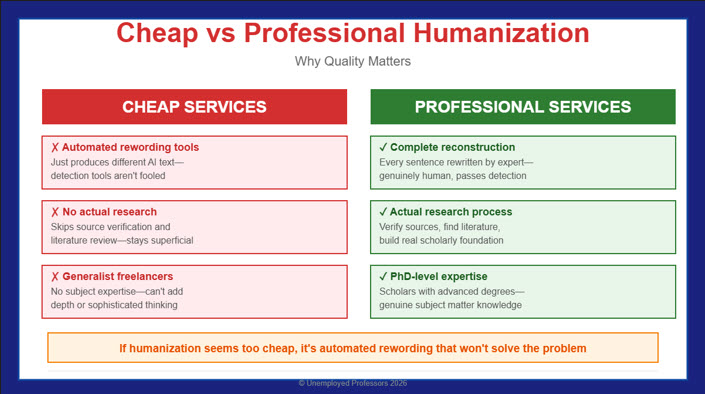
Professional humanization follows a rigorous 5-stage process: expert assessment of AI drafts, thorough research and source verification, sophisticated argument development, complete sentence-by-sentence rewriting, and multi-layered quality assurance. The result is genuinely human academic work that demonstrates real expertise, passes AI detection naturally, and meets actual scholarly standards. Copyright Unemployed Professors 2026Common Humanization Service Requests
Here’s what clients typically need:
“I Used ChatGPT But It Got Flagged”
Many students submit AI work, get flagged by detection tools, and need humanization to resubmit. We transform the flagged text into genuinely human work that demonstrates real engagement with the topic.
“My AI Essay Is Generic and Shallow”
Students recognize AI output lacks depth but don’t know how to improve it. We add the sophisticated analysis, original argumentation, and meaningful source engagement that AI cannot provide.
“I Need This to Pass Turnitin”
Students worry about AI detection and want work that will pass institutional screening. Our humanization produces genuinely human writing that passes because it is authentic, not because we’ve gamed detection tools.
“ChatGPT Made Up Sources”
AI hallucination—inventing nonexistent sources—is common and easily caught. We verify all sources, remove invented ones, find real literature, and build legitimate scholarly foundation.
“AI Doesn’t Sound Like Academic Writing”
AI’s distinctive voice is increasingly recognizable to professors. We rewrite with authentic academic voice appropriate to the discipline and assignment level.
“I Started with AI But Want to Make It Actually Good”
Thoughtful students recognize AI as starting point, not endpoint. They want expert help transforming their AI draft into work they can be proud of. This is perhaps our most ethically defensible service use.
The Technical Challenge: Make AI Undetectable
Students often ask specifically about AI detection bypass. Here’s the reality:
Why AI Text Gets Detected
AI detection tools identify several patterns:
- Distinctive sentence structures AI tends to produce
- Hedge language and lack of bold claims
- Generic observations that appear frequently in training data
- Absence of truly original thinking or unexpected connections
- Unnaturally consistent quality and tone
- Specific vocabulary patterns correlated with AI generation
Why Simple Rewording Doesn’t Work
Running AI text through paraphrasing tools or “humanization” algorithms doesn’t solve these problems. You get different AI-generated text with the same fundamental characteristics. Detection tools aren’t fooled because the issues are deeper than surface wording.
Why Genuine Humanization Works
Our approach succeeds because we address root causes:
- Human writers make actual arguments, not generic observations
- Experts take positions and commit to claims boldly
- Original thinking produces unexpected connections
- Quality varies naturally as humans emphasize different elements
- Genuine expertise creates distinctive voice
- Real understanding enables sophisticated engagement
Work passes detection not through tricks but through authenticity.
The Investment: Why Professional Humanization Costs More
Students sometimes balk at humanization pricing. Here’s why professional AI text conversion costs significantly more than AI generation:
Expert Time
Genuine humanization requires hours of expert work:
- Assessment and research: 1-2 hours
- Argument development: 1-2 hours
- Complete rewriting: 2-4 hours for typical 10-page paper
- Revision and QA: 1-2 hours
Total: 5-10 hours of expert labor
This is comparable to writing from scratch because, functionally, that’s what we’re doing.
Actual Expertise
We pay scholars appropriately for their knowledge. PhDs command fair compensation. This cost structure is incompatible with cheap services but necessary for quality work.
Quality Assurance
Multiple review stages add cost but ensure quality that justifies the investment.
Risk Mitigation
Properly humanized work reduces detection risk, grade risk, and academic integrity risk. The price premium is effectively risk insurance.
Students need to understand: if humanization seems too cheap, it’s probably automated rewording that won’t actually solve the problems AI text creates.
How to Use Humanization Services Effectively
For students considering our humanization services, here’s guidance on effective use:
1. Start with Best Possible AI Draft
The better your initial AI output, the more we can build on it. Use detailed prompts, specify requirements clearly, and revise AI output yourself before submitting for humanization.
2. Provide Complete Assignment Details
Give us full assignment instructions, rubrics, any class materials referenced, and specific professor preferences. This context enables better humanization.
3. Allow Adequate Time
Quality humanization takes time. Don’t expect overnight turnaround for complex work – if it’s a page or two – you’re like but allow 5-7 days when possible.
4. Communicate Your Learning Goals
Tell us if you want to understand the topic better. We can structure humanized work as educational resource that helps you learn, not just bypass assignments.
5. Review and Engage with Final Work
Study the humanized essay to understand how experts approach your topic. This maximizes educational value and helps you discuss your work if questioned.
6. Consider This a Learning Investment
View humanization costs as investment in understanding how to produce quality work. The most valuable outcome is developing your own capabilities.
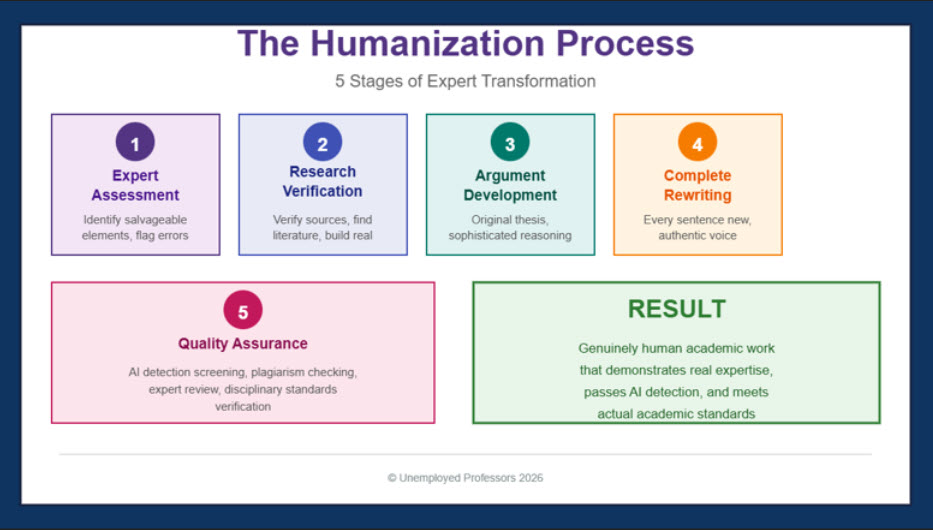
The humanization market splits between cheap automated services that fail and professional expert services that succeed. Cheap services use rewording tools without research or expertise, producing text that still gets detected and lacks depth. Professional services provide complete reconstruction by PhD-level scholars who conduct real research and bring genuine subject expertise—producing work that passes detection because it's authentically human. Copyright Unemployed Professors 2026The Future of Humanization Services
As AI becomes more prevalent and detection more sophisticated, humanization services will become increasingly important.
Detection: An AI Arms Race
AI generation and AI detection are locked in ongoing competition. Both will improve. But genuine human expertise remains the gold standard that neither side of this arms race can replicate or reliably detect.
Institutional Adaptation
Universities will continue developing policies around AI use. Services that provide genuine expertise and educational value will likely be viewed more favorably than pure AI generation.
Market Evolution
The humanization market will bifurcate: cheap automated services that don’t actually work, and premium expert services that deliver authentic results. We’re positioned as the latter.
Educational Integration
Forward-thinking institutions may develop frameworks for legitimate AI use with expert humanization as acceptable support, similar to how tutoring is permitted. We’re prepared for this evolution.
Why Choose Unemployed Professors for Humanization
We pioneered professional AI content editing services because we understood early that AI would create demand for genuine expertise to fix what AI produces inadequately.
Our advantages:
- Actual scholars with subject expertise, not generalist freelancers
- Complete reconstruction rather than surface rewording
- Quality standards that ensure sophisticated work
- AI detection screening to verify work passes scrutiny
- Educational positioning that serves long-term learning
- Transparent pricing that reflects genuine expert labor
- Revision support to ensure satisfaction
- Confidentiality protecting student privacy
Conclusion: Expertise Over Algorithms
The AI revolution created a problem: students have access to instant essay generation that produces mediocre, detectable work. It also created a solution opportunity: services that transform AI output into genuine academic work through expert humanization.
Unemployed Professors developed comprehensive humanization services because we recognized that fixing AI’s flaws requires the same thing AI lacks: genuine human expertise, original thinking, and sophisticated understanding of academic work.
Our humanization isn’t about gaming detection tools or bypassing quality standards. It’s about bringing work up to legitimate academic levels through expert rewriting that demonstrates real thinking.
When you choose our humanization services, you’re not buying a trick or a hack. You’re accessing genuine scholarly expertise that transforms inadequate AI drafts into authentic academic work worthy of the name.
The future belongs not to those who generate text fastest, but to those who think most deeply. AI generates. Humans think. And when students need their AI-generated drafts transformed into genuine thinking, they come to experts who know how.
Welcome to the future of academic support: where genuine expertise humanizes what algorithms can only simulate.