
The AI Trap – False Positives and the Challenges of Being a Serious Student Today
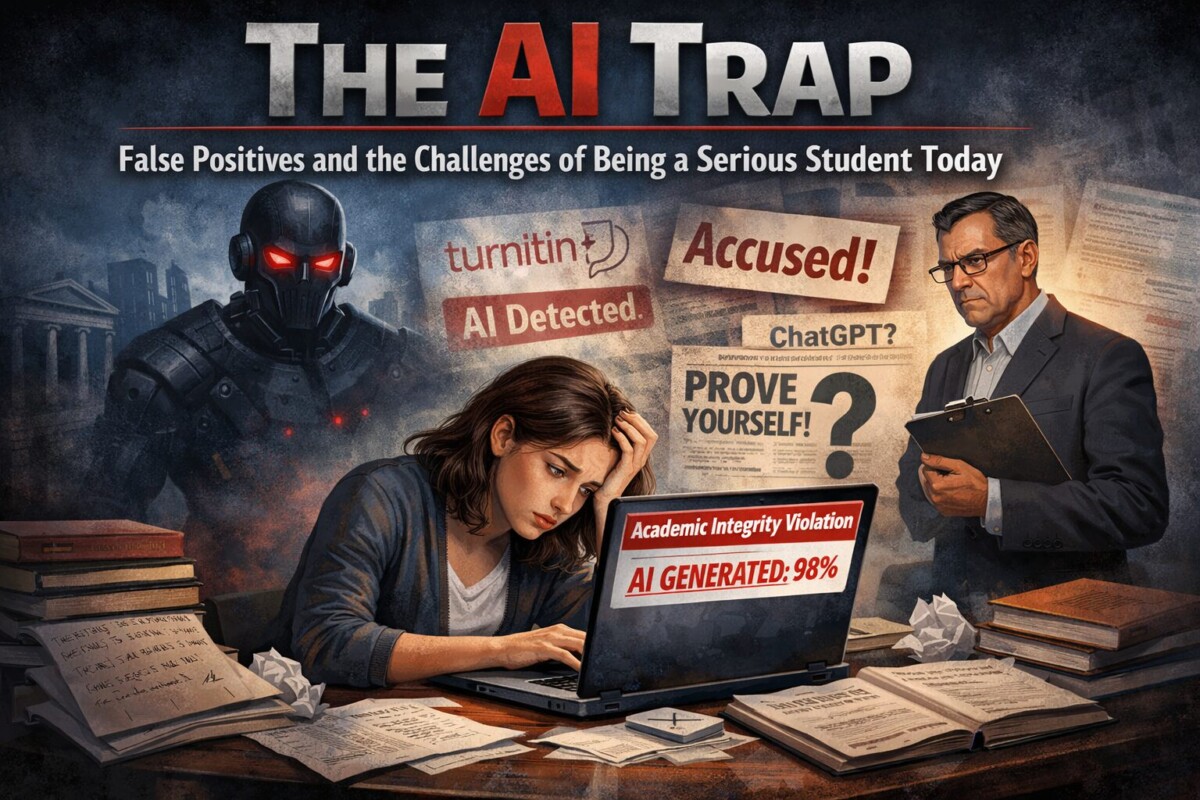
Sarah spent three weeks researching her history thesis. She interviewed primary sources, spent hours in the university archives, and wrote multiple drafts, carefully incorporating her professor’s feedback. She was proud of her work—until she received an email accusing her of using AI to write it. The evidence? Turnitin’s AI detection tool flagged her essay as “98% AI-generated.”
Sarah’s story isn’t unique. Across universities worldwide, serious students are falling into what we call “the AI trap”—a perfect storm of overzealous AI detection tools, institutional paranoia about ChatGPT, and a guilty-until-proven-innocent approach to academic integrity. The irony is devastating: the better you write, the more likely you are to be falsely accused of using AI.
At Unemployed Professors, we’re hearing from more students every week who’ve been wrongly flagged by AI detectors. These aren’t students trying to cheat the system—they’re dedicated scholars being punished for writing too well. Let’s talk about this crisis and what it means for academic integrity in 2026.
The False Positive Crisis Nobody’s Talking About
AI detection false positives aren’t a minor glitch in the system—they’re a systemic crisis that’s undermining trust between students and institutions. And the problem is getting worse, not better.
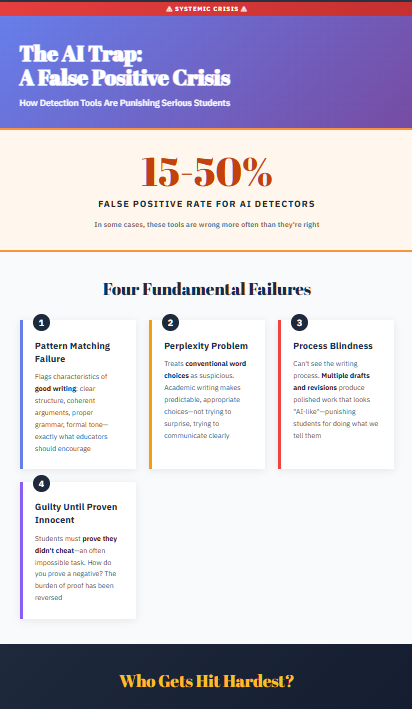
Studies have shown that AI detection tools like Turnitin AI Detection, GPTZero, and Originality.AI produce false positive rates ranging from 15% to over 50%, depending on the writing style and subject matter. Think about that: in some cases, these tools are wrong more often than they’re right.
The mathematics PhD student who writes with the precision and clarity their training demands? Flagged. The international student who worked with a writing tutor to perfect their grammar? Flagged. The English major who’s spent four years developing a sophisticated academic voice? Flagged.
The cruel irony is that AI detector errors most frequently target the exact qualities that educators should be encouraging: clear structure, coherent argumentation, proper grammar, and formal academic tone. These are the same patterns that AI writing tools produce, so detection algorithms can’t distinguish between “student who learned to write well” and “ChatGPT output.”
This creates an impossible situation for serious students. Write too casually and you’ll lose points for lack of academic sophistication. Write with the polish and clarity that comes from genuine effort and multiple revisions, and you risk being accused of using AI when you didn’t.
How AI Detection Actually Works (And Why It Fails)
Understanding why AI false positives happen requires understanding how these detection tools actually work. Most AI detectors use one of two approaches, both fundamentally flawed.
The first approach is pattern matching. The tool analyzes writing for characteristics commonly found in AI-generated text: certain sentence structures, particular transition phrases, specific patterns of word choice. The problem? Good human writing often shares these characteristics. Academic writing especially tends toward formality, clear transitions, and logical structure—exactly what AI detectors flag as suspicious.
The second approach is perplexity analysis. The tool calculates how “surprising” each word choice is based on statistical models. AI-generated text tends to have low perplexity—it makes predictable, safe word choices. But so does good academic writing. Students writing in formal contexts make conventional, appropriate word choices. They’re not trying to be surprising or creative—they’re trying to communicate clearly within disciplinary norms.
Both approaches produce high rates of Turnitin false positives and GPTZero mistakes because they’re built on a flawed assumption: that AI writing and human writing are categorically different. In reality, they overlap significantly, especially in academic contexts where conventional structures and formal language are expected.
The tools also can’t account for the writing process. A student who works through multiple drafts, incorporating feedback and polishing their prose, will produce writing that looks more “AI-like” than a rushed first draft full of errors and informal language. So AI detection problems actually punish students for doing what we tell them to do: revise, edit, and refine.
The Guilty-Until-Proven-Innocent Problem
Perhaps the most troubling aspect of the AI trap is how institutions respond when students are falsely accused AI writing. Many universities have adopted a presumption of guilt that shifts the burden of proof onto students.
When an AI detector flags an essay, students aren’t given the benefit of the doubt. Instead, they’re required to prove they didn’t use AI—an often impossible task. How do you prove a negative? How do you demonstrate that your words came from your own mind rather than ChatGPT?
Some institutions require students to reproduce their work in proctored settings, rewriting their essays from scratch while being watched. Even if you can recreate similar work (which is difficult given that writing is a process, not a one-time performance), this proves nothing about the original essay. It just proves you can write on demand.
Other schools demand to see drafts, outlines, and research notes. But plenty of students don’t work that way. Some write drafts in their heads before committing words to screen. Others make extensive edits directly rather than saving progressive versions. The lack of a particular writing process doesn’t prove AI use—it just proves you don’t work the way the institution expects.
The academic integrity challenges this creates are profound. Students learn that being a serious student isn’t enough. You also need to document your seriousness in ways that satisfy algorithmic suspicion. You need to write less well to avoid triggering false positives, or maintain elaborate paper trails to prove your work is your own.
This is exhausting, demoralizing, and fundamentally unfair. Students are being punished not for cheating but for failing to anticipate that their genuine effort might look suspicious to a flawed algorithm.
The International Student Crisis
AI detection false positives hit international students particularly hard, creating a devastating paradox: the more they improve their English, the more likely they are to be accused of cheating.
Many international students work with writing centers, tutors, or services like Unemployed Professors to improve their academic English. They learn to eliminate grammatical errors, structure arguments clearly, and write in formal academic register. This is exactly what they should be doing—developing the language skills necessary for academic success.
But when they submit polished work that’s been carefully edited and revised to meet English academic standards, AI detectors flag it. The logic is circular and cruel: their earlier work had errors and informal language (low AI detection score), so when they submit error-free, formally structured work (high AI detection score), it must be AI-generated.
We’ve worked with students who’ve been told by professors, “Your English wasn’t this good last semester, so you must have used ChatGPT.” The assumption that improvement equals cheating is both linguistically ignorant and deeply unfair. Language acquisition doesn’t progress linearly, and students often make dramatic improvements when they receive proper support and feedback.
The problem is compounded by the fact that many AI detection tools were trained primarily on native English speakers’ writing patterns. They may not accurately model the linguistic features of proficient L2 English writing, leading to even higher false positive rates for international students.
This creates a chilling effect on language learning. International students learn that improving too much, too quickly makes them suspect. Some deliberately maintain a certain level of error in their writing to avoid triggering AI detectors. This is pedagogically backwards and morally reprehensible—we’re discouraging students from developing the exact skills they need to succeed.
When Good Writing Becomes Suspicious
Here’s one of the most perverse effects of the AI trap: it’s made good writing suspicious. Faculty members who should be celebrating clear, coherent, well-structured student work are instead viewing it with suspicion.
Students report that professors have told them their work is “too good” or “too polished” to be authentic. The subtext is clear: if you write well, you must have cheated. This inverts the entire purpose of education, which is supposed to help students learn to write well.
The problem is especially acute in fields with strong writing conventions. Philosophy students learn to write with precision and logical clarity. STEM students learn to write with technical accuracy and formal structure. Business students learn to write with professional polish. When they successfully internalize these disciplinary writing norms, they produce work that looks “AI-like” because AI was trained on similar professional and academic writing.
We’re seeing students deliberately degrade the quality of their writing to avoid accusations. They leave in minor grammatical errors, use less sophisticated vocabulary, or maintain informal elements that don’t belong in academic work. They’re strategically performing incompetence to prove authenticity.
This is absurd. Education should encourage students to write as well as they possibly can, not to carefully calibrate their competence to stay below suspicion thresholds. But that’s the reality of being a serious student today when fighting AI accusations has become a necessary skill.
The Documentation Burden
To protect themselves against AI false positives, students are being told to maintain extensive documentation of their writing process. Save every draft. Keep detailed notes. Track your research. Preserve your brainstorming documents. Essentially, create a portfolio of evidence proving you wrote your own work.
For some students, this is manageable. For others, it’s an enormous additional burden on top of already demanding coursework. And it raises troubling questions about privacy and academic freedom.
Should institutions have the right to demand access to every stage of your creative and intellectual process? Is the burden of proving you didn’t cheat really appropriate in an educational context? What about students whose writing processes don’t naturally produce the kinds of artifacts that serve as “evidence”?
Moreover, this documentation requirement advantages privileged students who have time, resources, and knowledge to maintain elaborate writing portfolios. First-generation students, working students, students with learning differences—they may not have the bandwidth or know-how to create these proof-of-work archives. So they’re more vulnerable when AI detectors produce false positives.
The documentation burden also doesn’t actually solve the problem. Determined cheaters can fake drafts and notes. Meanwhile, honest students who simply don’t work that way are left without recourse when algorithms accuse them falsely.
At Unemployed Professors, we’re advising students to protect themselves however they can—keeping drafts, using version control, documenting their process. But we recognize this as a symptom of a broken system, not a solution to it.
The Psychology of Being Falsely Accused
The psychological impact of being falsely accused AI writing is severe and often underestimated by institutions. Students describe feeling violated, angry, helpless, and distrustful of their professors and universities.
Imagine working weeks on an assignment, putting genuine intellectual effort into developing your ideas, and then being told your work is fraudulent. The message you receive is clear: your effort doesn’t matter, your improvement doesn’t matter, and your word isn’t trusted.
Many students report losing motivation after false accusations. Why work hard if excellence triggers suspicion? Why take writing seriously if you’re safer submitting mediocre work? The AI trap creates learned helplessness and cynicism about academic values.
There’s also the stress of navigating the academic integrity challenges process. Even when students are eventually cleared, they’ve spent weeks or months under investigation, meeting with administrators, providing documentation, and defending themselves. The process itself is punishment, regardless of outcome.
Some students face ongoing suspicion even after being cleared. Professors who initially flagged their work remain skeptical. Future assignments receive extra scrutiny. The stain doesn’t fully wash away.
This is devastating for serious students who view their education as meaningful and their relationship with professors as based on mutual respect and trust. The AI trap corrodes these foundations, replacing them with surveillance, suspicion, and defensive documentation.
The Equity Problem
AI detection false positives don’t affect all students equally. The tools have built-in biases that make them less accurate for certain populations.
As mentioned, international students face higher false positive rates. So do students who use assistive technologies like Grammarly, which helps them overcome learning differences or language challenges. The tools can’t distinguish between AI writing and human writing enhanced by legitimate assistive technology.
Students at under-resourced institutions face different challenges. Their professors may rely more heavily on AI detectors because they lack time to evaluate work carefully or relationship with students that builds trust. False positives are more likely to be accepted at face value rather than investigated thoughtfully.
First-generation students and students from backgrounds underrepresented in higher education also face disadvantages. They may not know their rights when accused, may not feel empowered to advocate for themselves, and may not have access to resources that help them fight false accusations.
Meanwhile, privileged students have advantages at every stage. They’re more likely to have learned to write in ways that don’t trigger detectors. They’re more likely to have maintained documentation. They’re more likely to have advocates who can intervene on their behalf. They’re more likely to be given the benefit of the doubt.
The AI trap thus exacerbates existing educational inequities. It creates another mechanism through which marginalized students can be pushed out of higher education, even when they’re doing everything right.
What Students Can Do (And Shouldn’t Have To)
Given the current reality of AI detector errors and institutional paranoia, what can serious students actually do to protect themselves?
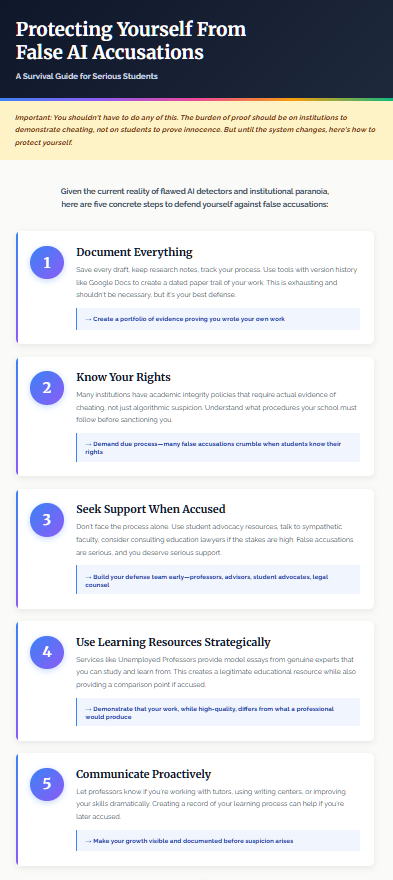
First, document your writing process obsessively. Save every draft. Keep your research notes. Use tools with version history like Google Docs. Create a dated paper trail of your work. This is exhausting and shouldn’t be necessary, but it’s your best defense against false accusations.
Second, understand your rights. Many institutions have academic integrity policies that require actual evidence of cheating, not just algorithmic suspicion. Know what procedures your school must follow before sanctioning you. Many false accusations crumble when students demand due process.
Third, seek support when accused. Don’t face the process alone. Use student advocacy resources, talk to sympathetic faculty, consider consulting education lawyers if the stakes are high. False accusations are serious, and you deserve serious support in fighting them.
Fourth, consider using services like Unemployed Professors strategically. We can provide model essays that demonstrate how expert writers approach your topic, which you can study and learn from. This creates a legitimate educational resource while also providing a comparison point if you’re accused—you can demonstrate that your work, while high-quality, differs substantially from what a professional would produce.
Fifth, communicate proactively with professors. Let them know if you’re working with tutors, using writing centers, or improving your skills dramatically. Creating a record of your learning process can help if you’re later accused.
But here’s what we really want students to know: you shouldn’t have to do any of this. The burden of proof should be on institutions to demonstrate cheating, not on students to prove innocence. The AI trap is unjust, and students have every right to be angry about it.
The Institutional Failure
Universities pride themselves on critical thinking and evidence-based reasoning. Yet many have abdicated these values when it comes to AI detection, uncritically accepting algorithm outputs and shifting burden of proof onto students.
This is a failure of educational leadership. Institutions should be protecting students from the harms of unreliable technology, not deploying it against them. They should be fostering trust and supporting learning, not creating surveillance systems that presume guilt.
The Turnitin false positive problem and similar issues with other AI detectors are well-documented in academic literature. Institutions know these tools are unreliable. They’re using them anyway, often because they lack better alternatives and need to appear responsive to concerns about AI cheating.
But appearing responsive and actually solving problems are different things. The current approach—deploy imperfect detection tools, investigate everyone they flag, make students prove their innocence—isn’t working. It’s catching few actual cheaters while traumatizing many innocent students.
Universities need to develop more thoughtful approaches to academic integrity in the AI era. This means:
- Treating AI detector results as preliminary indicators, not proof
- Maintaining burden of proof on the institution, not the student
- Considering context, including student history and improvement patterns
- Using multiple forms of assessment that reveal genuine understanding
- Building relationships with students that make trust possible
- Accepting that some cheating will go undetected rather than presuming all excellence is suspicious
Until institutions make these changes, serious students will continue falling into the AI trap, punished for doing exactly what education is supposed to encourage.
How Unemployed Professors Helps
At Unemployed Professors, we’re deeply aware of the challenges serious students face in this environment. Our services are designed to support genuine learning while helping students navigate the realities of AI suspicion.
When students work with us, they receive model essays created by genuine experts—not AI-generated content. These models demonstrate how professional scholars approach topics, construct arguments, and engage with sources. Students can learn from these examples while producing their own original work.
Importantly, our work is distinguishable from student work. We write at a professional level that, while excellent, differs in sophistication and voice from undergraduate or even graduate student writing. If a student is accused of AI use, they can point to the model we provided and demonstrate that their submitted work, while informed by our example, is distinctly their own.
We also advise students on how to protect themselves against false accusations. We understand the current landscape of AI detection and can help students navigate it without compromising their learning or their integrity.
Conclusion: The Path Forward
The AI trap—the perfect storm of unreliable detection tools, institutional paranoia, and presumption of guilt—represents a crisis in higher education. Serious students are being caught in systems that punish excellence and undermine the trust essential to learning.
This situation is unsustainable. Universities must develop more sophisticated approaches to academic integrity that don’t rely on flawed algorithms and don’t presume students are guilty until proven innocent. They must recognize that AI detection false positives aren’t acceptable collateral damage—they’re serious injustices that harm the students institutions are meant to serve.
Until these systemic changes happen, students need support navigating a hostile environment. They need resources that help them learn while protecting them from unjust accusations. They need advocates who understand both the technology and the stakes.
Unemployed Professors exists to provide that support. We believe in authentic learning, genuine expertise, and the right of students to be treated with dignity and fairness. In an era of AI traps and algorithmic suspicion, those values matter more than ever.
If you’ve been falsely accused AI writing, if you’re afraid that doing your best will make you suspect, if you’re exhausted by the documentation burden and loss of trust—you’re not alone. The system is broken, not you. Keep fighting for your right to learn, to improve, and to be judged fairly. The future of education depends on it.