
By Professor Rogue – January 31, 2025
I’ve been writing academic essays for Unemployed Professors since 2011. Fifteen years. Over 8,000 essays. More than 40,000 pages of academic writing across disciplines I never imagined I’d engage with when I finished my PhD in Political Science. I’ve written about quantum mechanics, medieval literature, nursing ethics, constitutional law, postmodern architecture, and approximately seven thousand variations on “analyze this text using critical theory.”
When ChatGPT launched in late 2022, I had the same initial reaction as most of my colleagues: existential dread mixed with morbid curiosity. Was this the end? Had I spent over a decade building expertise in academic ghostwriting only to be replaced by an algorithm?
Two years later, I’m still here, busier than ever, and working more efficiently than I ever have. But my academic writing workflow has fundamentally changed. This is my reflection on how a veteran academic writer learned to stop worrying and love AI—not by using it to write, but by integrating it thoughtfully into a process refined over thousands of essays.
The First Decade: Building Systematic Expertise
To understand how AI changed my work, you need to understand what that work looked like before. By 2022, I had developed a highly systematized approach to academic writing that came from sheer repetition across an absurd volume of work.
When you’ve written 8,000 essays, patterns emerge. You recognize that undergraduate philosophy papers follow predictable structures. You know that literature analysis essays require specific types of textual engagement. You understand that social science papers need particular kinds of evidence and argumentation. This pattern recognition becomes second nature—you can assess an assignment and know instantly what framework to apply.
My pre-AI workflow looked like this:
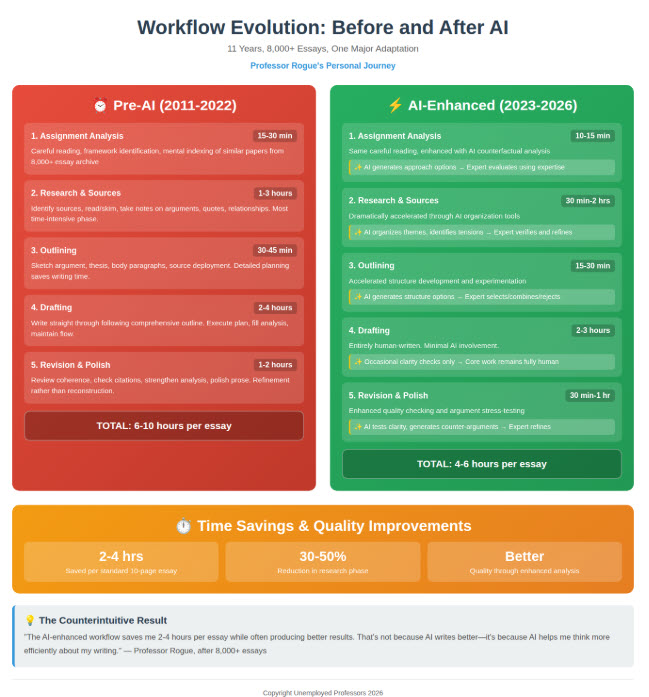
Stage 1: Assignment Analysis (15-30 minutes) I’d read the assignment carefully, identify the key theoretical frameworks or methodologies required, and mentally index similar papers I’d written. After thousands of essays, I’d almost certainly done something analogous before.
Stage 2: Research and Source Gathering (1-3 hours) I’d identify relevant sources, read or skim them depending on complexity, and take notes on key arguments, useful quotes, and how they might relate to each other. This was the most time-intensive phase.
Stage 3: Outlining (30-45 minutes) I’d sketch the argument structure, decide on thesis, map out body paragraphs, and identify where specific sources would be deployed. The outline was usually detailed—I’d learned that time spent planning saved time writing.
Stage 4: Drafting (2-4 hours for typical 10-page paper) I’d write the essay straight through, rarely stopping. The outline was comprehensive enough that drafting became almost mechanical—execute the plan, fill in the analysis, maintain flow.
Stage 5: Revision and Polish (1-2 hours) I’d review for argument coherence, check citations, strengthen analysis where needed, and polish prose. My first drafts were usually pretty clean after years of practice, so revision was more refinement than reconstruction.
Total time for standard 10-page essay: 6-10 hours
This worked. I could complete 3-4 essays per week comfortably, more during busy periods. The system was efficient, proven over thousands of iterations. But it was also reaching its limits. After a decade, the work was starting to feel mechanical in ways that weren’t entirely positive. I was very good at it, but the routine was becoming stifling.
The AI Disruption: Initial Panic and Experimentation
When ChatGPT went viral, my initial response was defensive. I tested it immediately, feeding it assignment prompts similar to ones I’d completed. The results were… troubling.
It wasn’t that the AI output was good—it was mediocre at best, shallow, often factually wrong. But it was fast. Disturbingly fast. And for someone who didn’t know better, it might seem adequate. I could see how students would be tempted, and how cheaper competitors might replace human writers with AI generation.
My second response was more analytical. I spent weeks testing AI’s capabilities systematically. I had it write essays on topics I’d covered extensively. I compared its output to my own work. I studied where it failed and where it succeeded. I needed to understand the technology not as a competitor, but as a tool I might leverage.
What I discovered fundamentally shaped how I adapted:
AI was terrible at actual writing in my field. The essays were generic, shallow, and lacked genuine engagement with theoretical frameworks. For the kind of sophisticated academic work I specialized in, AI was not a replacement threat.
But AI was potentially valuable for supporting tasks I found tedious or time-consuming. The research organization, the outlining experiments, the counterfactual analysis—AI could accelerate these processes if used thoughtfully.
This realization led to my current approach: AI for academics as workflow enhancement, not content generation.
How AI Changed My Workflow: The Current System
My academic writing workflow in 2026 looks substantially different from 2022, though the core intellectual work remains entirely mine. Here’s how AI integration actually functions in practice:
Stage 1: Assignment Analysis (10-15 minutes – AI-enhanced)
I still read assignments carefully, but now I also run them through AI for counterfactual analysis. I’ll ask: “What are five different approaches someone could take to this topic?” The AI generates options, most of which I immediately recognize as inadequate. But occasionally it suggests an angle I hadn’t considered, or reminds me of a theoretical framework I’d forgotten about.
This is AI for academics at its most useful—rapid option generation that I evaluate using my expertise. It doesn’t replace analysis; it accelerates it. What used to take 30 minutes of mental brainstorming sometimes takes 15 because I can react to AI suggestions rather than generating everything from scratch.
Stage 2: Research and Source Gathering (30 minutes – 2 hours – dramatically AI-enhanced)
This is where AI changed my work most dramatically. Research organization was always my least favorite part of the process—tedious, necessary, and time-consuming.
Now, when I identify relevant sources, I use AI to help organize and synthesize key arguments quickly. I might feed it abstracts from multiple papers and ask it to identify common themes, contrasting positions, or theoretical tensions. The AI gives me a quick conceptual map that I then verify and refine through actual reading.
For sources I need to engage deeply with, I still read completely. But for peripheral sources or background literature, AI-assisted summarization lets me process material much faster. I always verify the AI’s understanding—it frequently misses nuance or makes errors—but even catching errors is faster than doing everything manually.
I also use AI for counterfactual analysis during research: “If I wanted to argue X about this topic, what kinds of sources would I need?” This helps me identify gaps in my research before I start writing.
Time savings: 30-50% reduction in research phase
Stage 3: Outlining (15-30 minutes – AI-enhanced)
My outlining process always involved generating multiple potential structures and selecting the best one. Now I use AI to accelerate this. I’ll describe my thesis and source base and ask AI to generate three different outline structures.
The AI-generated outlines are usually terrible—generic, poorly organized, missing the nuances of my actual argument. But seeing them helps me clarify my own thinking. I know immediately why each AI structure doesn’t work, which helps me articulate what structure does work.
I might also use AI for drafting specific transitions or introductory framework paragraphs during outlining. The AI text never goes into the final essay directly, but it helps me think through how to introduce complex ideas or connect disparate sections.
This is AI workflow integration for ideation—the AI serves as a very fast, very mediocre thinking partner whose inadequate suggestions help me refine my own superior approach.
Stage 4: Drafting (2-3 hours – minimal AI involvement)
The actual writing remains entirely mine. I don’t use AI to generate paragraphs, arguments, or analysis. This is where my expertise matters most—the sophisticated engagement with sources, the original argumentation, the disciplined voice.
Occasionally, if I’m struggling to articulate a complex idea clearly, I’ll draft it myself, ask AI to paraphrase it, and then compare versions. Usually my original is better, but sometimes the AI paraphrase helps me see where my explanation was unclear. I then rewrite in my own words with better clarity.
But to be absolutely clear: no AI-generated text appears in my final essays. The drafting phase is human expertise applied to intellectual problems. That’s not something I’d delegate even if AI were capable of it, which it isn’t.
Stage 5: Revision and Polish (30 minutes – 1 hour – AI-enhanced)
During revision, I use AI for quality checking in specific ways:
I’ll ask AI to identify the main argument in my essay. If it gets it wrong or struggles to identify the thesis, that tells me my argument isn’t clear enough. This is faster than waiting for editorial feedback.
I’ll have AI generate potential counter-arguments to my position. If they’re stronger than I anticipated, I need to address them in my essay. This stress-testing improves argument quality.
I’ll check individual claims by asking AI whether they’re accurately stated. If AI hallucinates supporting evidence for my claim, that sometimes indicates I haven’t supported it sufficiently in my own text.
These AI tools for writers serve as rapid feedback mechanisms. They don’t replace my editorial judgment, but they surface potential issues faster than manual review alone.
Total time for standard 10-page essay: 4-6 hours
The AI-enhanced workflow saves me 2-4 hours per essay while often producing better results. That’s not because AI writes better—it’s because AI helps me think more efficiently about my writing.
What AI Can’t Do: The Irreplaceable Core
After two years of integration, I’m crystal clear about what AI cannot do and what therefore remains my irreplaceable value:
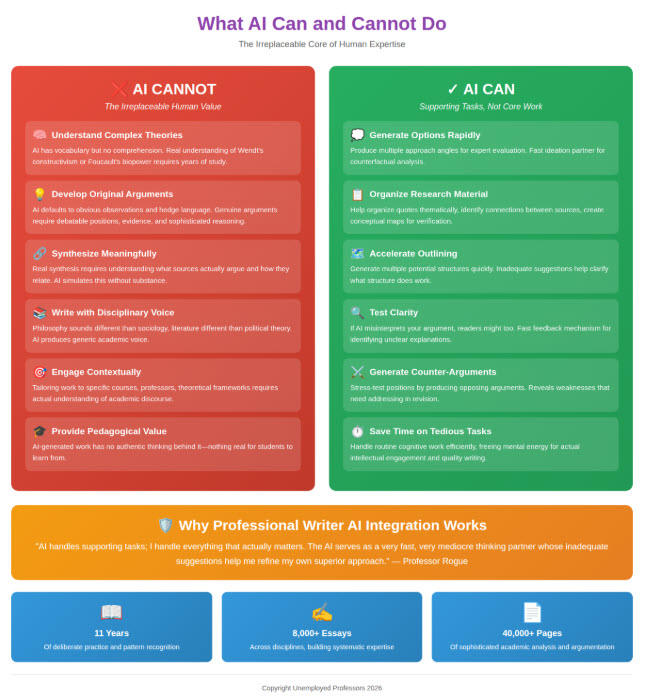
AI cannot understand complex theories. When I’m writing about Wendt’s constructivism or Foucault’s biopower, I actually understand these frameworks. I’ve spent years studying them. AI has vocabulary but no comprehension. This fundamental difference manifests throughout my writing in ways that matter.
AI cannot develop original arguments. My essays make genuine claims—debatable positions supported by evidence and reasoning. AI defaults to obvious observations and hedge language. After 8,000 essays, I know how to construct arguments that are sophisticated, defensible, and original. AI cannot replicate this.
AI cannot synthesize sources meaningfully. Real synthesis requires understanding what sources actually argue and how they relate to each other. I read sources, comprehend their positions, and can put them in genuine conversation. AI simulates this without substance.
AI cannot write with disciplinary voice. I know how philosophy papers should sound versus sociology versus literature analysis. These disciplinary voices reflect different intellectual traditions. AI produces generic academic voice that doesn’t match any real field.
AI cannot engage contextually. I can tailor work to specific course contexts, incorporate particular professors’ preferences, align with theoretical frameworks emphasized in class. This contextual intelligence requires actual understanding of academic discourse.
AI cannot produce work with pedagogical value. Students who study my essays are learning from genuine expertise. There’s actual scholarly thinking demonstrated that they can learn from. AI-generated work has no authentic thinking behind it—there’s nothing real to learn from.
This is why professional writer AI integration doesn’t threaten my livelihood. The AI handles supporting tasks; I handle everything that actually matters.
The Unexpected Benefits: Better Work, Less Burnout
The counterintuitive result of AI integration is that I’m doing better work with less burnout than before. This surprised me.
Before AI, the sheer volume of routine tasks created fatigue. After your 5,000th literature review or 3,000th research organization session, the tedium grinds you down. I was efficient, but I was also increasingly mechanical. The work felt repetitive in ways that sapped engagement.
AI handles much of this routine work now. Research organization happens faster. Outlining experiments are accelerated. Counterfactual analysis that used to require mental energy now involves reacting to AI suggestions.
This frees mental energy for the work I actually enjoy: the intellectual engagement with complex ideas, the construction of sophisticated arguments, the writing itself. I spend less time on logistics and more time on thinking. The result is work I’m more proud of, produced with less exhaustion.
I’m also learning more. When AI generates approaches I wouldn’t have considered, even if they’re ultimately wrong, they force me to think through why they’re wrong. This sharpens my own thinking. After 11 years, staying intellectually engaged with the work required finding new challenges. AI provides them by being an endlessly mediocre thinking partner whose inadequacy helps me sharpen my own expertise.
Professional Development AI: Staying Relevant Over Time
One concern about any career is obsolescence—will your skills remain valuable? For academic ghostwriters, AI seemed like the obsolescence trigger.
But professional writing experience actually became more valuable, not less. Here’s why:
The market flooded with AI-generated content. This made work from genuine experts more valuable by contrast. Students who tried AI alternatives discovered the difference in quality quickly. My repeat client rate increased because I offer something ChatGPT cannot: actual expertise.
My ability to use AI tools effectively became a skill differentiator. Not all experienced writers adapted successfully. Some rejected AI entirely out of fear or principle. Others used it inappropriately, letting it generate content directly. I found the middle path—thoughtful integration that enhanced expertise rather than replacing it.
My years of pattern recognition from 8,000+ essays gave me advantages in AI era. I can instantly recognize when AI-generated content appears in my field because I’ve seen thousands of examples of real academic writing. I know what genuine engagement looks like versus simulation.
My reputation and client relationships, built over a decade, proved more resilient than AI disruption. Students who’d worked with me knew the quality I delivered. They weren’t easily persuaded to switch to cheaper AI alternatives because they understood the difference.
The academic career longevity I’d built positioned me perfectly for AI adaptation. I had enough experience to recognize AI’s limitations immediately, enough expertise to use it thoughtfully, and enough reputation to weather industry disruption.
Advice for Other Academic Writers
Based on my experience adapting to AI after 11 years and 35,000+ pages of academic writing, here’s my advice for other professional writers:
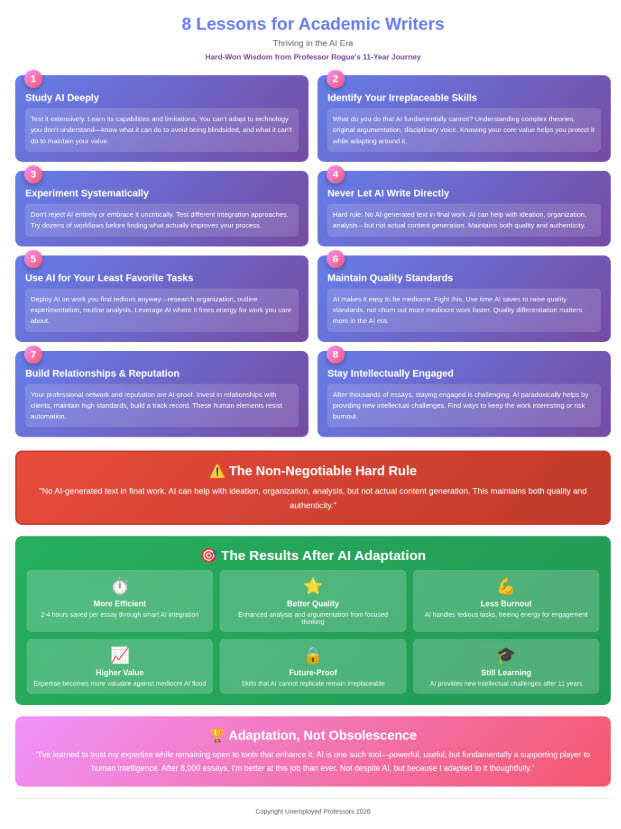
1. Study AI Deeply You can’t adapt to technology you don’t understand. Test it extensively. Learn its capabilities and limitations. You need to know what it can do to avoid being blindsided, and what it can’t do to maintain your value proposition.
2. Identify Your Irreplaceable Skills What do you do that AI fundamentally cannot? For me, it’s genuine understanding of complex theories, original argumentation, and disciplined academic voice. Knowing your core value helps you protect it while adapting around it.
3. Experiment Systematically Don’t reject AI entirely or embrace it uncritically. Test different integration approaches. I tried dozens of workflows before finding what actually improved my process. Your optimal integration will depend on your specific work.
4. Never Let AI Write Directly This is my hard rule: no AI-generated text in final work. AI can help with ideation, organization, analysis, but not actual content generation. This maintains both quality and authenticity.
5. Use AI for Your Least Favorite Tasks AI is best deployed on work you find tedious anyway. For me, that’s research organization. For others, it might be outlining or editing. Leverage AI where it frees energy for work you care about.
6. Maintain Quality Standards AI makes it easy to be mediocre. Fight this. Use the time AI saves to raise your quality standards, not to churn out more mediocre work faster. Quality differentiation matters more in the AI era.
7. Build Relationships and Reputation Your professional network and reputation are AI-proof. Invest in relationships with clients, maintain high standards, and build a track record. These human elements resist automation.
8. Stay Intellectually Engaged After thousands of essays, staying engaged is challenging. AI, paradoxically, helped me re-engage by providing new intellectual challenges. Find ways to keep the work interesting or risk burnout regardless of AI.
The Future: What the Next Decade Holds
I’ve been doing this for 11 years. I can probably do it for 11 more if I want to, despite AI. Maybe because of AI, given how it’s improved my workflow and reduced burnout.
The future I envision isn’t AI replacing academic writers—it’s AI making excellent academic writers more valuable by flooding the market with mediocre alternatives. Students will always need access to genuine expertise. The ones who understand the difference will seek it out and pay for it.
AI will keep improving, certainly. But the fundamental limitation—that it cannot understand, cannot truly think, cannot produce original intellectual work—seems architectural rather than temporary. Future models might simulate expertise more convincingly, but simulation isn’t the same as the real thing.
My competitive advantage comes from 11 years and 8,000 essays worth of accumulated expertise. That’s not easily replicated, by humans or algorithms. The pattern recognition, the disciplinary knowledge, the argumentation skills—these were built through deliberate practice over thousands of iterations.
New writers entering the field face different challenges. They need to develop expertise in an AI-saturated environment, which is harder. But they also have access to AI tools from the start, which changes learning curves. The barrier to entry might be higher (genuine expertise matters more), but the tools for developing it are more accessible.
Conclusion: Adaptation, Not Obsolescence
I started this reflection with a question: would AI make my decade of expertise obsolete? Two years later, the answer is definitively no.
But the work has changed. I use AI for counterfactual analysis, research organization, outlining experimentation, and quality checking. I’ve integrated it into my workflow in ways that make me more efficient without replacing the expertise that makes my work valuable.
The key insight from my experience: AI for academics means augmentation, not replacement. The technology is powerful but limited. Used thoughtfully, it enhances human capability. Used carelessly, it produces mediocrity at scale.
After 8,000 essays and 35,000 pages, I’ve learned to trust my expertise while remaining open to tools that enhance it. AI is one such tool—powerful, useful, but fundamentally a supporting player to human intelligence.
I’ve stopped worrying about AI replacing me because I understand what it can and cannot do. I’ve learned to love AI because it handles tasks I never loved anyway, freeing me to focus on the intellectual work that made me good at this in the first place.
Eleven years in, I’m better at this job than ever. Not despite AI, but because I adapted to it thoughtfully. That’s the lesson: technology disrupts, but expertise combined with smart adaptation endures.
Here’s to the next 8,000 essays. With AI’s help, they’ll take less time and be better quality than the first 8,000. And they’ll still be unmistakably, irreplaceably human.
Professor Rogue has been writing for Unemployed Professors since 2014, specializing in political theory, international relations, and interdisciplinary social science. He holds a PhD from a major research university and has completed over 8,000 academic essays totaling more than 35,000 pages across virtually every academic discipline.
Pingback: Unemployed Professors FAQ: Everything You Need to Know About Our Services in the AI Era | The Unemployed Professors Blog