
When ChatGPT launched in late 2022, the academic writing industry faced an existential crisis. Competitors panicked. Some shut down entirely, convinced AI had made human writers obsolete. Others pivoted hard into AI-generated content, firing their writers and automating everything. A few, like Unemployed Professors, saw an entirely different opportunity.
We recognized that the AI revolution would create a competitive edge AI for companies that understood one crucial insight: in a world where everyone has access to mediocre AI-generated content, genuine human expertise becomes more valuable, not less. The question wasn’t whether to use AI—it was how to use it strategically without replacing the human intelligence that makes our work valuable.
This is the story of how we turned a potential industry-killer into our strongest AI competitive advantage, not by generating content with algorithms, but by understanding the technology well enough to position ourselves as the obvious alternative to it.
The Fork in the Road: Automate or Differentiate
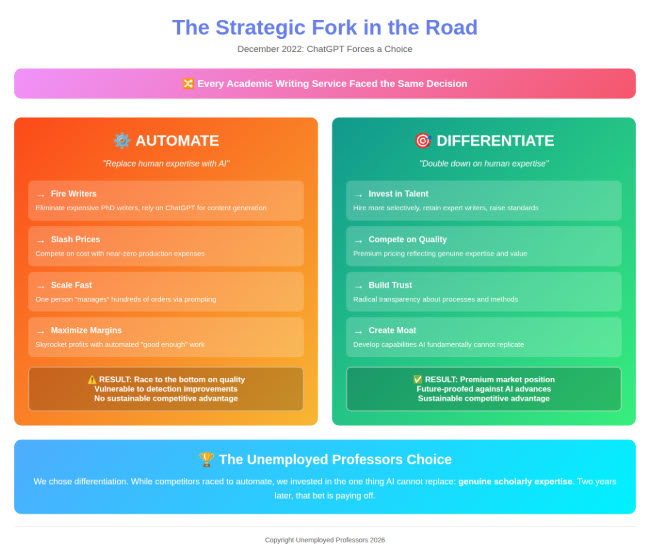
December 2022 marked a watershed moment for academic writing services. ChatGPT’s viral explosion , with Claude following soon thereafter, forced every company in our industry to make a choice: embrace automation or double down on expertise.
The economics of automation were seductive. AI-generated essays cost essentially nothing to produce. A single person could “manage” hundreds of orders simultaneously by prompting ChatGPT. Profit margins would skyrocket. Scaling would be trivial. Why maintain a network of expensive PhD-holding writers when an algorithm could produce “good enough” work instantly?
Many of our competitors made exactly this calculation. They replaced human writers with AI writing tools, slashed prices to undercut human-written services, and positioned themselves as the cheap, fast alternative. Their AI business strategy seemed logical: if the technology is inevitable, be first to adopt it completely.
We made a different calculation. We asked not what AI could do, but what it couldn’t do. We studied AI’s technological limitations, tested its outputs extensively, and consulted with our network of actual academics about what they were seeing in AI-generated student work.
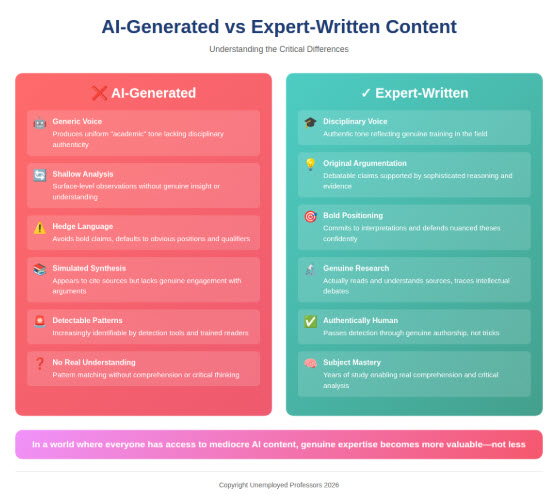
What we discovered shaped our entire strategic response: AI writes badly in ways that matter for academic purposes. It lacks genuine understanding, produces shallow analysis, makes factual errors, and cannot develop original arguments. More importantly, it was already being detected and would only become more detectable as institutions adapted.
This insight led to our core strategic decision: position Unemployed Professors not as an AI-powered service, but as the human alternative to AI. While competitors raced to the bottom with automated content, we would compete on quality, expertise, and authentic human thinking.
Copyright Unemployed Professors 2026
Understanding the Technology to Compete Against It
Here’s a counterintuitive aspect of our AI strategy: we invested heavily in understanding AI writing technology precisely because we weren’t using it to generate content. You can’t position yourself as superior to something you don’t understand.
We tested every major AI writing tool extensively. We studied how large language models work, what they excel at, and where they fail. We analyzed AI-generated essays across disciplines and difficulty levels. We monitored the development of AI detection tools and studied their capabilities and limitations.
This deep understanding of the technology became a competitive edge AI in multiple ways.
First, it allowed us to train our writers on what makes human writing genuinely distinct from AI output. They learned to recognize AI’s characteristic patterns—the hedge language, the generic observations, the absence of bold claims—and to deliberately write in ways that demonstrate authentic expertise.
Second, it enabled us to advise students effectively. When clients asked about AI detection risks or how to prove their work was human-written, we could provide informed guidance based on actual understanding of the technology rather than vague reassurances.
Third, it informed our quality control processes. We run finished work through multiple AI detection tools, not because we’re worried our writers used AI, but to ensure we’re delivering work that will pass institutional scrutiny. Understanding how detectors work lets us verify our quality standards.
Fourth, it shaped our marketing and positioning. We could speak intelligently about AI’s limitations, explain why human expertise in writing matters, and demonstrate that our understanding of the technology was sophisticated rather than defensive.
The irony is perfect: by studying AI deeply, we became better at competing against it.
The Talent Strategy: Doubling Down on Expertise
While competitors were firing writers, we were investing in ours. This became the foundation of our competitive advantage AI era positioning.
We didn’t just retain our existing writer network—we raised our hiring standards. We became more selective about who we brought on, prioritizing genuine subject matter expertise and demonstrated ability to write at a professional scholarly level. We couldn’t compete with AI on price or speed, so we competed on quality that AI fundamentally cannot match.
We also invested in writer development. We created training programs that helped our writers understand the AI landscape and adapt their work accordingly. This wasn’t about teaching them to “beat AI detectors” through tricks—it was about helping them produce work so clearly grounded in genuine expertise that detection would never be an issue.
Key elements of our smart AI use for workforce strategy included:
Expertise Verification We implemented more rigorous vetting for new writers, requiring them to demonstrate subject matter knowledge and writing ability through actual work samples. Anyone can access ChatGPT; we needed to verify that our writers brought capabilities AI couldn’t replicate.
Specialized Matching We refined our process for matching writers to assignments based on genuine expertise. A philosophy PhD writes philosophy papers. A literature specialist handles literary analysis. This specialization ensures authenticity that generalist AI cannot provide.
Quality Standards Elevation We raised our quality standards explicitly to exceed what AI could produce. Work needs to demonstrate original argumentation, sophisticated analysis, and genuine engagement with sources. These standards ensure AI remains inadequate as a replacement.
Professional Development We created ongoing education for writers about academic integrity in the AI era, effective uses of AI as thinking tools (not content generators), and how to maintain voice and expertise in their work.
This investment in human capital while competitors were cutting it created immediate differentiation. Students choosing between services could see the difference: AI-generated content from most providers versus expert-written work from us.
The Marketing Pivot: From Discretion to Education
Traditionally, academic writing services operated with strategic ambiguity about our methods. We didn’t advertise exactly how we worked or who our writers were. The AI revolution made this discretion untenable—and created an opportunity for radical transparency.
We pivoted our entire marketing approach from discretion to education. We started publishing detailed explanations of our processes, introducing the concept of AI meta-cognition, and explaining exactly how we use AI technology without replacing human expertise.
This transparency became a powerful AI competitive advantage. While competitors hid their use of AI or were vague about their methods, we were explicitly clear: we employ real scholars, we don’t generate content with AI, and we use technology intelligently to enhance expert work.
Key components of our educational marketing strategy:
Process Transparency We published articles explaining our workflow, how writers use AI for research organization and meta-cognition, and why this differs categorically from AI-generated content. This transparency built trust and differentiated us from secretive competitors.
Technology Explanation We created content explaining how AI writing tools work, what their limitations are, and why human expertise remains essential. This positioned us as thought leaders who understand the technology rather than luddites afraid of it.
Competitive Positioning We explicitly contrasted our approach with AI essay mills, helping students understand the difference between augmented expertise and automated generation. This clarity helped quality-conscious customers self-select.
Academic Audience Engagement We addressed professors and educators directly, explaining why our model essays serve legitimate educational purposes while AI-generated content does not. This helped reshape perception of our services.
Student Empowerment We created resources helping students understand AI detection, protect themselves against false positives, and use our services ethically as learning tools. This advisory role built loyalty and trust.
This pivot from discretion to education transformed our brand positioning. We became the informed, transparent alternative in a market full of secretive, AI-dependent competitors.
Copyright Unemployed Professors 2026
The Quality Assurance Revolution
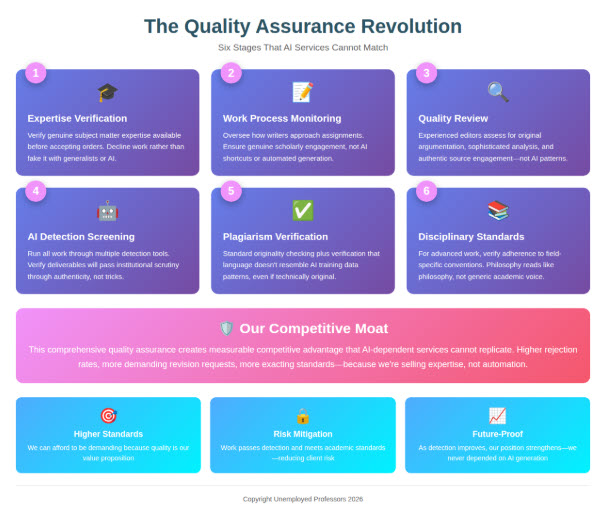
Understanding AI allowed us to build sophisticated quality assurance processes that guarantee our competitive edge. We developed multi-stage verification that ensures work meets standards AI cannot achieve.
Stage 1: Expertise Verification Before accepting any order, we verify that we have writers with genuine subject matter expertise available. We don’t assign philosophy papers to generalists or use AI to fill gaps. If we lack expertise in a specific area, we decline the work rather than fake it.
Stage 2: Work Process Monitoring We maintain oversight of how writers approach assignments. This isn’t micromanagement—it’s ensuring they’re engaging in genuine scholarly work rather than taking shortcuts with AI generation.
Stage 3: Quality Review Finished work undergoes review by experienced editors who assess whether it demonstrates genuine expertise. They look for original argumentation, sophisticated analysis, and authentic engagement with sources—qualities that AI-generated work lacks.
Stage 4: AI Detection Screening We run all completed work through multiple AI detection tools. This isn’t because we suspect our writers of using AI inappropriately—it’s verification that we’re delivering work that will pass institutional scrutiny.
Stage 5: Plagiarism Verification Standard plagiarism checking ensures originality. But we also check for a subtler issue: whether writing too closely resembles language that might appear in AI training data, even if technically original.
Stage 6: Disciplinary Standards Review For advanced work, we verify that writing adheres to disciplinary conventions in the relevant field. Philosophy papers should read like philosophy, sociology like sociology, etc. AI’s generic academic voice doesn’t meet this standard.
This comprehensive quality assurance creates measurable competitive advantage AI-dependent services cannot match. Our rejection rate is higher, our revision requests more demanding, and our standards more exacting—because we can afford to be. We’re selling expertise, not automation.
The Pricing Strategy: Competing on Value, Not Cost
AI made cheap essays ubiquitous. This could have destroyed our business model. Instead, it validated it.
We made a conscious decision not to compete on price. We couldn’t win a race to the bottom against automated services that cost pennies to operate. Instead, we competed on value—the demonstrable difference between expert-written work and AI-generated content.
Our pricing reflects several factors AI services don’t account for:
Genuine Expertise Our writers are actual scholars. They command appropriate compensation for their knowledge and skills. This cost structure is incompatible with cheap services but justifiable given the quality difference.
Time Investment Real research, analysis, and writing take time. We can’t promise two-hour turnarounds because genuine work doesn’t happen that fast. Our pricing reflects realistic timelines for quality work.
Quality Assurance Our multi-stage QA process requires human oversight at multiple points. This adds cost but ensures quality that automated services cannot guarantee.
Risk Mitigation We deliver work that passes AI detection, demonstrates genuine expertise, and meets academic standards. This reduces risk for clients significantly. The price premium is risk insurance.
Educational Value Our work serves as legitimate learning tools. Students receive model essays from genuine experts that they can study and learn from. This educational value justifies premium pricing.
Rather than apologizing for higher prices, we frame them as evidence of quality. If someone offers you a “PhD-written essay” for $5, they’re lying. Our pricing is honest about what quality costs.
This strategy segments the market naturally. Students seeking the absolute cheapest option will go elsewhere. Students who understand that quality matters and are willing to pay for genuine expertise choose Unemployed Professors. This self-selection improves our customer base.
Copyright Unemployed Professors 2026
The Product Differentiation: What AI Can’t Replicate
The AI revolution forced us to articulate clearly what makes our service valuable. We identified specific product features that AI fundamentally cannot replicate:
Subject Matter Expertise Our writers actually know their fields. They’ve spent years studying philosophy, literature, history, sciences. They understand theories deeply, recognize scholarly debates, and can engage with complex ideas. AI has vocabulary but no comprehension.
Original Argumentation Our essays make genuine arguments—debatable claims supported by reasoning. They take positions, commit to interpretations, and defend sophisticated theses. AI defaults to obvious positions and hedge language.
Disciplinary Voice Work reads like it was written by someone trained in the relevant discipline because it was. Philosophy sounds like philosophy, sociology like sociology. AI produces generic academic voice.
Research Synthesis Our writers actually read sources, understand arguments, and synthesize meaningfully. They identify real relationships between scholars, trace intellectual debates, and position work within scholarly conversations. AI simulates this without substance.
Contextual Customization We can tailor work to specific course contexts, incorporate class discussions, align with particular professors’ preferences. This contextual intelligence requires actual understanding.
Pedagogical Value Our model essays demonstrate expert thinking that students can learn from. There’s actual expertise to study. AI-generated work has no genuine thinking behind it to learn from.
Authenticity Verification Our work passes AI detection not through tricks but through authenticity. It’s actually human-written by actual experts. This fundamental authenticity can’t be faked.
By clearly articulating these differentiators, we transformed the AI threat into a showcase for our value proposition. Everything AI cannot do, we can—and this became our core message.
The Customer Education Initiative
A crucial element of our AI adaptation strategy was educating customers about making informed choices. Many students don’t understand the difference between AI-generated content and expert-written work. Helping them understand became a business strategy.
We created extensive educational content:
Technology Explainers We published guides explaining how AI writing tools actually work, what they can and cannot do, and why human expertise matters. This knowledge helps students make better decisions.
Quality Comparison We produced side-by-side comparisons of AI-generated essays versus expert-written ones, highlighting differences in depth, originality, and sophistication. Seeing the difference is persuasive.
AI Risk Education We explained AI detection technology, false positive risks, and the academic integrity landscape. Understanding these risks makes our value proposition clearer.
Ethical Use Guidance We positioned our services as educational resources—model essays to learn from—and provided guidance on ethical use. This framework distinguishes us from AI mills.
Long-term Value Framing We helped students understand that genuine learning serves them better long-term than shortcuts. This appeal to their better judgment builds lasting relationships.
This educational approach did something counterintuitive: it probably talked some potential customers out of using any service, ours or competitors’. But it built tremendous trust and loyalty among those who chose us. They understood what they were paying for and why it mattered.
The Results: Market Position in the AI Era
Two years into the AI revolution, our strategy has produced measurable results that validate our approach:
Market Differentiation We’ve successfully positioned ourselves as the premium, expert-driven alternative to AI essay mills. Students seeking quality know to choose us; students seeking cheapness go elsewhere. This segmentation works in our favor.
Customer Loyalty Our retention rates increased as students who tried AI alternatives or cheaper services returned to us after experiencing poor quality. Once clients understand the difference, they stay.
Pricing Power We’ve maintained premium pricing while competitors race to the bottom. Our value proposition justifies the cost for quality-conscious customers.
Brand Authority Our educational content and thought leadership position us as industry experts who understand both the technology and academic writing. This authority attracts customers and talent.
Competitive Moat Our investment in genuine expertise, quality assurance, and writer development creates barriers competitors can’t easily replicate. Buying ChatGPT access is easy; building a network of expert writers takes years.
Future-Proofing As AI detection improves and institutions crack down on AI-generated work, our position strengthens. We’re not vulnerable to these developments because we never depended on AI generation.
Lessons for Other Industries
Our experience offers lessons for businesses across industries facing AI disruption:
1. Understand the Technology Deeply You can’t compete against AI without understanding it. Study its capabilities and limitations thoroughly. Your competitive response should be informed by reality, not hype or fear.
2. Identify What AI Cannot Do Every technology has limits. Find what AI cannot replicate in your industry and build competitive advantage around those capabilities.
3. Invest in Human Capital When competitors are cutting talent to automate, doubling down on human expertise can create differentiation. The best people become more valuable when mediocre work is automated.
4. Compete on Quality, Not Cost You cannot win price wars against automation. Compete on value, quality, and capabilities that justify premium pricing.
5. Use AI Strategically Smart AI use means leveraging technology to enhance human capability, not replace it. Use AI for what it’s good at; use humans for what they’re good at.
6. Be Transparent In disrupted industries, transparency builds trust. Explain your approach, differentiate clearly from competitors, and help customers make informed choices.
7. Educate Your Market Many customers don’t understand the difference between cheap automation and quality expertise. Education serves both their interests and yours.
8. Play the Long Game Short-term, automation looks like a threat. Long-term, quality and expertise become more valuable. Position for the future you believe will emerge.
Conclusion: The Sustainable Competitive Advantage
The AI revolution in academic writing created a choice: automate or differentiate. We chose differentiation—doubling down on genuine expertise while using AI strategically to enhance rather than replace human capability.
This choice required investment when cutting costs was tempting, transparency when discretion was traditional, and confidence that quality would matter when cheap alternatives proliferated. It required betting that in a world where everyone has access to mediocre AI content, genuine expertise becomes more valuable rather than obsolete.
Two years later, that bet is paying off. We’ve turned a potential existential threat into our strongest competitive edge AI positioning. We didn’t do it by using AI writing to generate content. We did it by understanding AI deeply enough to compete against it effectively, investing in human expertise when others were abandoning it, and articulating clearly why that expertise matters.
The sustainable competitive advantage isn’t the technology you use—it’s the value you create that technology cannot replicate. For Unemployed Professors, that value is genuine scholarly expertise applied to academic writing. AI can generate text. It cannot think, understand, or produce the kind of sophisticated analysis that real learning requires.
That difference is our moat, our value proposition, and our future. In the age of AI, authentic expertise isn’t obsolete—it’s premium.
Pingback: Unemployed Professors FAQ: Everything You Need to Know About Our Services in the AI Era | The Unemployed Professors Blog