
The AI revolution has given students unprecedented access to writing technology. ChatGPT can generate essays in minutes. Claude can draft research papers. Dozens of AI tools promise to make academic work easier. But here’s the paradox students are discovering: using AI to write your essays is both easier than ever and more dangerous than ever.
At Unemployed Professors, we’ve watched thousands of students navigate this landscape. Some use AI successfully as a powerful learning tool. Others use it destructively as a shortcut that undermines their education. The difference isn’t whether they use AI—it’s how they use it.
This article explains the critical distinction between using AI writing (which doesn’t work and carries serious risks) versus using AI properly (which can genuinely enhance your learning and productivity). Understanding this difference could determine your academic success in the AI era.
The Fundamental Mistake: Using AI to Write
Let’s start with what doesn’t work: using AI to generate content that you submit as your own work.
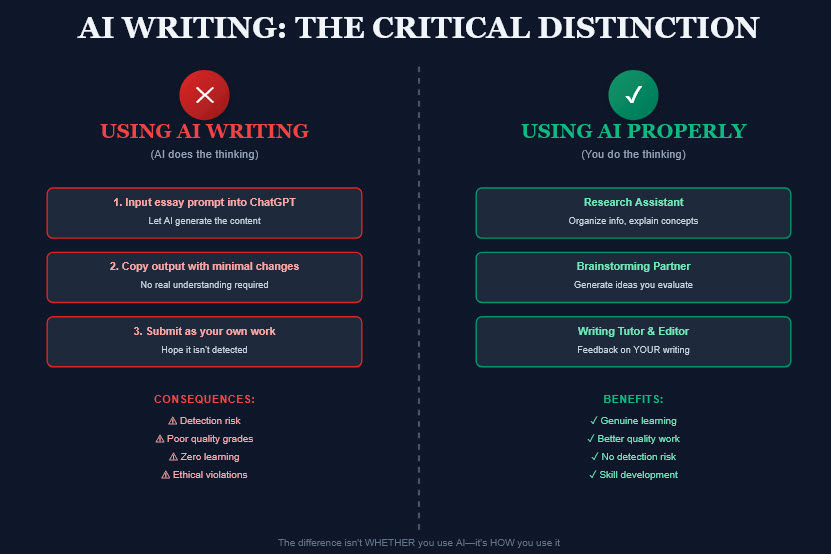
When students “use AI writing,” they typically:
- Input their essay prompt into ChatGPT or similar tools
- Copy the AI-generated output with minimal or no changes
- Submit the result as their own work
- Hope professors don’t notice or can’t detect it
This approach fails on multiple levels:
Copyright Unemployed Professors 2026
Detection Risk
Universities deploy AI detection tools extensively. Turnitin AI Detection, GPTZero, Originality.AI, and others scan student work. These tools aren’t perfect, but they catch AI-generated content frequently enough to create serious risk. When you’re flagged:
- Academic integrity investigations follow
- Grade penalties or course failures result
- Disciplinary records affect future opportunities
- Stress and anxiety compound throughout the process
Quality Problems
Even when AI text passes detection, it often receives poor grades because:
- Arguments are generic and obvious, lacking originality
- Analysis stays surface-level without depth
- Sources are cited superficially or incorrectly
- Writing has distinctive AI patterns professors recognize
- Factual errors and hallucinations undermine credibility
Learning Failure
Using AI to write teaches you nothing. You cannot:
- Discuss your topic in class or office hours
- Perform on exams covering related material
- Build skills you need for future courses
- Develop capabilities employers value
- Understand the subject matter you’re supposedly studying
Ethical Discomfort
Most students feel uncomfortable submitting AI work as their own, even when desperate. This discomfort signals that something’s wrong with the approach. Academic integrity violations create psychological stress that extends beyond grade concerns.
Using AI writing is the wrong approach. But using AI properly? That’s different.
What “Using AI Properly” Actually Means
Proper AI use treats these tools as assistants for your thinking, not replacements for it. Here’s the framework:
AI as Research Assistant
Use AI to help organize information and identify starting points:
- Ask AI to explain complex concepts in simpler terms to build initial understanding
- Have AI generate lists of potential topics or angles to explore
- Request suggestions for search terms or source types
- Use AI to summarize your own notes to identify themes
Example: You’re writing about climate policy. Instead of asking AI to write the essay, ask: “What are the main theoretical frameworks scholars use to analyze climate policy? What key debates exist in this field?”
AI gives you a roadmap. You then do the actual research, reading, and thinking.
AI as Brainstorming Partner
Use AI to generate ideas you can evaluate:
- Ask for multiple thesis statement options to consider
- Request different outline structures to choose from
- Have AI suggest counter-arguments to your position
- Generate questions you should address in your analysis
Example: You have a topic but no clear argument. Ask AI for ten possible thesis statements. AI generates options—most terrible, some interesting. You evaluate using your judgment, select the most promising, and develop it yourself.
The thinking remains yours. AI just accelerates option generation.
AI as Writing Tutor
Use AI to improve your own writing:
- Submit your draft and ask for feedback on argument clarity
- Have AI identify where your reasoning seems weak
- Request suggestions for stronger evidence or examples
- Ask AI to point out where your writing is unclear
Example: You’ve written a paragraph but it feels muddled. You paste it to AI and ask: “What’s the main point of this paragraph? Is it clear?” If AI misunderstands your point, that tells you the paragraph needs clarification.
You do the rewriting based on this feedback.
AI as Study Tool
Use AI to help you learn material:
- Ask AI to quiz you on concepts from your readings
- Have AI explain difficult theories from different angles
- Request examples that illustrate abstract ideas
- Use AI to check your understanding of complex topics
Example: You read a challenging theoretical article but struggle to understand it. Ask AI to explain the theory simply, then try to explain it back in your own words. Use AI to verify whether you’ve grasped the concept correctly.
You’re using AI to learn, not to avoid learning.
AI as Editor
Use AI for technical feedback:
- Check grammar and syntax in your writing
- Identify awkward phrasing or unclear sentences
- Verify citation formatting
- Spot logical inconsistencies in your argument
Example: You’ve completed your essay. Run it through AI asking for grammar check and clarity feedback. AI identifies problems; you fix them yourself.
This is similar to using Grammarly or spell-check—AI assists with technical polish, not with thinking.
Copyright Unemployed Professors 2026
The Critical Distinction: Tool vs. Replacement
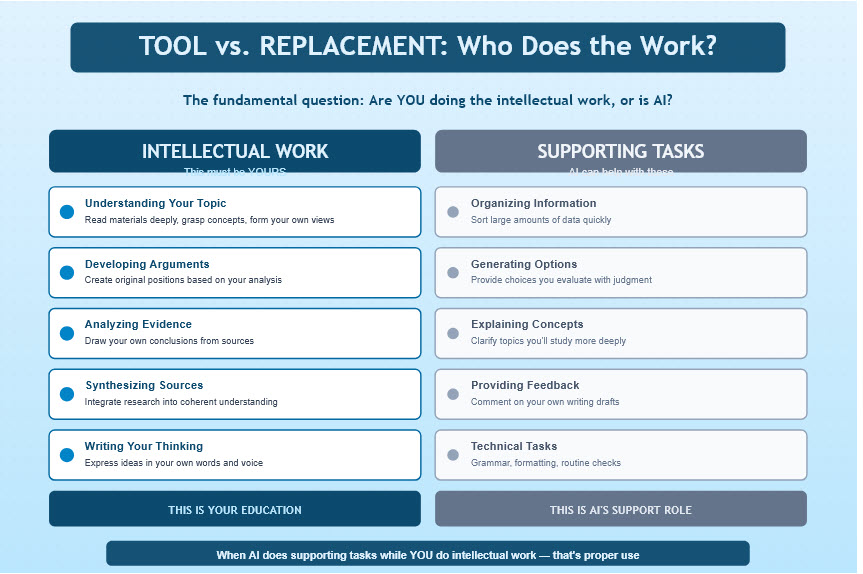
The fundamental difference between using AI properly and misusing it comes down to one question: Are you doing the intellectual work, or is AI doing it for you?
Intellectual Work You Must Do:
- Understanding your topic and readings
- Developing your own arguments and positions
- Analyzing evidence and drawing conclusions
- Synthesizing sources into coherent analysis
- Writing that expresses your actual thinking
- Learning from the process
Supporting Tasks AI Can Help With:
- Organizing large amounts of information quickly
- Generating options to evaluate with your judgment
- Explaining concepts you’ll then study more deeply
- Providing feedback on your own work
- Handling routine technical tasks
- Accelerating processes that don’t require original thought
When AI does supporting tasks while you do intellectual work, you’re using AI properly. When AI does the intellectual work, you’re using AI to cheat—and probably getting caught.
How to Use AI for Writing Without Using AI Writing
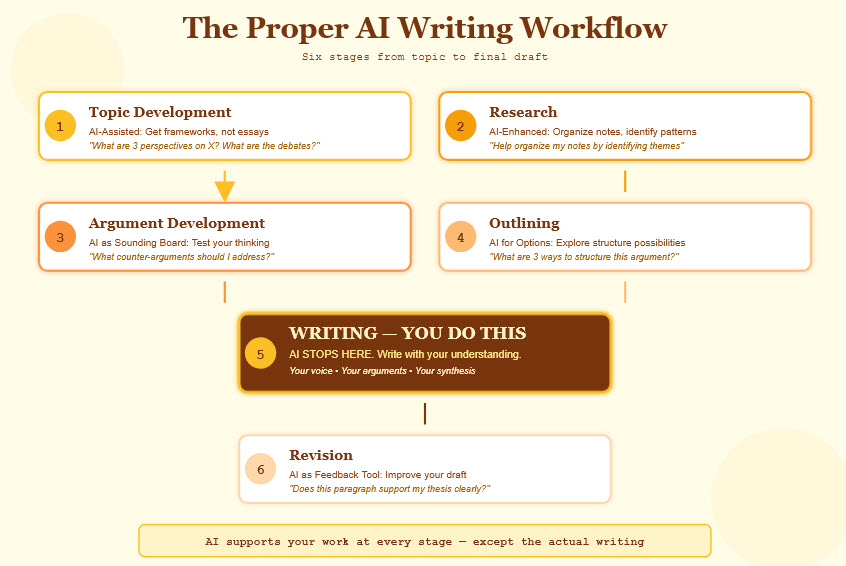
Here’s a concrete workflow showing proper AI use throughout the essay-writing process:
Stage 1: Topic Development (AI-Assisted)
Instead of asking AI to generate your essay, use it to develop your thinking:
❌ Wrong: “Write an essay about social media’s effects on democracy”
✅ Right: “What are three different perspectives scholars take on social media’s effects on democracy? What are the main debates in this field?”
AI gives you framework. You then research actual scholarship, read sources, and develop informed position.
Stage 2: Research (AI-Enhanced)
Use AI to accelerate research organization:
❌ Wrong: “Summarize these five articles about social media and democracy for my essay”
✅ Right: “I’m reading articles about social media and democracy. Help me organize my notes by identifying common themes across these abstracts.”
AI helps you see patterns. You still read the actual articles and develop real understanding.
Stage 3: Argument Development (AI as Sounding Board)
Use AI to test and refine your thinking:
❌ Wrong: “Generate a thesis statement for my essay on social media and democracy”
✅ Right: “I’m thinking of arguing that social media undermines deliberative democracy by fragmenting public discourse. What counter-arguments should I address? What evidence would I need?”
AI helps you think through your argument. You develop the actual thesis and supporting reasoning.
Stage 4: Outlining (AI for Structure Ideas)
Use AI to explore structural options:
❌ Wrong: “Create an outline for my essay”
✅ Right: “I want to argue X, addressing Y and Z. What are three different ways I could structure this argument? What are the advantages of each?”
AI generates structural options. You evaluate and select based on your judgment about what serves your argument best.
Stage 5: Writing (You Do This)
This is where AI stops and you start. The actual writing must be yours:
- Write based on your understanding of material
- Develop your arguments in your own words
- Synthesize sources based on your reading
- Create analysis that reflects your thinking
- Use your voice, not AI’s generic academic tone
If you’ve used AI properly in earlier stages, you have framework, understanding, and plan. Now you execute with your own writing.
Stage 6: Revision (AI as Feedback Tool)
Use AI to improve your draft:
❌ Wrong: “Rewrite this paragraph to make it better”
✅ Right: “Does this paragraph clearly support my thesis? Is the reasoning logical? Where could I strengthen the evidence?”
AI provides feedback. You do the actual revision based on that feedback.
Why Proper AI Use Works Better Than AI Writing
Students often assume using AI to write is “easier” than using AI properly. Short-term, maybe. Long-term, absolutely not. Here’s why proper use actually serves you better:
You Actually Learn
When you use AI as tool while doing intellectual work yourself, you learn the material. This helps you:
- Discuss topics intelligently in class
- Perform well on exams
- Build skills for future courses
- Develop capabilities employers value
- Actually understand your field of study
You Avoid Detection
Work you actually write yourself doesn’t trigger AI detectors because it’s genuinely human-written. No tricks or workarounds needed—authenticity is the solution.
You Produce Better Quality
Your own writing, informed by real understanding and genuine thinking, is better than AI’s generic output. Professors recognize the difference, and your grades reflect it.
You Maintain Integrity
Using AI properly feels ethically defensible because you’re not cheating—you’re using available tools to enhance your own work. This psychological comfort matters.
You Develop A Sustainable Approach
Proper AI use creates a workflow you can continue using throughout your academic career and into professional life. Using AI to write creates unsustainable dependence on shortcuts.
Common Objections and Responses
“But I don’t have time to do all that work myself”
If you don’t have time to learn the material and write your own essay, you don’t have time to succeed in the course regardless of how you complete this assignment. Using AI to write might get you through one essay, but you’ll fail exams, struggle in future courses, and lack foundation you need.
Proper AI use actually saves time by making genuine work more efficient. You’ll complete assignments faster than pure manual work while still learning.
“My writing isn’t good enough, even with AI help”
This is exactly why you need to do the writing yourself—to improve. Using AI to write means you never develop writing skills. Using AI properly helps you learn by providing feedback while you do the actual work.
If you genuinely need writing support, services like Unemployed Professors provide expert model essays you can study to improve your own skills.
“Everyone else is using AI to write, so I’m at a disadvantage if I don’t”
Not everyone is using AI to write, and those who are face detection risks and quality problems. Moreover, using AI properly gives you the advantages (efficiency, feedback, organization help) without the disadvantages (detection, poor quality, learning failure).
You’re not competing to cheat most effectively. You’re competing to actually learn and demonstrate competence. Proper AI use supports that goal better than AI writing.
“How will professors know the difference?”
They often can tell, through AI detection tools and through recognition of AI’s distinctive patterns. But more importantly: the question isn’t whether you can fool professors, it’s whether you’re actually learning and developing capabilities you need.
Using AI properly means you don’t need to fool anyone—you’re doing legitimate work enhanced by available tools.
The Academic Integrity Framework
Most universities are developing policies around AI use. Understanding these frameworks helps you use AI ethically:
Generally Prohibited:
- Submitting AI-generated text as your own work
- Having AI write substantial portions of your assignments
- Using AI to avoid doing required intellectual work
- Failing to cite AI assistance where required
Often Permitted:
- Using AI to understand concepts you then study more deeply
- Asking AI for brainstorming help while you develop actual arguments
- Using AI for grammar checking and technical editing
- Getting AI feedback on your own work
Gray Areas (Verify Your Institution’s Policy):
- Using AI to organize research notes
- Having AI suggest outline structures you then modify
- Getting AI help with argument development
- Using AI as study tool for course material
The key principle: AI should support your learning and work, not replace it. When in doubt, ask your professor what’s acceptable.
Copyright Unemployed Professors 2026
How Unemployed Professors Fits This Framework
Our services align with proper AI use philosophy:
We Don’t Provide AI-Generated Content
Our writers are actual scholars who produce genuine human work based on expertise. We don’t use AI to write essays—we use expert human thinking.
We Provide Educational Resources
Our model essays serve similar functions to proper AI use: they help you understand how to approach topics, see how experts construct arguments, and learn effective writing techniques. You study our work to improve your own, similar to how you’d use AI for learning support.
We Encourage Genuine Learning
We position our services as tools for developing your capabilities, not shortcuts to avoid learning. This aligns with proper AI use philosophy: use available resources to enhance your own work.
We Complement AI Tools
Proper AI use gets you far, but sometimes you need human expertise AI cannot provide. Our services fill that gap, providing genuine scholarly thinking that helps you understand topics AI can only describe superficially.
Practical Guidelines for Students
Based on everything discussed, here are concrete guidelines for using AI properly:
Do:
- Use AI to explain concepts you then study more deeply
- Ask AI for brainstorming ideas you evaluate yourself
- Have AI provide feedback on your own writing
- Use AI to organize information and identify patterns
- Treat AI as tutor or research assistant, not ghostwriter
- Cite AI assistance where your institution requires it
Don’t:
- Submit AI-generated text as your own work
- Have AI write substantial portions of assignments
- Use AI to avoid reading assigned materials
- Rely on AI to understand topics without actual study
- Copy AI output without transforming it through your own thinking
- Assume AI information is accurate without verification
When in Doubt:
- Check your institution’s AI policy
- Ask your professor what’s acceptable
- Err on the side of doing work yourself
- Remember that learning is the goal, not just completing assignments
The Long-Term Perspective
The skills you develop through proper AI use—critical thinking, research, analysis, writing—are exactly what employers value and what graduate programs require. These capabilities are AI-proof because they’re fundamentally human.
Using AI to write develops no skills. It’s a dead-end strategy that serves you poorly beyond individual assignments.
Using AI properly develops capabilities while leveraging technology intelligently. This is the approach that serves you throughout your academic career and into professional life.
The choice isn’t between using AI and not using AI. That’s a false binary. The choice is between using AI destructively (to replace your thinking) and using AI constructively (to enhance your thinking).
One path leads to detection, poor learning, and unsustainable shortcuts. The other leads to genuine skill development enhanced by powerful tools.
Conclusion: Intelligence, Not Automation
AI is neither savior nor devil—it’s a tool. Like any tool, it can be used well or poorly. Used to write your essays, it’s destructive. Used to support your own intellectual work, it’s powerful.
The students who succeed in the AI era won’t be those who use AI most extensively. They’ll be those who use it most intelligently. They’ll leverage AI to enhance their capabilities while maintaining the human thinking that AI cannot replicate.
Don’t use AI writing. Use AI properly—as a research assistant, brainstorming partner, study tool, and feedback mechanism that supports the genuine intellectual work only you can do.
Your education is an investment in yourself. AI can make that investment more productive, but it can’t replace the investment itself. Do the work. Use the tools. Learn the material. Develop the capabilities.
That’s not just better ethics—it’s better strategy for academic success and long-term capability development.
Use AI properly, not to replace your thinking but to enhance it. That’s the path to genuine success in the AI era.