
AI is Changing the Ghostwriting Game; Unemployed Professors is Ahead of It!
The academic writing landscape has undergone a seismic shift in the past two years. With AI ghostwriting tools like ChatGPT, Claude, and Jasper flooding the market, students and professionals alike have access to instant essay generation at their fingertips. But here’s the uncomfortable truth that most ghostwriting services won’t tell you: AI-generated content is increasingly detectable, often mediocre, and fundamentally misses what makes academic writing valuable. At Unemployed Professors, we saw this revolution coming—and we’ve positioned ourselves not just to survive it, but to thrive in it.
The AI Writing Revolution: Promise vs. Reality
When ChatGPT launched in late 2022, the academic world panicked. Headlines screamed about the “death of the essay” and the “end of traditional education.” Students discovered they could generate a five-page paper in minutes. Naturally, opportunistic ghostwriting services pivoted immediately, replacing their human writers with AI writing tools to maximize profit margins.
The promise of AI ghostwriting seemed irresistible: instant turnaround, lower costs, and unlimited scalability. No more waiting for writers. No more managing freelancers. Just prompt engineering and profit.
But the reality? It’s far more complicated.
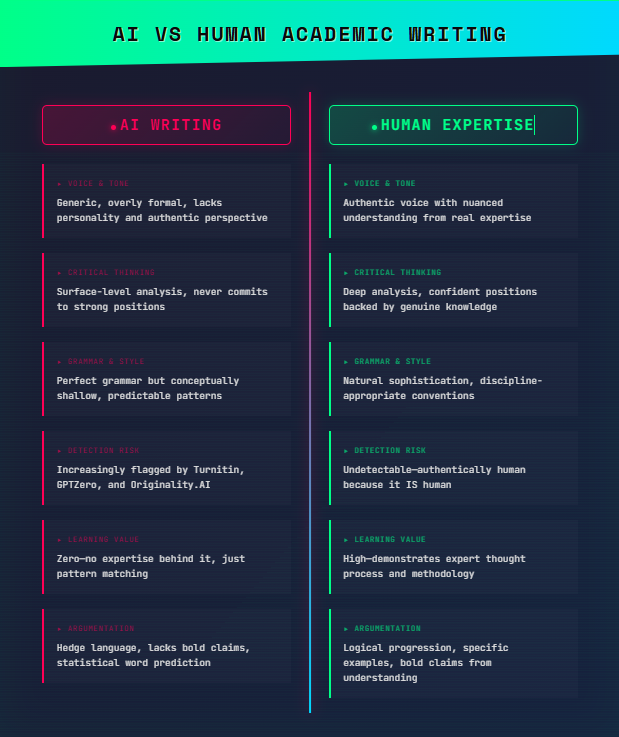
AI-generated essays have a fundamental problem: they lack authentic voice, genuine critical thinking, and the nuanced understanding that comes from actual expertise. Professors aren’t fools. They’ve been reading student work for decades, and they can spot the telltale signs of AI-generated content—the overly formal yet somehow generic tone, the surface-level analysis that never quite commits to a position, the suspiciously perfect grammar paired with conceptual shallowness.
More importantly, institutions have fought back. AI detection tools like Turnitin’s AI detector, GPTZero, and Originality.AI have become standard in academic settings. These tools are far from perfect, but they’re improving rapidly, and they’ve created a new risk profile for students who rely on pure AI-generated work.
Why Most Ghostwriting Services Are Failing the AI Test
Here’s what happened to most ghostwriting services when AI exploded onto the scene: they saw dollar signs and abandoned their principles.
Traditional custom essay writing services built their reputations on one promise: authentic, human-written work tailored to individual student needs. But when AI offered the chance to automate away expensive human writers, many companies couldn’t resist. They began using ChatGPT and other AI writing tools to generate essays, often without disclosing this to customers who were paying premium prices for “custom academic writing.”
The results have been predictable and disastrous. Students submit AI-generated essays that immediately get flagged by AI detection software. The work lacks the depth and originality that professors expect. Worst of all, these services have eroded trust in the entire ghostwriting industry.
The fundamental misunderstanding is this: these services treated AI as a replacement for human writers rather than a tool to augment human expertise. They thought they could cut costs without cutting quality. They were wrong.
The Unemployed Professors Difference: Human Expertise Enhanced by AI
At Unemployed Professors, we took a different path. We didn’t panic when AI ghostwriting tools emerged. We studied them. We tested them. We learned their strengths and limitations. And then we did something radical: we kept our human writers at the center of everything we do.
Our approach is simple but sophisticated: we use AI writing tools the way professionals in every industry use technology—as assistive tools that make experts more efficient, not as replacements for expertise itself.
Here’s how it works in practice. When a client submits a request for a custom essay, we don’t feed the assignment into ChatGPT and call it a day. Instead, our genuine academic writers—all of them former professors, PhD candidates, and subject matter experts—use AI strategically throughout their writing process.
They might use AI for initial research organization, helping them quickly synthesize source materials. They might employ AI writing tools to generate multiple outline approaches, selecting the most promising one to develop with their own critical thinking. They use AI detection software themselves to ensure their final work won’t raise red flags when submitted.
But the actual writing, the analysis, the argumentation, the voice—that’s all human. That’s all authentic. That’s all the product of genuine expertise.
This hybrid approach gives us superpowers that pure AI ghostwriting services can’t match. Our writers are faster than they were five years ago, but their work is indistinguishable from fully human-written essays because it is fully human-written. It’s just human-written by experts who have embraced technology smartly.
Why Academic Integrity Demands Human Writers
Let’s address the elephant in the room: academic integrity and ghostwriting services have always had a complicated relationship. We’re not going to pretend otherwise. But there’s an important distinction between commissioning custom academic writing and submitting AI-generated content as your own work.
When students use ghostwriting services like Unemployed Professors, they’re accessing expertise and mentorship. They’re seeing how a professional scholar approaches their topic. They’re learning by example. The work can serve as a model, a study guide, or inspiration for their own efforts.
But AI-generated essays offer none of these learning opportunities. They’re simply content manufacturing—hollow text that checks superficial boxes without demonstrating genuine understanding. There’s no expertise behind them, no human thought process to learn from.
Educational institutions are increasingly drawing this same distinction. Many academic integrity policies now specifically mention AI writing tools as prohibited, while they’ve had decades to develop nuanced positions on tutoring, editing services, and yes, ghostwriting services. The key difference? Human expertise versus algorithmic pattern matching.
Our writers don’t just know the subject matter—they understand academic writing at a level that AI simply cannot replicate. They know how to construct arguments that build logically from premise to conclusion. They understand disciplinary conventions and can adjust their writing style to match different academic fields. They can engage with complex theoretical frameworks and apply them thoughtfully to specific cases.
This depth of understanding is what makes custom essays valuable learning tools rather than mere shortcut mechanisms. And it’s what AI ghostwriting fundamentally lacks.
The Technology Behind Our Advantage
Being “ahead of” the AI revolution doesn’t mean rejecting technology—it means understanding it better than the competition.
We’ve invested heavily in understanding exactly how AI detection tools work. Our quality assurance process includes running every essay through multiple plagiarism detection and AI detection platforms before delivery. If any red flags appear, we work with our writers to revise the content—not by having them avoid certain phrases (which doesn’t work), but by ensuring they’re writing with sufficient complexity, originality, and authentic voice.
We’ve also developed proprietary guidelines for our writers on how to use AI writing tools ethically and effectively in their research and outlining processes. This isn’t about gaming the system—it’s about leveraging technology while maintaining the human expertise that makes our service valuable.
Our writers receive ongoing training on the limitations of AI-generated content. They learn to recognize AI writing patterns so they can deliberately avoid them. They understand that ChatGPT’s tendency toward hedge language, its particular sentence structures, and its characteristic lack of bold claims are all markers that detection tools look for.
More importantly, they write the way experts write—with confidence born from genuine knowledge, with specific examples from deep research, with argumentation that reflects actual understanding rather than statistical prediction of what words should come next.
The Future of Ghostwriting Services in an AI World
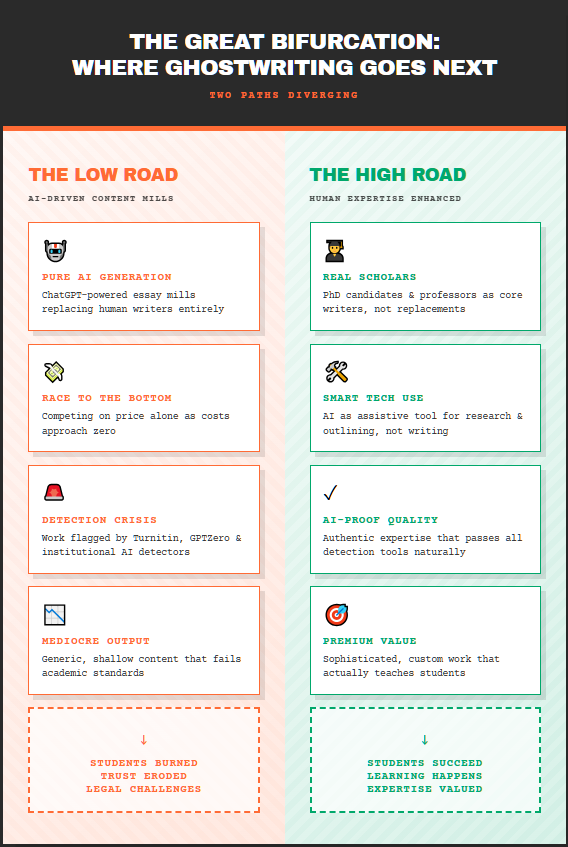
Here’s our prediction: the ghostwriting industry will bifurcate completely over the next few years.
On one side, you’ll have cheap, AI-driven content mills churning out detectable, mediocre work that serves neither students nor educational goals. These services will compete on price alone, racing to the bottom as AI tools become cheaper and more accessible. They’ll face increasing legal and ethical challenges as institutions crack down on AI-generated submissions.
On the other side, you’ll have premium services like Unemployed Professors that position themselves as they truly are: access points to genuine academic expertise. We’re not selling AI-generated content. We’re selling access to scholars who use technology intelligently while keeping human expertise central.
The students who choose AI ghostwriting services to save a few dollars will find themselves with work that gets flagged, fails to meet academic standards, or teaches them nothing. The students who invest in human expertise will get work that passes scrutiny, demonstrates genuine understanding, and actually helps them learn.
This bifurcation is already happening. We’ve seen a significant increase in clients who specifically request confirmation that our work is human-written. They’ve been burned by cheaper services or they’ve simply done their homework on AI detection. They understand that in an era where AI can generate mediocre content instantly, human expertise has become more valuable, not less.
Why “AI-Proof” Matters for Custom Academic Writing
The term “AI-proof” has become crucial in academic writing discussions. It refers to work that won’t trigger AI detection software—but more importantly, it refers to work that demonstrates the kind of thinking AI cannot replicate.
Unemployed Professors delivers AI-proof custom essays not through tricks or workarounds, but through authenticity. Our writers produce work that reflects genuine expertise because they have genuine expertise. They make arguments that require understanding of complex theories because they understand complex theories. They cite sources thoughtfully because they’ve actually read and engaged with the literature.
This is why our academic writing services remain relevant and valuable in the AI era. We’re not competing with ChatGPT—we’re offering something ChatGPT cannot provide: authentic scholarly work from real academics.
Students don’t come to us for AI-generated content they could get for free. They come to us for the kind of sophisticated, nuanced, expertly crafted work that will actually help them understand their subject matter and succeed in their courses.
The Unemployed Professors Commitment
As AI continues to evolve, so will we. We’re committed to staying ahead of technological changes while never losing sight of what makes academic writing valuable: human thought, expertise, and authentic intellectual engagement.
We will continue to employ real scholars as our writers. We will continue to use technology as a tool to enhance, never replace, human expertise. We will continue to deliver work that passes the scrutiny of both AI detection tools and, more importantly, expert human readers.
The ghostwriting game has changed, yes. But Unemployed Professors didn’t just adapt to the change—we anticipated it, prepared for it, and positioned ourselves to thrive in it.
When you choose Unemployed Professors, you’re not getting AI-generated content disguised as human writing. You’re getting actual human writing from actual experts who use technology intelligently. You’re getting work that’s genuinely custom, genuinely thoughtful, and genuinely valuable.
That’s not just our competitive advantage in the AI era. That’s our commitment to you.
Conclusion: Expertise Matters More Than Ever
The rise of AI ghostwriting tools has created a paradox: as it becomes easier to generate mediocre content, authentic expertise becomes more valuable. In a world where anyone can prompt ChatGPT to write an essay, the ability to produce genuinely insightful, sophisticated academic work stands out more than ever.
Unemployed Professors embraces this paradox. We’re not fighting against AI—we’re using it smartly while keeping human scholars at the heart of our service. We’re delivering custom academic writing that’s truly custom, truly academic, and truly valuable in ways that pure AI-generated content can never be.
The ghostwriting game has changed. And we’re not just ahead of it—we’re defining what success looks like in the new landscape.
Pingback: AI Content Generation is the Future but Do You Know the Present? | The Unemployed Professors Blog