
Cornell Has Confirmed That Writing a Reflective Essay Is Meaningful Accountability for Sexual Violence. This Should Concern Everyone Who Values Academic Writing.
According to court documents and reporting from the past two weeks, Cornell University’s internal disciplinary system allowed some students found responsible for sexual misconduct to mitigate their sanctions by submitting reflective essays. A former Cornell student has alleged that seven Chi Phi fraternity members drugged and gang-raped her at a fraternity house in 2024, that she reported the assault to Cornell University police, and that Cornell’s disciplinary response included, for some of the accused, the option to reduce their sanctions by writing an essay. Cornell disputes aspects of this characterization, noting that two students were expelled and two received multi-semester suspensions, while declining to provide further details citing federal privacy law. New York prosecutors reopened a criminal investigation on September 30, 2026.
The facts of what happened to the woman at the center of this case are not in dispute in the reporting. What is in dispute is whether Cornell’s institutional response was adequate to those facts.
This post is not about that dispute. Cornell’s lawyers and New York prosecutors can handle that.
This post is about something Cornell’s disciplinary system has inadvertently confirmed: that the institution believes a written essay is a form of meaningful accountability. That essay submission is evidence of something real.
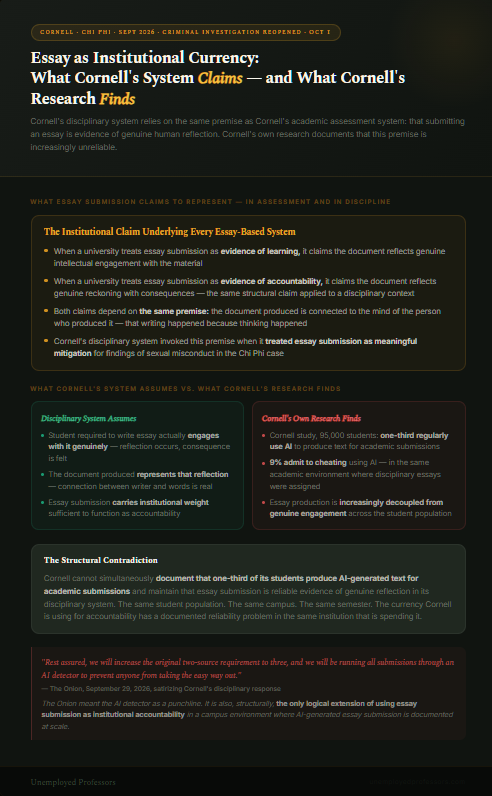
If Cornell believes that — and it must, or the sanction is meaningless even on its own terms — then Cornell is making a specific claim about what essay-writing represents. It is claiming that the document produced is connected to genuine thought. That the words on the page reflect authentic reckoning with what happened.
What Essay Submission Claims to Represent
Universities have always used written work as institutional currency. When a student submits an essay, the institution is treating that submission as proof of something: that the student thought through a problem, engaged with material, processed an experience, grappled with consequences.
This is the premise of essay-based assessment at every level. It is also the premise of essay-based sanction. When Cornell’s disciplinary system includes essay-writing as a meaningful component of accountability, it is relying on the same assumption that underlies every take-home midterm and graded paper: that the document in front of us reflects the thinking of the person who submitted it.
A Cornell campus climate survey found that 35 percent of undergraduate women at Cornell had experienced nonconsensual sexual contact during their time at the school. The institution asked some students found responsible for contributing to that environment to write essays. Whatever else one says about that response, the institution is treating the essay as currency serious enough to function in a disciplinary context.
The Problem Cornell’s System Has Not Considered
In May 2026, a Cornell study of 95,000 students across 20 public research universities found that approximately one-third regularly used generative AI to produce text, video, or code when completing assignments. Nine percent admitted to using AI to cheat.
These are Cornell’s own students, in Cornell’s own academic environment, regularly producing AI-generated text and submitting it as their own work.
The specific accountability mechanism that Cornell’s disciplinary system was relying on — student produces essay, essay demonstrates genuine reflection, institution treats reflection as meaningful consequence — is the exact mechanism that Cornell’s academic environment has documented as unreliable.
Cornell has not, to public knowledge, required that disciplinary essays be accompanied by any verification of human authorship. Cornell has not run disciplinary essays through AI detection tools, despite using such tools on academic submissions. Cornell has not asked students to defend their disciplinary essays in any format that would verify the reflection actually occurred.
The Onion’s satire of this situation — published September 29 — noted that Cornell had committed to running future disciplinary essays through an AI detector to prevent anyone from taking the easy way out. The Onion meant this as a punchline. It is also, structurally, the only logical extension of using essay submission as institutional accountability in a campus environment where AI-generated essay submission is documented at scale.
What This Reveals About Institutional Credibility
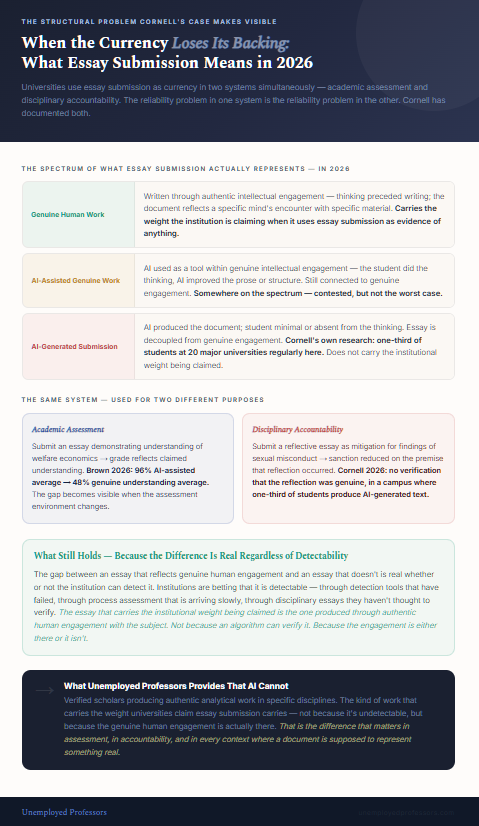
When an institution uses essay submission as evidence of something — learning, reflection, accountability, consequence — it is making a claim about what essays represent. That claim is either true or it is not. If it is true that writing a reflective essay constitutes a meaningful form of accountability, then the essay submitted must actually reflect genuine reckoning. If it is not true — if an essay is just a document that anyone can produce in any number of ways without genuine engagement — then the institution is using a meaningless currency for meaningful purposes.
Cornell’s academic environment has documented, in its own research, that essay production is increasingly decoupled from genuine engagement. The institution cannot simultaneously document widespread AI-generated essay submission in its academic environment and treat essay submission as reliable evidence of genuine reflection in its disciplinary environment. These two facts exist in the same institution, among the same student population, in the same semester.
The Essay That Actually Means Something
The academic writing that carries the weight institutions claim it carries — in assessment, in accountability, in any context where the document is treated as evidence of genuine thought — is the writing that reflects genuine human engagement with the subject. Not because human authorship is verifiable by algorithm. Because genuine engagement produces something that AI cannot replicate: authentic connection between the writer’s mind and what ended up on the page.
This is the standard that every academic essay is supposed to meet. It is the standard that Cornell’s disciplinary essays were supposed to meet. It is the standard that falls apart when essay production becomes mechanical, whether through AI generation or any other form of disconnected document production.
Unemployed Professors has provided genuinely human scholarly expertise since 2010. The scholars who produce work on our platform are verified subject-matter experts whose writing reflects authentic analytical engagement with specific academic disciplines. The essay that represents something genuine — that carries the weight the institution is claiming when it uses it as evidence of thought or accountability — is the essay produced through real human engagement. Not because the institution can always tell the difference. Because the difference is real regardless of whether the institution can tell.
The Bottom Line
Cornell’s disciplinary system determined that writing a reflective essay is a meaningful response to findings of sexual misconduct. Cornell’s own research has documented that one-third of its students regularly produce AI-generated text for academic submissions. These two facts coexist in the same institution and point to the same structural problem: an institution that treats essay submission as evidence of genuine engagement while presiding over an academic environment in which essay submission is increasingly decoupled from genuine engagement.
What happened to the woman at the center of this case is not a punchline. The institution’s response to it is a case study in what happens when essay-as-currency loses its backing. Universities have built assessment systems, accountability mechanisms, and disciplinary processes on the premise that submitting a written document represents something real. That premise is only as reliable as the relationship between the document and the mind that produced it.
In 2026, that relationship is under more pressure than at any point in the history of academic writing. Cornell has inadvertently demonstrated what happens when it breaks.