
The Federal Hiring Freeze Has a Law Enforcement Exception. The Degree Is What Gets You Through the Door.
There is a federal civilian hiring freeze active right now. If you work in the federal government or have been following federal employment news, you know this. Agencies across the executive branch have been told to hold positions vacant, suspend new hires, and in many cases actively reduce headcount.
The current USAJOBS posting for FBI Special Agent says something that stands out from that context: “The position advertised has been exempted from the federal civilian hiring freeze.”
Federal law enforcement is hiring. The freeze does not apply.
The FBI, DEA, ATF, U.S. Marshals Service, Homeland Security Investigations, Secret Service, U.S. Customs and Border Protection, and the Bureau of Prisons are all continuing to recruit, evaluate, and hire — because national security and law enforcement operations cannot be paused the way administrative functions can. The exemption is not incidental. It reflects a recognition that federal law enforcement capacity is a different category of government function.
For law enforcement professionals looking at the federal government as a career destination, this is a significant moment. The competition for available federal positions has not disappeared — federal law enforcement agencies are selective in ways that the broader federal civilian workforce is not — but the door is genuinely open in a way that it is not for most of the federal government right now.
The question is what gets you through it.
What Federal Law Enforcement Actually Requires
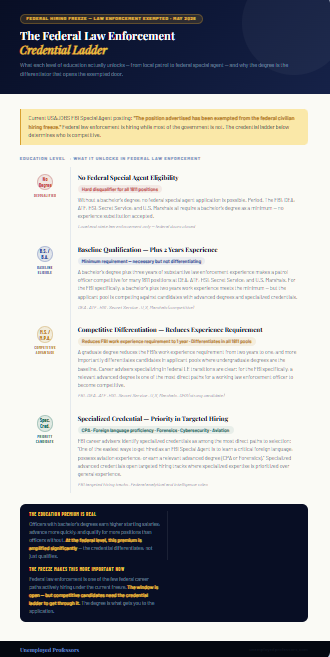
Every major federal law enforcement agency — FBI, DEA, ATF, HSI, Secret Service, U.S. Marshals — requires a bachelor’s degree as a baseline requirement for special agent positions. This is not a preference. It is a hard requirement. No degree, no application.
That last clause matters. A graduate degree does not just check the education box — it reduces the work experience requirement and, more importantly, makes a candidate more competitive in what is already a highly selective process. There are approximately 10,100 FBI special agents. The bureau receives many times that number of applications for each hiring cycle.
The path from local law enforcement to federal law enforcement is real but not automatic. Career advisers who specialize in federal law enforcement transitions are direct about this: a college degree paired with three years of substantive work experience would make a patrol officer a competitive candidate for many 1811 positions — the federal classification for criminal investigators that covers DEA, ATF, HSI, Secret Service, and U.S. Marshals. For the FBI specifically, which places law enforcement and military candidates in the same applicant pool, the most direct additional credential for a working officer is a relevant advanced degree.
The education premium in law enforcement is real and measurable at every level. Officers with bachelor’s degrees are eligible for more positions, earn higher starting salaries at many agencies, and advance more quickly through promotional processes than officers without degrees. The federal level amplifies this premium significantly — a master’s degree or specialized credential does not just qualify a candidate, it differentiates them in an applicant pool where a significant proportion of candidates already have undergraduate degrees.
The Degree Problem Law Enforcement Officers Actually Face
Working law enforcement officers who want to pursue the credentials that federal agencies require face a specific challenge that differs from the typical graduate student experience.
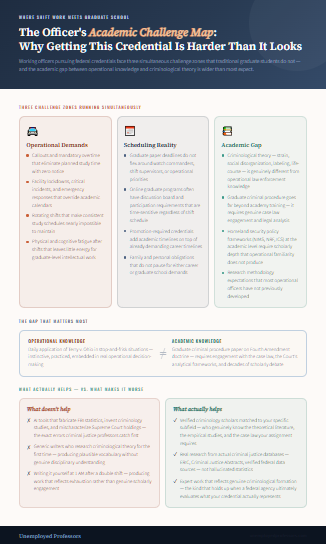
Shift work is unpredictable in ways that academic timelines are not. A patrol officer can plan around a paper deadline and then have an incident, a callout, or mandatory overtime eliminate the planned study time with zero notice and zero flexibility. A corrections officer whose facility goes on lockdown the week of finals is not making an excuse — they are describing their professional environment.
The subjects that matter most for federal law enforcement credentials are not always the subjects that working officers feel most confident writing about academically. Criminological theory — the scholarly literature on crime causation that graduate criminal justice programs require students to engage with at depth — is genuinely different from the operational knowledge officers develop through years of field work. An officer who can navigate a tactical situation flawlessly may find the academic literature on routine activities theory, social disorganization, and labeling theory genuinely foreign. That is not a reflection of intelligence or capability — it is a reflection of how different academic criminology is from operational law enforcement.
Constitutional criminal procedure at the graduate level requires genuine engagement with Fourth, Fifth, and Sixth Amendment doctrine in ways that go well beyond what officers learn in the academy and apply in the field. A graduate criminal justice program paper on Fourth Amendment search and seizure is not the same exercise as the daily operational application of Terry v. Ohio. It requires genuine engagement with the case law, the Court’s analytical frameworks, and the policy debates that legal scholars and criminal justice faculty have been conducting for decades.
For officers who are serious about the credentials that open federal law enforcement doors, these academic challenges are real — and the time and energy available to address them is genuinely limited.
Why AI Is the Wrong Tool for Law Enforcement Academic Work
Many officers working toward criminal justice credentials have experimented with using AI tools to help with academic writing. The results are consistently problematic in ways that are specific to criminal justice as a discipline.
Criminal justice papers cite specific things: FBI Uniform Crime Report statistics, Bureau of Justice Statistics data, specific Supreme Court decisions and their holdings, specific criminological studies and their findings. These are not decorative citations — they are the empirical and legal grounding that criminal justice professors, many of whom have professional backgrounds in law enforcement, law, or public policy, verify and evaluate.
AI fabricates all of these with complete confidence. It generates specific-sounding crime statistics that do not match any actual federal data series. It invents criminological studies with plausible-sounding author names and journal titles. It mischaracterizes what actual Supreme Court cases held — sometimes reversing the actual holding entirely. It describes homeland security frameworks like NIMS and the National Response Framework with confident inaccuracies that any professional with experience in emergency management will catch immediately.
For a working officer who submits an AI-generated criminal procedure paper that mischaracterizes the holding of a major Fourth Amendment case to a professor who has spent twenty years teaching constitutional law, the result is not just a bad grade. It is a paper that signals that the student does not actually understand the material. That signal matters in graduate programs that are, in effect, evaluating whether a student has the scholarly foundation for advanced professional roles.
The credential that opens federal law enforcement doors is only worth what it represents. A master’s degree in criminal justice that was assembled through AI-generated papers represents something different — and something less — than a master’s degree earned through genuine engagement with criminological theory, criminal law, and criminal justice research.
What Genuine Criminal Justice Scholarship Looks Like — And Why It Matters for Your Career
The graduate criminal justice curriculum is not arbitrary. The theoretical frameworks, the empirical methods, the constitutional doctrine, and the policy analysis that programs require students to engage with are the intellectual foundations of advanced criminal justice practice.
An officer who genuinely understands deterrence theory — not just the name, but the rational choice assumptions underlying it, the empirical literature on its effects, and the methodological debates around measuring deterrence — is better equipped to evaluate the evidence base for crime prevention programs. An officer who genuinely understands Fourth Amendment doctrine — not just the practical application but the scholarly debates around Terry, Whren, and Utah v. Strieff — is better equipped to navigate the constitutional dimensions of complex investigations. An officer who genuinely understands the research literature on procedural justice is better equipped to understand why the legitimacy of policing matters for long-term crime reduction.
These are not academic exercises disconnected from operational reality. They are the theoretical foundations that distinguish officers who can analyze, evaluate, and lead from officers who can execute. The federal law enforcement agencies that are actively hiring right now — with their hiring exempted from the freeze that covers most of the federal government — are specifically looking for the analytical and leadership capacity that advanced education is supposed to develop.
This is why the kind of academic help that working officers use for their graduate work matters more than it might appear to. Help that produces papers without developing genuine understanding is, ultimately, help that undermines the credential it produces. Help that connects officers to genuine scholarly expertise — to the authentic criminological formation that federal agencies are ultimately hiring for — is a different kind of investment.
Unemployed Professors provides the second kind of help. Our criminal justice scholars have genuine formation in criminological theory, criminal law and procedure, policing research, corrections policy, homeland security policy, and forensic science. When a working officer needs help with a criminological theory paper, we match them with a criminologist who actually knows the field. When an officer needs help with a constitutional criminal procedure essay, we match them with a scholar who has genuine legal training and authentic knowledge of the case law.
The Bottom Line
The federal hiring freeze has a law enforcement exception. Federal law enforcement agencies are hiring, and they are selective in ways that make the credentials competitive candidates bring genuinely consequential.
The degree is what gets officers through the initial qualification screen. The quality of the education — the genuine intellectual formation in criminological theory, criminal law, and criminal justice research — is what ultimately makes the difference in an applicant pool where the baseline degree requirement is met by most serious candidates.
Working toward those credentials while managing the scheduling demands of shift work, the time constraints of operational law enforcement, and the genuine intellectual challenge of graduate-level criminal justice scholarship is not easy. It deserves support that actually understands the field — not AI tools that fabricate the specific empirical and legal details that criminal justice professors check, and not generic writers who research criminological theory for the first time before writing your paper.
Unemployed Professors has been providing genuine criminal justice scholarship from verified scholars since 2010. For officers who are serious about the credentials that open federal law enforcement doors — that is who we are here for.