
Teacher Appreciation Week Just Ended. The Government Is Withholding $220 Million for Teacher Training.
Teacher Appreciation Week ran from May 4 through May 8. There were social media posts. There were discounts at Chipotle and Barnes & Noble. There were heartfelt letters from principals and proclamations from governors.
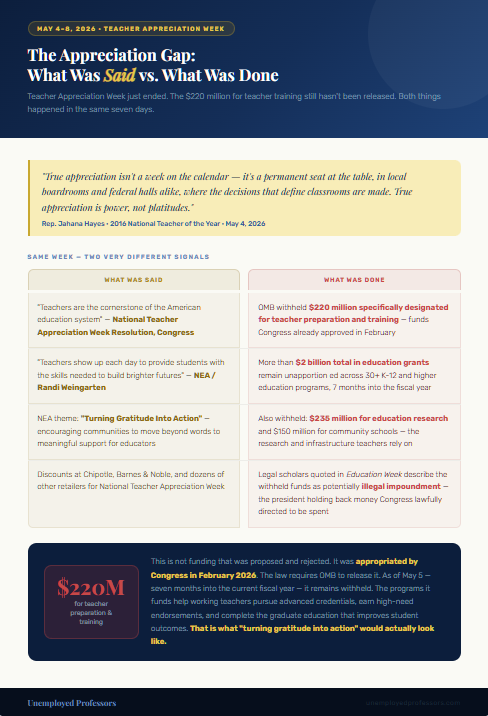
Rep. Jahana Hayes — the 2016 National Teacher of the Year, now a congresswoman from Connecticut — introduced a resolution marking the occasion. She put it in terms that cut through the appreciation-industrial complex with unusual directness: “True appreciation isn’t a week on the calendar — it’s a permanent seat at the table, in local boardrooms and federal halls alike, where the decisions that define classrooms are made.”
The same week, Education Week reported that the Trump administration’s Office of Management and Budget has withheld more than $2 billion in education grants that Congress already approved in February. The withholding covers more than thirty separate K-12 and higher education programs. Among them: $220 million specifically designated for teacher preparation and training.
The $220 million is not a line item that was proposed and rejected. It was appropriated by Congress. The law requires the OMB to release it. As of May 5 — seven months into the fiscal year it was budgeted for — it remains locked.
Teacher Appreciation Week. Teacher training funding withheld. Both in the same seven days.
Rep. Hayes is right that true appreciation is not a week on the calendar. The calendar just made her point for her.
What the $220 Million Was For
The $220 million in withheld teacher preparation and training funding represents a specific category of federal investment: grants to states, universities, and organizations that support the professional development of teachers and the preparation of new ones.
These are not administrative overhead dollars. They are the funding mechanism for programs that help working teachers pursue advanced credentials, participate in research-based professional development, earn endorsements in high-need areas like special education and bilingual education, and complete the graduate education programs that qualify them for leadership roles. They are funding for exactly the kind of professional growth that teachers are told — correctly — is essential for improving student outcomes.
The National Education Association framed Teacher Appreciation Week this year around the theme of turning gratitude into action. The action that would most directly express gratitude to working teachers — releasing the funding that supports their professional development — is the action that is not happening.
This is not primarily a partisan observation. The funds were appropriated by a Congress that includes members of both parties. Legal scholars quoted in Education Week described the withholding as potentially constituting illegal impoundment — the president holding back funds that Congress has lawfully directed to be spent, without the congressional approval that impoundment legally requires.
Whatever the legal resolution, the practical effect is the same: teachers who were expecting federal support for professional development programs are not getting it, and the institutions that deliver teacher preparation are operating under sustained uncertainty about whether promised funding will arrive.
What This Means for Teachers Going Back to School
The teachers most directly affected by the withheld professional development funding are, in many cases, the same teachers who have decided not to wait for the system to invest in them — and are instead investing in themselves.
Graduate enrollment in education programs has been climbing. More working teachers are pursuing M.Ed. degrees, Ed.D. programs, educational leadership credentials, and specialist endorsements on their own initiative and, increasingly, at their own expense. The teachers returning to school in 2026 are doing so in an environment where the federal funding that has historically supported teacher professional development is under sustained pressure, where school districts are trimming professional development budgets under their own fiscal constraints, and where the career advancement that advanced credentials enable is more important than ever as schools compete for and retain experienced educators.
The implicit message to these teachers from the current policy environment is clarifying, even if it is not comfortable: if you want to advance your credentials and your professional practice, you are largely on your own.
That is not a counsel of despair. It is a description of reality that has a straightforward implication: teachers who are pursuing advanced degrees under their own momentum, with their own resources, managing their own professional development alongside the full demands of teaching, need every source of genuine support they can access.
Support that actually understands what graduate education programs require — that knows what action research methodology demands, what educational leadership theory expects, what literacy education scholarship looks like at the master’s level — is worth more than generic academic help. Teachers going back to school are not generalists pursuing degrees in unspecified academic subjects. They are educational professionals pursuing highly specialized graduate credentials in a discipline that requires genuine theoretical and practical formation to engage at the level their programs demand.
The Appreciation Gap
Rep. Hayes’ observation — that true appreciation is power, not platitudes — points to a structural problem in how American education treats its teachers that predates the current administration and will outlast it.
Teachers are consistently told they are the most important factor in student learning. Research supports this — the quality of teaching is the most significant school-based variable affecting student achievement. And yet the structural supports for teacher professional growth have been chronically underfunded, intermittently targeted for cuts, and always positioned as discretionary rather than essential.
The $220 million for teacher preparation and training was discretionary in the sense that it was a competitive grant program rather than a formula entitlement. That discretionary status is precisely what made it available to be withheld. The things we call discretionary in education policy tend to be the things we most like to say are priorities when the calendar calls for it.
The gap between how teachers are valued in rhetoric and how they are supported in policy is not new. What is new is how visible that gap has become — and how clearly teachers themselves are articulating it. The educators speaking this week are not asking for more appreciation. They are asking for structural change.
That change is slow in coming. In the meantime, the working teachers who have decided to advance their credentials regardless of what the system does or does not provide are doing something genuinely admirable — and genuinely demanding.
What Unemployed Professors Provides to Teachers Going Back to School
The teachers pursuing graduate education in 2026 are not taking the easy path. They are managing full-time classrooms — planning instruction, assessing student learning, supporting children through challenges that extend well beyond academic content — while simultaneously completing graduate coursework that requires substantive engagement with educational research, theory, and practice.
Graduate education programs are demanding precisely because they should be. The theoretical literature of education — learning science, curriculum theory, educational leadership frameworks, literacy research, special education law and practice — is genuinely complex. Applying it with the depth that education faculty expect requires genuine formation in the field, not surface familiarity with theoretical names and vocabulary.
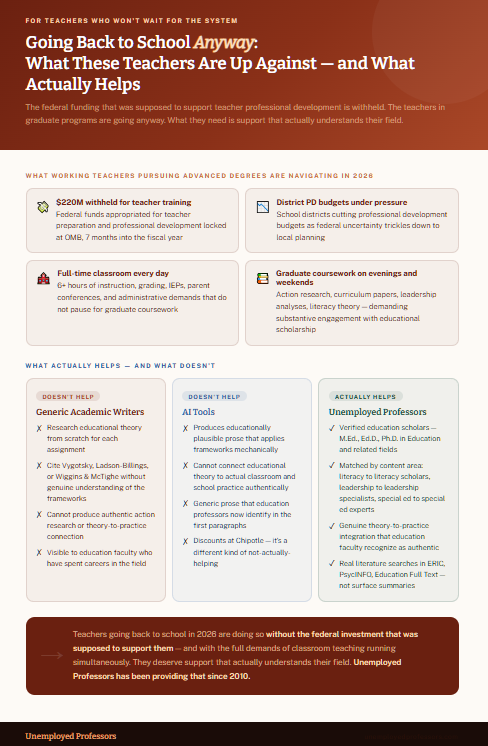
Unemployed Professors provides working teachers with access to verified education scholars who have that genuine formation. Our scholars have advanced degrees in education and related disciplines, authentic engagement with the educational research literature, and real understanding of how educational theory functions in classroom and school practice. When a working teacher pursuing an M.Ed. in curriculum and instruction needs help with an action research paper, we match them with a literacy or curriculum scholar who genuinely knows what action research requires. When an experienced teacher pursuing an administrative license needs help with an educational leadership paper on instructional supervision, we match them with a scholar who genuinely understands school leadership.
This is not generic academic help with an education subject. It is subject-matched expertise from scholars who understand education from the inside — the same distinction that separates the teacher who has genuinely internalized Vygotsky’s framework from the one who can cite the Zone of Proximal Development correctly.
Teachers who are doing the hard work of advancing their credentials deserve support that actually understands their field. Discounts at Chipotle are nice. Expert education scholarship matched to your specific program and assignment is what actually helps.
The Bottom Line
Teacher Appreciation Week ended. The $220 million for teacher preparation and training remains withheld. Rep. Hayes is right: true appreciation is not a week on the calendar.
For teachers pursuing advanced degrees — doing the unglamorous, demanding, expensive, evenings-and-weekends work of advancing their own professional formation while the system that is supposed to support that formation pulls back — the question is not whether to keep going. The teachers in graduate education programs are going. The question is what kind of support is actually worth their time and money.
Generic academic help from writers who research educational theory for the first time produces papers that education faculty recognize as lacking genuine disciplinary depth. AI produces the generic educationally-plausible prose that experienced education professors now identify in the first paragraphs. Neither is worth the investment of a teacher who is serious about their professional development.
Genuine education scholarship from verified scholars who actually understand educational theory and practice — who know the difference between citing Ladson-Billings and genuinely applying her framework, who understand what action research actually requires, who can produce educational leadership analysis that reflects real understanding of how schools work — is the kind of support that actually serves teachers’ professional interests.
Unemployed Professors has been providing that since 2010. For teachers who are going back to school because they believe in their own professional development regardless of what the funding environment does or does not support — that is who we are here for.
POST YOUR PROJECT today and work with a verified education scholar who actually understands your program, your assignment, and your field.