
Graduate school has always demanded more than undergraduate work—deeper analysis, original research, sophisticated argumentation, and contributions to scholarly knowledge. But the AI revolution has fundamentally raised the bar for graduate students in ways that many aren’t yet recognizing. If you’re pursuing a master’s or PhD in 2026, you’re facing expectations that would have seemed unreasonable just five years ago.
At Unemployed Professors, we work extensively with graduate students navigating this new landscape. What we’re seeing is unprecedented: AI has made basic competence trivial while making genuine excellence mandatory. For grad students, this shift creates both challenges and opportunities that require strategic navigation. Let’s examine what’s changed and how graduate students can meet—or exceed—the new standards.
The Paradox: AI Made Easy Work Easier, Hard Work Harder
Here’s the fundamental paradox reshaping graduate education: AI tools have made routine academic tasks so accessible that they no longer demonstrate competence. Simultaneously, this accessibility has made truly sophisticated work more essential for distinguishing yourself as a scholar.
Consider what ChatGPT can do easily: generate literature review summaries, outline research proposals, draft methodology sections, produce serviceable abstracts, and create basic analytical frameworks. Five years ago, demonstrating competence at these tasks showed you belonged in graduate school. Today, anyone with internet access can produce similar output in minutes.
This creates a critical problem for graduate students: the threshold of “good enough” has moved dramatically upward. Work that would have earned praise in 2020 might now seem barely adequate. The bar for graduate students isn’t just slightly higher—it’s categorically different.
The new standard isn’t competence—it’s excellence that obviously required genuine expertise. This is simultaneously more demanding and more important than ever before.
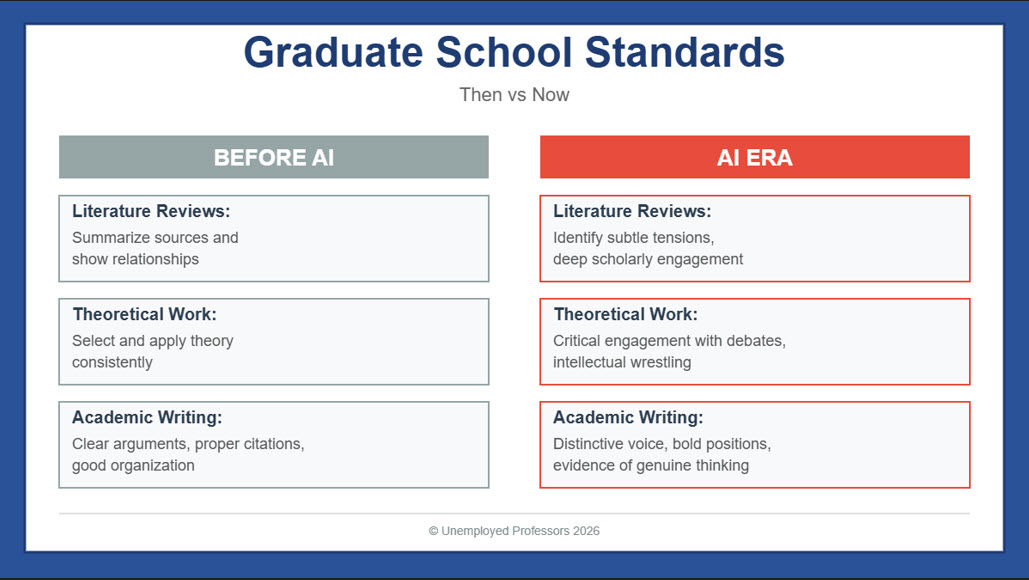
The bar for graduate school has fundamentally shifted. What once demonstrated competence—summarizing sources, applying theories, writing clearly—is now baseline work that AI can handle. Today's graduate students must prove deeper engagement, critical thinking, and original perspectives that only human expertise can provide. Copyright Unemployed Professors 2026What “Good Enough” Meant vs. What It Means Now
Let’s get specific about how graduate school standards have shifted:
Literature Reviews – Then vs. Now
Pre-AI Standard: Demonstrate you’ve read key sources in your field, can summarize their arguments accurately, and understand how they relate to your research question.
AI-Era Standard: Demonstrate deep engagement with literature that reveals genuine understanding—identifying subtle tensions between scholars, recognizing unstated assumptions, positioning your work within ongoing debates in ways that show you’ve actually participated in scholarly discourse.
Why? Because AI can generate competent literature summaries from abstracts and titles. To prove human expertise, you need to demonstrate the deep reading that AI cannot do: engagement with actual arguments, recognition of theoretical nuances, synthesis that reflects real comprehension.
Theoretical Frameworks – Then vs. Now
Pre-AI Standard: Select appropriate theoretical lens for your research, explain its core concepts, apply it consistently to your analysis.
AI-Era Standard: Demonstrate sophisticated understanding of theoretical traditions, engage critically with frameworks rather than applying them mechanically, show awareness of debates within theoretical schools, and apply theories in ways that reveal genuine intellectual wrestling rather than surface-level citation.
Why? Because AI can describe theories competently without understanding them. Graduate students must now demonstrate the understanding that distinguishes scholars from well-trained autocomplete.
Research Proposals – Then vs. Now
Pre-AI Standard: Clear research question, appropriate methodology, literature foundation, feasible scope, contribution to field articulated.
AI-Era Standard: All of the above, plus: originality that couldn’t be AI-generated, methodological sophistication that shows genuine expertise, awareness of implementation challenges that reveals real research experience, positioning within scholarly conversations that demonstrates you’re part of the academic community.
Why? Because AI can generate research proposals that check all the basic boxes. Committees now look for evidence of genuine scholarly thinking that AI cannot fake.
Academic Writing – Then vs. Now
Pre-AI Standard: Clear argumentation, proper citations, disciplinary conventions followed, grammatically correct, well-organized.
AI-Era Standard: All of the above, plus: distinctive scholarly voice, bold argumentative positions, deep engagement with sources, original synthesis, writing that demonstrates actual thinking rather than competent arrangement of appropriate words.
Why? Because AI produces grammatically perfect, well-organized, properly cited text that lacks intellectual substance. Graduate students must now write in ways that obviously reflect genuine expertise and original thought.
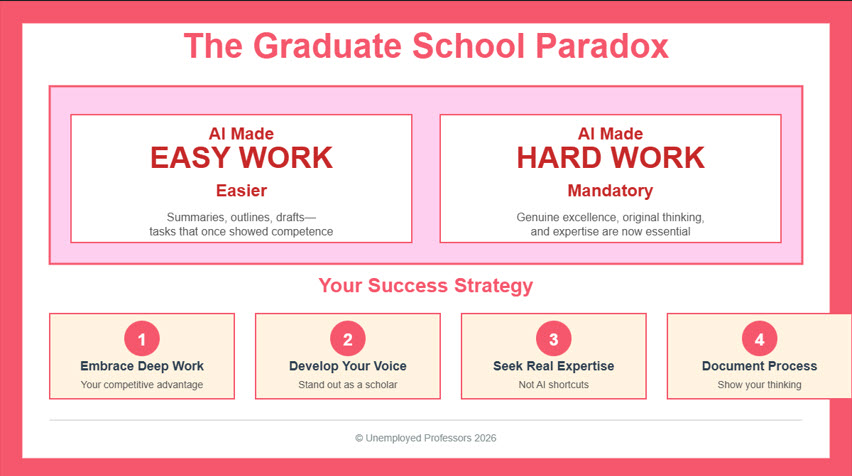
Faculty now expect three core capabilities that AI cannot replicate: deep reading that goes beyond summaries to engage with actual scholarly arguments, genuinely original intellectual contributions that emerge from real expertise, and critical engagement that questions assumptions and recognizes limitations. These aren't just higher standards—they're fundamentally different requirements. Copyright Unemployed Professors 2026The New Graduate Student Expectations
Given these shifted standards, what are faculty actually expecting from graduate students in the AI era?
Demonstrable Deep Reading
You need to show you’ve actually read sources, not just processed their titles and abstracts. This means:
- Engaging with specific arguments from texts, not just general themes
- Recognizing how scholars position themselves within debates
- Identifying methodological choices and their implications
- Understanding intellectual genealogies—who’s responding to whom
- Catching nuances that summaries miss
Faculty can tell the difference between students who’ve done the reading and students who’ve relied on AI-generated summaries. With AI, the latter is now unacceptable even as competent performance.
Original Intellectual Contribution
“Contribution to the field” has always been graduate education’s goal, but AI has made originality more crucial. You need to:
- Develop arguments that couldn’t be predicted from existing literature
- Ask questions that emerge from genuine engagement with scholarship
- Make connections between ideas that require actual understanding
- Challenge existing frameworks from positions of knowledge
- Produce insights that demonstrate real thinking
Methodological Sophistication
Understanding research methods deeply enough to make and defend complex choices is now essential:
- Knowing why specific methods fit your questions
- Recognizing methodological limitations and trade-offs
- Adapting methods to your particular context
- Understanding epistemological foundations of your approach
- Defending choices based on actual comprehension
AI can describe research methods. You need to demonstrate the expertise to deploy them appropriately in novel situations.
Critical Engagement
Graduate students must engage critically with everything—literature, theories, methods, findings, even their own arguments:
- Questioning assumptions rather than accepting them
- Recognizing limitations of theoretical frameworks
- Identifying gaps in existing scholarship
- Evaluating evidence quality and interpretation
- Maintaining intellectual honesty about uncertainty
This critical stance requires genuine understanding that AI fundamentally lacks.
Disciplinary Depth
You need to demonstrate you’re becoming part of your scholarly community:
- Understanding disciplinary conversations and their histories
- Recognizing key debates and where scholars stand
- Writing with appropriate disciplinary voice
- Engaging with current scholarship in your field
- Positioning yourself within intellectual traditions
Surface-level familiarity isn’t enough. You need the deep immersion that creates actual expertise.
Why Graduate School Is Harder Now
These elevated expectations make graduate school genuinely more difficult than it was pre-AI:
1. The Work Cannot Be Faked
Previously, competent students could sometimes fake depth through good summarization and proper citation. AI made this easier initially, but committees adapted by making genuine depth mandatory. You cannot fake deep reading, original thinking, or actual expertise anymore.
2. The Time Investment Increased
Meeting new standards requires more time. You can’t rely on AI to speed up literature reviews or methodology sections if your work needs to demonstrate genuine engagement. The deep reading, critical thinking, and original synthesis that’s now required simply takes more time than performing competence.
3. The Anxiety Is Higher
Graduate students face new anxieties: Is my work original enough? Am I demonstrating deep enough engagement? Will my committee think I used AI inappropriately? Does my writing show genuine expertise? These concerns add psychological burden to already demanding programs.
4. The Support Is Often Inadequate
Many graduate programs haven’t adapted their support structures to new realities. Advisors might not provide clearer guidance about new expectations. Workshops might not address how to demonstrate genuine engagement in the AI era. Students are left figuring out raised standards without proportionally raised support.
5. The Competition Intensified
Other graduate students are also adapting to new standards, creating competitive pressure. The student who produces genuinely excellent work stands out more than ever, which means adequate work stands out less than ever.
The PhD Student Challenges Are Most Acute
These shifts hit PhD students particularly hard because doctoral education is specifically about becoming an independent scholar—exactly what AI cannot be.
Dissertation Expectations
Dissertations must now obviously demonstrate what AI cannot produce:
- Sustained original argument across hundreds of pages
- Deep engagement with vast bodies of literature
- Methodological sophistication applied to novel questions
- Contribution to knowledge that emerges from years of expertise
- Scholarly voice that reflects actual intellectual development
Committees know AI can generate dissertation-like text. Your dissertation must show what only human expertise can produce.
Qualifying Exams
Written and oral exams now test for understanding AI cannot fake:
- Synthesis across multiple subfields in your discipline
- Historical knowledge of how debates developed
- Ability to apply theories to novel situations spontaneously
- Deep familiarity with scholarly traditions
- Critical engagement that reveals genuine expertise
If your exam answers could be AI-generated, you haven’t demonstrated doctoral-level mastery.
Research Independence
PhD students must show capacity for independent scholarly work:
- Developing original research questions from real engagement with literature
- Making sound methodological choices for complex situations
- Managing multi-year research projects
- Producing scholarship worthy of publication
- Contributing to academic discourse meaningfully
AI can assist with tasks, but cannot demonstrate the independence that defines doctoral education.
Master’s Thesis Requirements Have Also Risen
Master’s students face similar pressures, though sometimes less acknowledged:
Demonstrating Research Capability
Master’s theses now need to show genuine research sophistication:
- Original questions emerging from literature engagement
- Appropriate methodology deployed competently
- Analysis that reveals real understanding
- Writing at scholarly publication quality
- Contribution to field at appropriate scale
The “good master’s thesis” bar is now where “strong master’s thesis” was five years ago.
Preparing for Further Study
Students planning to continue to PhDs need to demonstrate scholarly potential more clearly because admissions committees know AI can generate impressive-looking writing samples. You need work that shows actual research capability.
Professional Credentialing
For professional master’s programs, demonstrating expertise beyond what AI can generate matters for employment. Your capstone project needs to show problem-solving, critical thinking, and domain knowledge that employers value specifically because AI cannot replicate it.
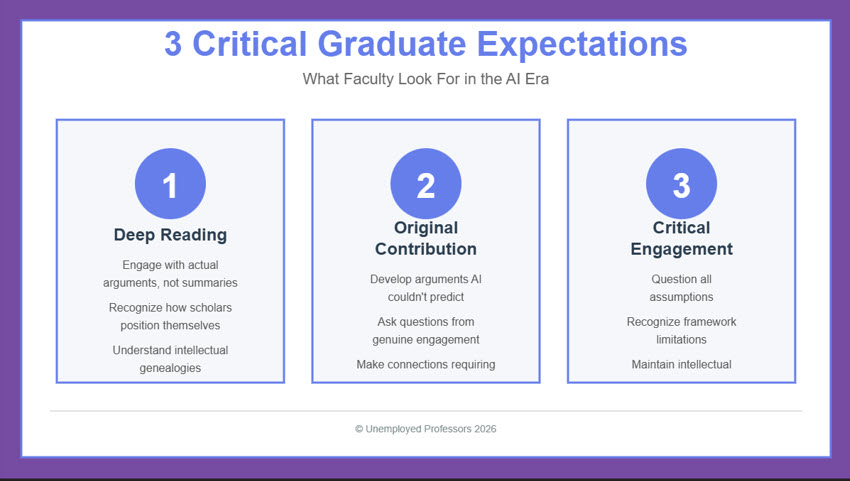
Graduate students face a stark paradox: AI has made routine academic tasks trivial while making genuine excellence absolutely mandatory. Success requires embracing deep work as your competitive advantage, developing a distinctive scholarly voice, seeking real expertise over AI shortcuts, and documenting your intellectual process. The challenge is greater, but so is the value of meeting it. Copyright Unemployed Professors 2026How Graduate Students Can Meet the New Standards
Given these challenges, how do graduate students actually succeed in this environment?
1. Embrace Deep Work
Dedicate serious time to genuine engagement with literature, not just processing it efficiently. Read slowly, think critically, make connections. This deep work is now your competitive advantage—AI cannot do it.
2. Develop Distinctive Voice
Find your scholarly voice through extensive writing practice. The more your work sounds like you—reflecting your particular interests, perspectives, and intellectual commitments—the more obviously human it is.
3. Seek Genuine Expertise
When you need support, seek sources of actual expertise rather than AI shortcuts. Work with advisors, engage with scholars in your field, use services like Unemployed Professors that provide access to genuine academic expertise rather than AI generation.
4. Document Your Process
Keep research journals, save progressive drafts, maintain notes. This documentation helps you demonstrate the work behind your output, showing committees that your insights emerged from genuine intellectual labor.
5. Engage Scholarly Communities
Participate in conferences, workshops, reading groups. This engagement develops the disciplinary knowledge and scholarly identity that distinguish you from AI-generated competence.
6. Embrace Revision as Thinking
Treat revision as intellectual development, not just polish. Each revision should deepen your understanding and strengthen your arguments. This iterative thinking process produces work AI cannot replicate.
7. Take Methodological Training Seriously
Develop genuine methodological expertise through coursework, workshops, and practice. This expertise serves you throughout your career and demonstrates capability AI lacks.
8. Build Relationships with Faculty
Strong advisor relationships provide guidance, feedback, and advocacy. Faculty who know your capabilities can distinguish your work from AI-generated content and support your success.
How Unemployed Professors Helps Graduate Students
Our service is particularly valuable for graduate students because we provide access to genuine scholarly expertise:
Expert Consultation
Our writers are actual scholars who can help you think through complex theoretical problems, methodological choices, and research design issues. This consultation provides the expertise that AI cannot—actual understanding of scholarly work.
Model Examples
We produce model chapters, sections, or proposals that demonstrate what genuine scholarly engagement looks like. Graduate students can study these examples to understand how experts approach complex academic work.
Quality Benchmarks
Our work sets quality benchmarks for graduate-level writing, analysis, and argumentation. Seeing what excellent work actually looks like helps you calibrate your own standards upward.
Strategic Guidance
We can advise on navigating graduate school challenges, meeting raised expectations, and producing work that demonstrates genuine expertise rather than competent performance.
Critically, we provide human expertise, not AI generation. Our writers understand what committees expect because they’ve been on committees. They know what distinguishes adequate from excellent work because they’ve evaluated thousands of papers. This expertise is what graduate students need to meet new standards.
The Opportunity in Higher Standards
Here’s the optimistic take: raised expectations create opportunities for graduate students willing to meet them.
Genuine Excellence Stands Out More
In a world where AI produces adequate work easily, excellent work is more valuable than ever. Graduate students who develop real expertise distinguish themselves more clearly from peers who rely on competence alone.
Expertise Is More Valuable
The deep knowledge and sophisticated thinking that graduate education develops is exactly what AI cannot replicate. This makes your graduate training more valuable in the job market, not less.
Scholarly Community Matters More
AI cannot replace genuine participation in scholarly discourse. Graduate students who engage authentically with academic communities develop irreplaceable professional capital.
Original Thinking Is Premium
Your capacity for original thought—developed through graduate training—is the most AI-proof skill there is. Raising the bar for originality increases the value of genuine innovation.
Conclusion: Rising to the Challenge
Graduate school has always been challenging. The AI era has made it more challenging by raising standards for what counts as adequate work. But this isn’t cause for despair—it’s call for strategic adaptation.
Graduate students who recognize the new reality, develop genuine expertise, engage deeply with scholarship, and demonstrate original thinking will thrive. Those who treat graduate school as performing competence rather than developing capability will struggle.
The bar for graduate students is indeed higher than ever. But the opportunities for those who clear it are correspondingly greater. Your graduate training develops exactly what AI cannot provide: genuine expertise, original thinking, deep understanding, and scholarly capability.
Unemployed Professors exists to support graduate students navigating these challenges by providing access to actual scholarly expertise. We understand what committees now expect because our writers are the scholars sitting on those committees. We know what distinguishes adequate from excellent work because we produce excellent work ourselves.
The new standards are demanding. But you chose graduate school precisely to develop the advanced capabilities that these standards require. With appropriate support, strategic approach, and genuine commitment to scholarly development, you can not only meet the raised bar—you can exceed it.
Welcome to graduate education in the AI era. The bar is higher. And that’s exactly why your achievement in clearing it matters more than ever.