
There’s a crucial distinction lost in most conversations about AI and academic writing: the difference between using AI to write versus using AI to think about writing. At Unemployed Professors, we’ve developed a sophisticated approach that leverages AI meta-cognition while keeping genuine human expertise at the center of every essay we produce. Understanding this distinction is key to understanding why our work remains valuable, authentic, and pedagogically sound in the age of ChatGPT and Claude.
When students or educators ask if we use AI, the honest answer is: yes, but not in the way you think. Our expert writers don’t feed prompts into ChatGPT and copy the output. Instead, they use AI writing tools the way professionals in every field use technology—as instruments that enhance human capability rather than replace it. Let’s explore what AI meta-cognition actually means and why this approach produces fundamentally different results than AI-generated content.
What Is AI Meta-Cognition?
Meta-cognition means thinking about thinking—the process of examining your own thought processes, evaluating your reasoning, and refining your approach to intellectual problems. AI meta-cognition extends this concept: using artificial intelligence as a tool to enhance, accelerate, and deepen human meta-cognitive processes.
When our writers engage in AI meta-cognition, they’re not asking ChatGPT to write their essays. They’re using AI writing tools to:
- Quickly generate multiple potential angles on a topic to evaluate which is most promising
- Test the coherence of their argument by having AI paraphrase it back and identifying where meaning gets lost
- Rapidly organize large volumes of research material to identify patterns and gaps
- Challenge their own thinking by generating counter-arguments to stress-test their positions
- Explore alternative structures and outlines before committing to an approach
- Verify that their writing communicates clearly by checking how AI interprets their claims
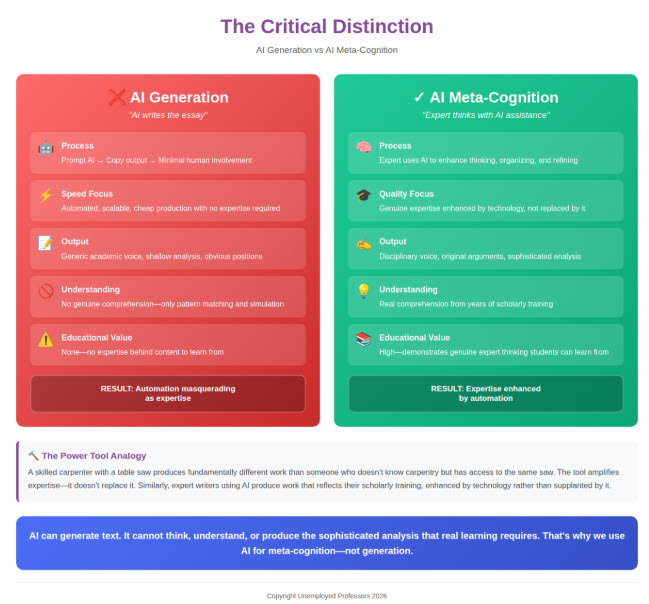
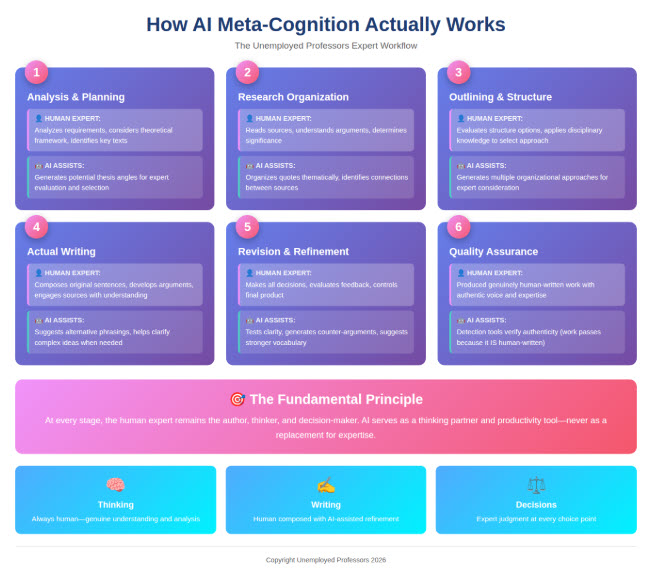
This is fundamentally different from AI-generated content. The human expert remains the author, the thinker, and the decision-maker at every stage. AI serves as a thinking partner, a sounding board, and a productivity tool—not as a replacement for expertise.
Think of it like a carpenter using power tools. A skilled carpenter with a table saw produces fundamentally different work than someone who doesn’t know carpentry but has access to the same saw. The tool amplifies expertise; it doesn’t replace it. Similarly, our writers using AI for writers approaches produce work that reflects their scholarly training and disciplinary knowledge, enhanced by technology rather than supplanted by it.
How Professional AI Writing Use Actually Works
Let’s get specific about what AI augmented writing looks like in practice at Unemployed Professors. Understanding our actual workflow reveals why this approach produces superior results compared to pure AI generation.
When a client submits a request for an essay on, say, the role of surveillance in contemporary society through a Foucauldian lens, here’s what happens:
Stage 1: Initial Analysis and Planning
Our assigned writer—a genuine scholar with expertise in social theory—begins by analyzing the assignment requirements, considering the appropriate theoretical framework, and identifying key texts and concepts that need to be engaged.
At this stage, they might use AI writing tools to quickly generate a range of potential thesis statements or approaches. The AI produces ten different angles on surveillance and Foucault. The expert writer evaluates these, recognizes which ones are theoretically sound versus superficial, and either selects one to develop or uses them as inspiration to formulate their own superior thesis.
This is AI meta-cognition in action: the technology accelerates the brainstorming process, but the evaluation and selection require genuine expertise that only a human possesses.
Stage 2: Research Organization
The writer has identified relevant sources—Foucault’s “Discipline and Punish,” contemporary scholarship on surveillance capitalism, case studies of modern surveillance systems. They might have dozens of sources with hundreds of pages of material.
Here, AI writing assistance can be invaluable. The writer might use AI to help organize quotes and concepts thematically, identify connections between sources, or flag potential contradictions in the literature that need to be addressed. Some AI tools can summarize key arguments from texts, which the expert then verifies and contextualizes within broader theoretical debates.
Again, the critical work is human. AI helps with logistics and organization, but understanding what the sources actually mean, how they relate to each other, and which arguments are most significant—that requires the scholarly expertise our writers bring.
Stage 3: Outlining and Structure
With research organized, the writer develops an outline. They might use AI to generate several potential structures—different ways of organizing the material and building the argument. The AI might suggest: chronological approach, thematic approach, comparative approach, dialectical approach.
The expert writer evaluates these suggestions based on deep understanding of academic argumentation in their field. They know which structure will best serve the specific argument they want to make. They might combine elements from multiple AI-generated outlines or reject all of them in favor of their own approach informed by disciplinary conventions.
This is a perfect example of AI for research and planning. The technology provides options quickly, but selecting among options—or rejecting them entirely—requires judgment that only expertise provides.
Stage 4: Actual Writing
Here’s where our approach diverges most dramatically from services that use AI-generated content. Our writers actually write their essays. They compose original sentences, develop arguments in their own voice, and engage with sources based on genuine understanding – in part because AI essays are unethical, in part because AI writes terribly, and in part because Unemployed Professors produces the highest quality custom essays.
They might use AI writing process tools in specific ways:
- If struggling to articulate a complex idea, they might draft it, ask AI to paraphrase, and use that paraphrase to identify where their original lacked clarity
- They might write a paragraph, then have AI generate an alternative version, comparing them to decide which approach is more effective
- They might use AI to suggest transitions between sections or alternative ways to introduce quotations
But the core intellectual work—making arguments, analyzing evidence, synthesizing sources, developing original insights—is entirely human. The writing reflects the author’s expertise, voice, and genuine engagement with material.
Stage 5: Revision and Refinement
In the revision stage, AI meta-cognition becomes particularly valuable. Our writers might:
- Use AI to identify sections where their argument isn’t clear (if AI misinterprets your point, readers might too)
- Have AI generate counter-arguments to test whether their reasoning is robust
- Check for coherence by asking AI to summarize their argument and seeing if the summary captures their intended meaning
- Use AI to suggest stronger vocabulary or more precise phrasing for specific claims
Throughout this process, the writer makes every decision. AI provides feedback, options, and perspectives, but the human expert evaluates, selects, and ultimately controls the final product.
Stage 6: Quality Assurance
Finally, we run finished essays through AI detection tools. This might seem paradoxical—we use AI in our process, so why wouldn’t we trigger AI detectors? The answer reveals the fundamental difference between AI augmented writing and AI-generated content.
Work produced through AI meta-cognition doesn’t trigger detectors because it’s genuinely human-written. The thinking, the argumentation, the voice—all human. AI assisted in the process but didn’t produce the output. It’s the difference between a painter who used photographs for reference versus someone who just ran a photo through a filter.
When our essays pass AI detection, it’s not because we’ve gamed the system—it’s because they authentically are human-written work that used technology intelligently in their creation.
Why This Approach Produces Superior Results
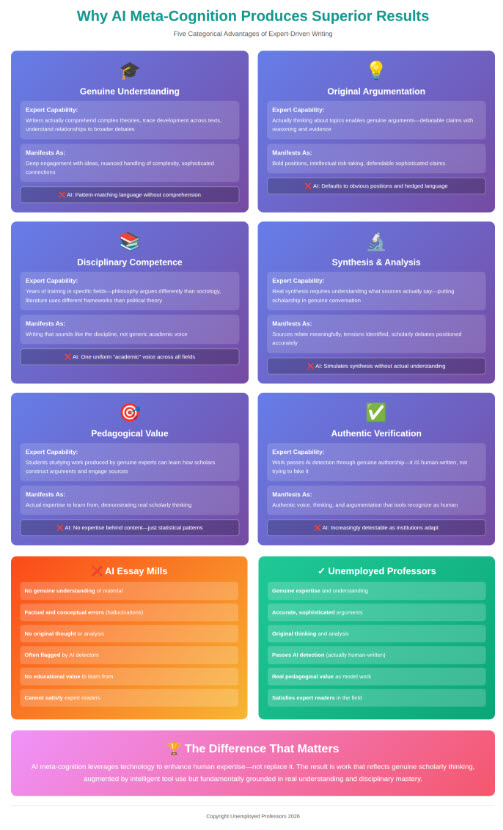
The difference between AI-generated content and content produced through AI meta-cognition isn’t subtle—it’s categorical. Here’s why our approach yields fundamentally better academic writing:
Genuine Understanding
Our writers understand the material they’re writing about. When they make claims about Foucault’s biopower, they actually comprehend the concept, can trace its development in Foucault’s work, and understand its relationship to broader theoretical debates. AI cannot do this—it can only pattern-match language about these concepts.
This understanding manifests in writing that engages deeply with ideas, handles complexity with nuance, and makes sophisticated connections that pure AI generation cannot achieve.
Original Argumentation
Because our writers are actually thinking about their topics, they develop genuine arguments—debatable claims supported by reasoning and evidence. AI defaults to obvious positions and hedged language. Human experts commit to positions, take intellectual risks, and make bold claims they can defend.
This originality is what makes academic writing valuable. It’s what professors want to see. And it’s what students should be learning to produce.
Disciplinary Competence
Academic writing varies significantly across disciplines. Philosophy papers argue differently than sociology papers. Literary analysis uses different frameworks than political theory. These disciplinary conventions reflect different intellectual traditions and methodological commitments.
Our writers know these conventions because they’ve been trained in these disciplines. They write like scholars in their fields, not like generic “academic writing.” AI produces one voice; experts produce disciplinary voices.
Synthesis and Analysis
Real synthesis—putting sources in genuine conversation, identifying tensions and convergences, positioning arguments within scholarly debates—requires understanding what sources actually say. Our writers read, comprehend, and engage meaningfully with scholarship. AI cannot.
The resulting synthesis in our essays demonstrates genuine intellectual work rather than simulating it. Sources relate to each other and to the argument in ways that reflect actual understanding.
Pedagogical Value
Students who use our model essays as learning tools are studying work produced by genuine experts. They can learn from these examples—see how scholars construct arguments, engage sources, and develop sophisticated analyses. There’s actual expertise to learn from.
AI-generated essays offer no pedagogical value. There’s no expertise behind them to learn from, just statistical patterns. The difference matters enormously for students who want to improve their own writing.
The Ethical Framework Behind AI Writing Assistance
Our approach to using AI writing tools is guided by clear ethical principles that distinguish augmentation from replacement:
Transparency
We’re transparent with our writers about how we expect them to use AI. We provide training and guidelines that clarify appropriate versus inappropriate uses. We’re also transparent with clients about our methods—hence this very article.
Expertise-First Philosophy
We hire writers based on their expertise, not their access to AI tools. Anyone can use ChatGPT; not everyone can produce sophisticated academic analysis. Our value proposition is expert human thinking, enhanced by technology.
Authentic Attribution
Our writers produce original work. They’re not plagiarizing AI output—they’re creating content informed by their expertise and refined through AI-assisted processes. The work is genuinely theirs.
Educational Purpose
We position our services as educational resources. Students receive model essays that demonstrate expert thinking, which they can study and learn from. This educational framework is incompatible with simply generating AI content.
Quality Standards
We maintain quality standards that AI alone cannot meet. Our essays must demonstrate genuine understanding, original argumentation, and sophisticated engagement with sources. These standards ensure AI remains a tool rather than a replacement.
How This Differs from AI Essay Services
The market now includes services that generate essays entirely with AI, often disguising this fact from customers. Understanding how we differ from these services is crucial.
AI essay mills use prompts to generate entire essays, maybe run them through “humanization” tools, and deliver them to students. The process is automated, scalable, and cheap—because no genuine expertise is involved.
These services produce work that:
- Lacks genuine understanding of material
- Makes factual and conceptual errors (hallucinations)
- Demonstrates no original thought
- Often gets flagged by AI detectors
- Provides no real educational value
- Cannot pass the scrutiny of expert readers
Unemployed Professors uses AI meta-cognition as part of an expert-driven process. Our writers bring years of training and disciplinary knowledge. AI accelerates and enhances their work but doesn’t replace it.
We produce work that:
- Reflects genuine expertise and understanding
- Makes accurate, sophisticated arguments
- Demonstrates original thinking and analysis
- Passes AI detection because it’s actually human-written
- Offers real pedagogical value as model work
- Satisfies expert readers familiar with the subject matter
The difference isn’t just in quality—it’s in fundamental nature. One is automation masquerading as expertise. The other is expertise enhanced by automation.
The Future of Professional Writing in the AI Era
Our approach represents how professional writing will evolve across all fields, not just academic writing. The future isn’t AI replacing human expertise—it’s AI augmenting it.
Journalists are already using AI to analyze data, identify patterns, and generate initial drafts of routine stories, while maintaining human control over investigation, analysis, and final writing. Lawyers use AI for case research and document analysis while providing the legal reasoning and strategy. Doctors use AI to analyze scans and suggest diagnoses while maintaining responsibility for patient care.
In every professional context, the pattern is the same: AI handles routine cognitive tasks, accelerates processes, and provides options, while human experts make judgments, provide creativity, and take responsibility for outcomes.
Academic writing follows this pattern. AI can help with research organization, outline generation, and revision feedback. But the actual work of understanding complex theories, developing original arguments, and writing with genuine scholarly voice—that requires human expertise.
This hybrid approach is sustainable and ethical. It leverages technology’s strengths (speed, pattern recognition, option generation) while preserving what makes human expertise valuable (understanding, judgment, creativity, responsibility).
Services that try to replace expertise with automation will produce increasingly problematic results as stakes increase and scrutiny intensifies. Services that augment expertise with technology will thrive by delivering genuine value.
Why Students Should Care About This Distinction
For students using academic writing services, understanding the difference between AI generation and AI meta-cognition matters practically and educationally.
Practical Concerns
Pure AI-generated essays carry real risks: detection by AI tools, factual errors, lack of depth that results in poor grades. Essays produced through AI meta-cognition by genuine experts avoid these problems while providing superior quality.
Educational Value
When you study a model essay produced by an expert using AI meta-cognition, you’re learning from genuine expertise. You can see how scholars think, argue, and write. This has real educational value.
When you submit AI-generated content, you learn nothing except how to prompt an algorithm. There’s no expertise to learn from, no thinking demonstrated.
Long-term Skill Development
Students who engage with expert-produced work as learning tools develop their own capabilities. They learn to construct arguments, engage with sources, and write with sophistication.
Students who rely on pure AI generation develop no skills. They might get through specific assignments, but they haven’t learned anything that serves them in future courses, exams, or careers.
Academic Integrity
Using expert-written model essays as learning tools exists in an established ethical framework around tutoring, editing, and educational support. Universities have developed nuanced positions on these practices over decades.
Using AI-generated content and submitting it as your own work violates most academic integrity policies explicitly. The ethical and practical risks are categorically different.
The Unemployed Professors Commitment
Our commitment to AI meta-cognition rather than AI generation reflects our core values about education, expertise, and quality.
We believe genuine expertise is irreplaceable and invaluable. Our writers are scholars who’ve spent years developing knowledge in their fields. This expertise is what we sell—not access to ChatGPT that anyone can use for free.
We believe technology should enhance human capability, not replace it. AI writing tools can make expert writers more efficient and effective. They cannot make non-experts produce expert work.
We believe in educational integrity. Our services exist to support learning by providing access to genuine expertise that students can learn from. This is incompatible with automated AI content generation.
We believe in quality and responsibility. Every essay we deliver reflects real human thought, genuine understanding, and actual expertise. We take responsibility for our work because it’s actually ours.
Conclusion: The Power of Augmented Expertise
The AI revolution in writing has created a choice point: replacement or augmentation. Do we use AI to replace human thinking, or to enhance it?
At Unemployed Professors, we’ve chosen augmentation. We use AI for meta-cognition—as a tool that helps expert writers think more efficiently, organize more effectively, and write more productively. But the thinking, the expertise, and the final work remain fundamentally human.
This approach produces superior results precisely because it leverages what both humans and AI do best. Humans provide understanding, judgment, creativity, and genuine expertise in writing. AI provides speed, option generation, and processing power. Together, they produce work that neither could achieve alone—but that remains, critically, the product of human expertise.
When you choose Unemployed Professors, you’re not getting AI-generated content. You’re getting the work of genuine scholars who use technology intelligently to enhance their already considerable capabilities. You’re getting authentic expertise, augmented by AI but never replaced by it.
That’s not just a better approach to academic writing services—it’s a vision for how expertise and technology should relate in every professional field. The future belongs not to automation or to luddites, but to those who can thoughtfully integrate technology with human capability to achieve what neither could accomplish alone.
We don’t write with AI. We think with it, work with it, and use it to produce better results faster. But we write with expertise, understanding, and genuine scholarly engagement. That difference matters. And it always will.
Pingback: How Unemployed Professors Turned AI Into a Competitive Edge Without Using AI Writing | The Unemployed Professors Blog