
AI Content Generation is the Future but Do You Know the Present?
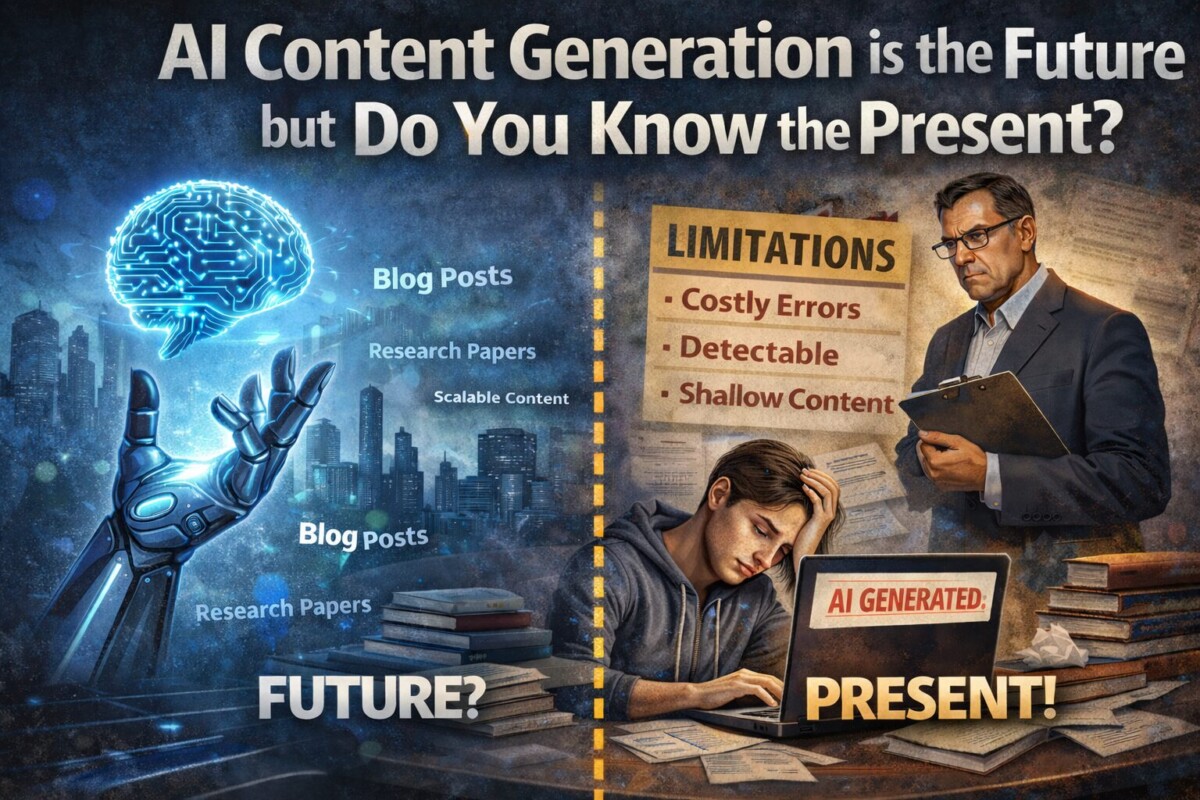
Everyone’s talking about the future of AI content generation. Tech evangelists promise a world where artificial intelligence handles all writing tasks, from blog posts to research papers. Students imagine a utopia where essays write themselves. Content marketers dream of unlimited scalability. But here’s the question nobody seems to be asking: do you actually understand what AI content generation can and cannot do right now, today, in 2026?
At Unemployed Professors, we’ve spent the past three years deeply embedded in the reality of AI writing tools. Not the hype, not the promises, not the future—the messy, complicated present. And what we’ve learned might surprise you: the gap between AI content generation’s reputation and its actual capabilities is enormous, especially when it comes to academic writing and content that requires genuine expertise.
The Reality Check: What AI Content Generation Actually Does
Let’s start with what AI content generation tools like ChatGPT, Claude, Jasper, and others actually excel at right now. Understanding their genuine strengths is crucial before we can discuss their limitations.
AI writing tools are exceptional at pattern recognition and reproduction. They’ve been trained on billions of words from across the internet, and they’ve learned statistical relationships between words, phrases, and ideas. When you prompt GPT to write about a topic, it’s essentially predicting which words are most likely to follow each other based on its training data.
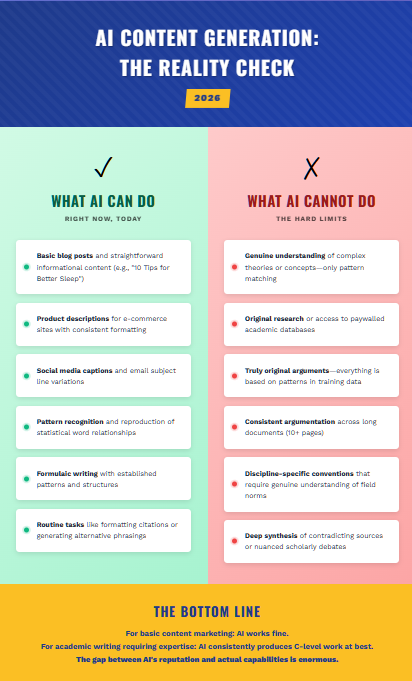
This makes current AI technology remarkably good at certain tasks. Need a basic blog post about “10 Tips for Better Sleep”? AI content generation can produce something serviceable in seconds. Want to generate product descriptions for an e-commerce site? AI writing future tools handle this efficiently. Looking for social media captions or email subject line variations? Automated content creation excels here.
But here’s where the present reality diverges sharply from the promised future: AI content generation struggles profoundly with anything requiring genuine expertise, original analysis, or sophisticated argumentation. And nowhere is this more apparent than in academic writing.
Why Academic Content Exposes AI’s Current Limitations
Academic writing reveals the fundamental weaknesses of AI content generation more clearly than any other writing form. This isn’t because academic writing is inherently more difficult—it’s because it requires things that current AI technology simply cannot provide.
First, academic content demands actual understanding of complex theories and concepts. When a professor assigns an essay analyzing Foucault’s power-knowledge relationship in contemporary surveillance capitalism, they’re not looking for a surface-level summary that could be gleaned from Wikipedia. They want evidence of genuine engagement with difficult ideas, the ability to synthesize multiple theoretical perspectives, and original application to specific contexts.
AI writing tools can produce text that mentions Foucault and surveillance capitalism. They can generate paragraphs that sound academic. But they cannot actually understand these concepts, which means they cannot produce the kind of insightful analysis that academic work requires.
Second, quality academic writing requires engagement with current scholarship. Students need to find, read, synthesize, and cite relevant academic sources. While AI content generation tools are getting better at accessing information, they fundamentally cannot “read” in the way humans do. They process text statistically, not comprehensionally. This means they miss nuances, misunderstand arguments, and often cite sources inappropriately or inaccurately.
Third, academic integrity demands originality. Professors aren’t looking for regurgitation—they want to see how students think. They want unique arguments, fresh perspectives, and individual voice. But AI content generation, by its nature, produces text based on patterns it’s seen before. It’s inherently derivative, even when it’s not technically plagiarizing.
This is the present reality that gets lost in discussions about the future of AI content generation: current technology cannot produce the kind of academic content that actually meets educational standards.
The Detection Problem Nobody Wants to Discuss
Here’s an uncomfortable truth about AI content generation in its current state: it’s increasingly detectable, and the detection tools are improving faster than the generation tools.
Universities have deployed AI detection software across their learning management systems. Tools like Turnitin AI Detection, GPTZero, and Originality.AI have become standard gatekeepers. These tools aren’t perfect—they produce false positives and can be fooled—but they’re good enough to create serious problems for students who rely on pure AI-generated content.
More importantly, human readers—professors who’ve spent careers reading student work—are developing intuition about AI writing. They recognize the telltale signs: the overly formal yet somehow generic tone, the hedge language that never commits to strong positions, the suspicious consistency in quality across all assignments, the lack of personal voice or specific examples from class discussions.
Many AI content generation enthusiasts believe this is a temporary problem. They assume that as AI writing tools improve, detection will become impossible. But this misunderstands the fundamental issue. The problem isn’t that AI-generated text is detectably robotic—the problem is that it’s detectably empty of genuine thought.
A student using current AI technology to write an essay about their assigned reading hasn’t actually read the assignment. They haven’t engaged with the ideas. They haven’t developed their own perspective. And no matter how sophisticated AI content generation becomes, professors will always be able to spot the difference between work that reflects genuine intellectual engagement and work that doesn’t.
This is the present reality of academic AI writing: it creates risk without providing real value.
How Content Generation Tools Actually Work (And Why It Matters)
Understanding how AI content generation actually functions is crucial for understanding its limitations. Most users treat these tools as magic boxes—prompt goes in, content comes out. But the mechanics matter enormously.
Large language models like GPT work through next-token prediction. The system looks at all the words (tokens) that have come before and calculates the probability distribution for what word should come next. It samples from this distribution, chooses a word, adds it to the context, and repeats the process.
This approach has profound implications. The AI isn’t thinking about your topic, developing an argument, or trying to communicate ideas. It’s pattern-matching at a massive scale. It’s finding sequences of words that typically appear together and arranging them in plausible-sounding ways.
For straightforward content creation—product descriptions, basic blog posts, social media content—this works reasonably well. These writing tasks are relatively formulaic, with established patterns and structures. AI writing tools can recognize and reproduce these patterns effectively.
But for complex academic content, this approach breaks down. Academic writing requires more than pattern recognition. It requires actual reasoning about specific cases, application of theories to particular situations, synthesis of multiple sources with potentially contradicting viewpoints, and development of original arguments supported by evidence.
Current AI technology can’t reason, can’t truly understand, and can’t be original in any meaningful sense. It can only predict likely word sequences based on training data. This is the present reality of AI content generation, and it’s important to understand before betting your academic success on it.
The Hybrid Approach: How Professionals Actually Use AI
Here’s where understanding the present reality of AI content generation becomes practically valuable. While pure AI-generated content fails to meet academic standards, AI tools used intelligently by human experts can enhance productivity without sacrificing quality.
At Unemployed Professors, our writers use AI content generation tools as assistive technology, not as replacements for their expertise. This hybrid approach leverages the genuine strengths of current AI technology while avoiding its weaknesses.
Our academic writers might use AI tools for initial research organization, quickly synthesizing multiple sources to identify key themes and debates. They might employ automated content tools to generate multiple outline structures, choosing the most promising approach to develop with their own critical thinking. They use AI to handle tedious tasks like formatting citations or generating alternative phrasings for complex ideas.
But the actual analysis, argumentation, and writing? That’s human. That’s where genuine expertise enters the picture. Our writers bring years of academic training, deep knowledge of their subject areas, and real understanding of scholarly discourse to every project.
This is how professionals in every industry use AI—as a tool to enhance human capability, not replace it. Journalists use AI to analyze data but write their own stories. Lawyers use AI for case research but craft their own arguments. Doctors use AI to analyze scans but make their own diagnoses.
The future of AI content generation isn’t about replacing human expertise—it’s about augmenting it. But you have to understand the present limitations to use the technology effectively.
Why Students Are Being Sold a Dangerous Lie
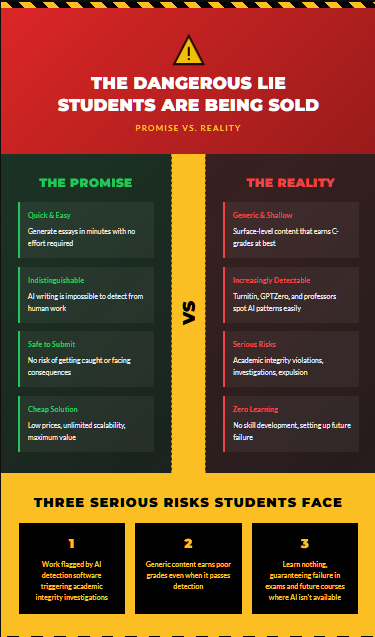
There’s a booming market in AI content generation services aimed at students. Cheap essay mills have pivoted from exploiting human writers to exploiting AI writing tools. They promise quick turnarounds and low prices, using automated content creation to maximize profit margins.
These services are selling students a dangerous lie: that AI-generated content is indistinguishable from human writing and safe to submit as their own work.
The present reality is far different. Students who submit pure AI-generated content face multiple serious risks. First, their work may be flagged by AI detection software, triggering academic integrity investigations. Second, even if it passes detection, the content is often so generic and surface-level that it receives poor grades. Third, they learn nothing from the experience, setting themselves up for failure in subsequent courses or exams where AI isn’t available.
Most dangerously, these cheap AI writing services are training students to view academic work as a transaction rather than a learning opportunity. They’re encouraging students to see their education as an obstacle to overcome rather than an opportunity to develop skills and knowledge.
This is perhaps the most important gap between AI content generation’s promised future and its current reality: AI tools cannot provide the learning and skill development that education is meant to provide. A student who uses ChatGPT to write all their essays might get through their courses, but they haven’t actually learned to write, think critically, or engage with complex ideas.
At Unemployed Professors, we’ve always taken a different philosophical approach. We don’t see our custom academic writing services as ways for students to avoid work—we see them as educational resources. When our expert writers produce model essays, students can study them to understand how sophisticated academic arguments are constructed. They can learn from example how to engage with sources, develop original theses, and support claims with evidence.
This use of academic writing services as learning tools remains valuable even as AI content generation becomes more widespread. In fact, it becomes more valuable because it offers something AI cannot: genuine expertise worth learning from.
The Technical Limitations Everyone Ignores
Let’s get specific about what current AI technology actually cannot do, despite what marketing materials might suggest.
AI content generation tools cannot conduct original research. They can’t go to libraries, access paywalled academic databases, or read newly published scholarship. Their knowledge is frozen at their training cutoff date, and while some tools now have internet search capabilities, they can’t truly “read” and comprehend sources the way human researchers can.
Current AI cannot maintain consistent argumentation across long documents. Ask GPT to write a 10-page essay and you’ll often find it contradicts itself or loses track of its thesis halfway through. Human writers maintain argumentative coherence because they actually understand the argument they’re making. AI writing tools just predict plausible next sentences without genuine comprehension of the overall structure.
AI content generation struggles with discipline-specific conventions. Academic fields have particular writing styles, citation practices, and argumentation patterns. A philosophy paper reads differently from a sociology paper, which reads differently from a literature analysis. While AI can mimic these styles superficially, it often makes errors that reveal its lack of genuine understanding of disciplinary norms.
These aren’t temporary limitations that will disappear as AI writing technology improves. They’re fundamental to how current approaches to AI content generation work. The future may bring different approaches that overcome these limitations, but that’s speculation. The present reality is clear: AI content tools have significant, meaningful boundaries.
What “Good Enough” Really Means
One argument we hear frequently is that AI-generated content doesn’t need to be perfect—it just needs to be “good enough.” For basic content marketing, social media posts, or straightforward informational writing, this might be true. Automated content creation can produce serviceable text for these purposes.
But “good enough” has a very different meaning in academic contexts. A “good enough” essay might technically fulfill the assignment requirements while completely missing the point of the learning exercise. It might receive a passing grade while teaching the student nothing. It might get through AI detection while still being obviously hollow to an experienced reader.
Moreover, academic grading isn’t pass-fail. The difference between a C paper and an A paper is substantial—in grades, in learning outcomes, and in future opportunities. AI content generation in its current state consistently produces C-level work at best. It hits the basic requirements but lacks the depth, originality, and sophistication that earn top grades.
Students who rely on AI writing tools and accept “good enough” are settling for mediocrity when they could be learning to produce excellent work. They’re trading short-term convenience for long-term capability.
This is why the Unemployed Professors model remains relevant and valuable. We don’t offer “good enough” AI-generated content. We offer excellent work produced by genuine experts. Our clients receive essays that don’t just pass—they excel. And more importantly, they receive work worth learning from.
The Real Future of AI Content Generation
So what does the actual future of AI content generation look like, based on current technological trajectories and realistic assessments rather than hype?
The likely future is continued improvement in AI’s ability to produce basic, formulaic content. Marketing copy, product descriptions, routine business communications—these will increasingly be AI-generated, and most readers won’t care because authenticity and depth aren’t required for these purposes.
For academic writing and other content requiring genuine expertise, the future is hybrid approaches. Experts will use AI tools to handle routine aspects of their work—formatting, basic research, outlining—while providing the critical thinking, analysis, and originality themselves. This is already happening at Unemployed Professors and across professional writing fields.
We’re also likely to see continued improvement in AI detection technology. As generation tools improve, detection tools will advance in parallel. The cat-and-mouse game will continue, but the fundamental difference between human expertise and pattern matching will remain detectable.
Most importantly, educational institutions will continue adapting their approaches. Rather than simply trying to catch AI use, many are redesigning assignments to require in-class work, oral presentations, or other formats that demonstrate genuine understanding. The future of education involves working around AI’s current capabilities, not surrendering to them.
Why Expertise Beats Automation
Here’s the core insight about AI content generation’s present reality: for work that actually matters—work that requires deep knowledge, sophisticated analysis, or genuine originality—human expertise remains irreplaceable.
Unemployed Professors isn’t afraid of AI writing tools because we understand what they can and cannot do. We use them where they add value, and we rely on human expertise where it’s essential. Our competitive advantage isn’t just that we employ real scholars—it’s that we understand the current technological landscape well enough to use tools intelligently while maintaining standards of quality that pure AI content generation cannot achieve.
When students choose Unemployed Professors, they’re not getting automated content churned out by GPT. They’re getting custom academic writing produced by experts who understand their subjects deeply, who can construct sophisticated arguments, who can engage with sources meaningfully, and who produce work that passes both AI detection and the far more important test of human expert evaluation.
Conclusion: Understanding Today to Navigate Tomorrow
The future of AI content generation may indeed be transformative. Five or ten years from now, we might have tools that can produce genuinely sophisticated academic writing indistinguishable from expert human work. But we’re not there yet. Not even close.
Understanding the present reality of AI writing technology—its genuine capabilities and very real limitations—is crucial for making smart decisions about your academic work. The gap between AI’s reputation and its actual performance is vast, especially for complex academic content.
Students who understand this gap don’t waste time with cheap AI essay generators that produce detectable, mediocre content. They don’t risk their academic standing on automated content tools that can’t deliver what they promise. Instead, they seek out genuine expertise from services like Unemployed Professors that understand how to use technology effectively while keeping human knowledge and skill at the center of the process.
The future of AI content generation is exciting and uncertain. But the present is clear: expertise matters, quality matters, and authentic human intellectual work remains irreplaceable.
Choose services that understand this reality. Choose Unemployed Professors.